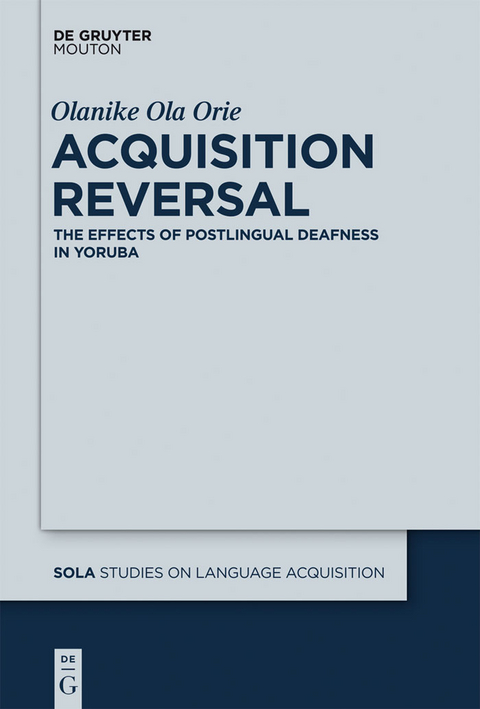
Acquisition Reversal (eBook)
292 Seiten
De Gruyter (Verlag)
978-1-61451-045-1 (ISBN)
This is the first comprehensive account of prolonged hearing loss and its impact on a language that was once spoken fluently. The reader is introduced to a significant deaf population - Yoruba speakers who have been profoundly deaf for more than twenty years and who have no access to hearing aids or speech therapy. These speakers exhibit language loss patterns which mirror acquisition stages in the speech of Yoruba children. This similarity argues for a link between language loss and first language acquisition, and shows that prolonged hearing loss results in the reversal of language.
Olanike Ola Orie, Tulane University, New Orleans, Louisiana,USA.
This is the first comprehensive account of prolonged hearing loss and its impact on a language that was once spoken fluently. Although it is currently assumed that hearing loss results in speech deterioration, it is shown that language loss occurs when speakers remain deaf for a long time. The reader is introduced to a significant deaf population - postlingually deafened Yoruba speakers who have been deaf for more than twenty years and who have no access to hearing aids or speech therapy. After becoming deaf, they continue to speak Yoruba from memory and "e;hear"e; visually through lip reading. These speakers exhibit phonological, lexical and syntactic losses which mirror acquisition patterns attested in the speech of Yoruba children. Based on these similarities, it is argued that a direct link exists between language loss and first language acquisition. It is further argued that prolonged deafness results in language reversal. Finally, the book presents the first description of the sign language and gestures used by deafened speakers to augment their spoken language. These findings will be of value to linguists, speech, language and hearing therapists, anthropologists, Africanists, deaf studies researchers, and non-specialists who are interested in hearing health and wellness.
lt;!doctype html public "-//w3c//dtd html 4.0 transitional//en">
Olanike Ola Orie, Tulane University, New Orleans, Louisiana,USA.
Acknowledgments 9
Abbreviations 11
Chapter 1 Postlingual Deafness 13
1.1 Introduction 13
1.2 Factors affecting language development and maintenance after hearing loss 16
1.3 Deafness and its causes among the Yoruba 18
1.4 First language attrition, postlingual deafness, language loss 20
1.5 The Empirical Base 23
1.6 Theoretical framework 24
1.6.1 Optimality Theory: markedness and faithfulness 27
1.6.2 Childhood Postlingual Deafness: Belfast English Patterns 32
1.7 Goals and Organization of the Book 35
Chapter 2 The Yoruba: the people and their language 37
2.1 The Yoruba of West Africa and Diaspora 37
2.2 Yoruba Language 43
2.2.1 The sound system (Phonetics and Phonology) 44
2.2.2 Word size and word formation (Morphology) 58
2.2.3 Sentence formation (Syntax) 60
Chapter 3 Deafness, Societal Attitude, and Language Adaptation 65
3.1 Attitude toward the Deaf 65
3.2 Congenital deafness 66
3.3 When a deaf child is motherless or orphaned: the story of Kuye.? 71
3.4 Postlingually Acquired Deafness: Challenges and Language Adaptation 76
3.4.1 “I cannot believe I can still talk”: the postlingually deafened child 76
3.4.2 “Listening and hearing with my eyes”: reading lips and reading gestures 79
3.4.3 Life at School for the Deaf 81
3.4.4 “I miss hearing my language”: the challenges of mothering hearing children 85
3.4.5 “Ears are like kidneys, you can indeed live well with only one”: hearing with one ear 89
3.4.6 Hearing aids and language preservation 91
Chapter 4 Yoruba Sign Language: A Basic Description 93
4.1 Background 93
4.2 Contrasting Yoruba co-speech gesture and Yoruba Sign Language 99
4.2.1 Gestures and YSL Similarity: Pointing 99
4.2.2 Gestures and YSL Differences 100
4.3 The phonology of YSL 109
4.3.1 One- versus Two-Handed Signs 110
4.3.2 Hand shapes 112
4.3.3 Location 119
4.3.4 Movement 124
4.3.5 Non-manual articulators - head, mouth, face, nose, arm, leg 128
4.4 The Morphology of YSL 135
4.4.1 Monomorphemic signs 135
4.4.2 Polymorphemic signs 136
4.4.3 Other Morphological Processes 138
4.5 YSL Syntax 142
4.5.1 Basic Word order 142
4.5.2 Negation and Questions 144
4.6 Discussion and Conclusion 149
Chapter 5 Postlingual Deafness at Age 5: Patterns of Loss after 25 Years 151
5.1 Postlingual Deafness Phonological Patterns 152
5.1.1 Consonants 152
5.1.2 Vowels 158
5.1.3 Tones 165
5.1.4 Syllable structure 171
5.2 Morphology 175
5.3 Syntax 178
5.4 Summary of M’s grammar 182
Chapter 6 Postlingual Deafness at Age 8: Patterns of Loss after 25 Years 184
6.1 Postlingual Deafness Phonological Patterns 184
6.1.1 Consonants 184
6.1.2 Vowels 188
6.1.3 Tone patterns 195
6.1.4 Syllable structure 200
6.2 Morphology 203
6.3 Syntax 207
6.4 Summary and Comparison of T and M’s grammars 212
Chapter 7 The Connection of Postlingual Deafness Language Loss to Acquisition 215
7.1 Children’s acquisition of phonology 215
7.2 Yoruba child phonology 216
7.2.1 Tones 217
7.2.2 Oral Vowels 220
7.2.3 Nasal vowel patterns 227
7.2.4 Consonants 229
7.2.5 Syllables 236
7.2.6 Phonological Acquisition and Postlingual Deafness Attrition 240
7.3 Morphology 243
7.4 Syntax 247
7.4.1 Two-word stage 247
7.4.2 Telegraphic Multi-word Stage 249
7.4.3 Full finite sentences 251
7.4.4 Complex sentences: Focus construction 252
7.4.5 Child Yoruba syntax and syntactic attrition 255
7.5 Acquisition and Postlingual Deafness Attrition as Mirror Markedness-based Systems 256
Chapter 8 Summary, Suggestions for Rehabilitation and Further Research 262
8.1 Summary of findings 262
8.1.1 Defining Deafness 262
8.1.2 Documenting a less known aspect of Yoruba: postlingual deafness data 263
8.1.3 Parallel patterns in attrition and acquisition 263
8.1.4 The age factor in determining the degree of attrition 264
8.1.5 Documenting Yoruba Sign Language 264
8.2 Suggestions for Linguistic Rehabilitation 264
8.3 Remaining issues and recommendations for further research 267
References 270
Index 291
| Erscheint lt. Verlag | 1.10.2012 |
|---|---|
| Reihe/Serie | ISSN |
| ISSN | |
| Studies on Language Acquisition [SOLA] | Studies on Language Acquisition [SOLA] |
| Zusatzinfo | 14 b/w tbl., One map |
| Verlagsort | Boston |
| Sprache | englisch |
| Themenwelt | Schulbuch / Wörterbuch ► Wörterbuch / Fremdsprachen |
| Geisteswissenschaften ► Philosophie ► Sprachphilosophie | |
| Geisteswissenschaften ► Sprach- / Literaturwissenschaft ► Sprachwissenschaft | |
| Schlagworte | Deaf Communities • Language acquisition • Language attrition • Sign Languages • Spracherwerb • Taubheit • Yoruba |
| ISBN-10 | 1-61451-045-8 / 1614510458 |
| ISBN-13 | 978-1-61451-045-1 / 9781614510451 |
| Informationen gemäß Produktsicherheitsverordnung (GPSR) | |
| Haben Sie eine Frage zum Produkt? |
 PDF (Wasserzeichen)
Größe: 3,3 MB
DRM: Digitales Wasserzeichen
Dieses eBook enthält ein digitales Wasserzeichen und ist damit für Sie personalisiert. Bei einer missbräuchlichen Weitergabe des eBooks an Dritte ist eine Rückverfolgung an die Quelle möglich.
Dateiformat: PDF (Portable Document Format)
Mit einem festen Seitenlayout eignet sich die PDF besonders für Fachbücher mit Spalten, Tabellen und Abbildungen. Eine PDF kann auf fast allen Geräten angezeigt werden, ist aber für kleine Displays (Smartphone, eReader) nur eingeschränkt geeignet.
Systemvoraussetzungen:
PC/Mac: Mit einem PC oder Mac können Sie dieses eBook lesen. Sie benötigen dafür einen PDF-Viewer - z.B. den Adobe Reader oder Adobe Digital Editions.
eReader: Dieses eBook kann mit (fast) allen eBook-Readern gelesen werden. Mit dem amazon-Kindle ist es aber nicht kompatibel.
Smartphone/Tablet: Egal ob Apple oder Android, dieses eBook können Sie lesen. Sie benötigen dafür einen PDF-Viewer - z.B. die kostenlose Adobe Digital Editions-App.
Zusätzliches Feature: Online Lesen
Dieses eBook können Sie zusätzlich zum Download auch online im Webbrowser lesen.
Buying eBooks from abroad
For tax law reasons we can sell eBooks just within Germany and Switzerland. Regrettably we cannot fulfill eBook-orders from other countries.
aus dem Bereich