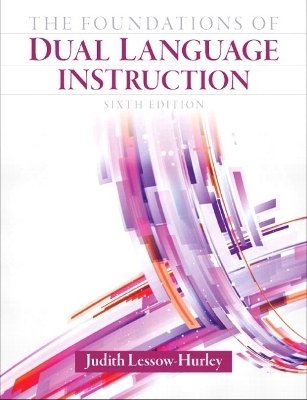
Foundations of Dual Language Instruction, The Plus MyEducationLab with Pearson eText -- Access Card Package
Pearson
978-0-13-290021-8 (ISBN)
- Titel ist leider vergriffen;
keine Neuauflage - Artikel merken
Packages
Access codes for Pearson's MyLab & Mastering products may not be included when purchasing or renting from companies other than Pearson; check with the seller before completing your purchase.
Used or rental books
If you rent or purchase a used book with an access code, the access code may have been redeemed previously and you may have to purchase a new access code.
Access codes
Access codes that are purchased from sellers other than Pearson carry a higher risk of being either the wrong ISBN or a previously redeemed code. Check with the seller prior to purchase.
--The Foundations of Dual Language Instruction is a practical, comprehensive, objective look at dual language instruction and the social, political, historical, and educational issues of teaching second language learners in today’s diverse classrooms. With its emphasis on English language learners, the book provides descriptions of effective programs and instructional strategies that can be used in the classroom, and includes sections on the history and legal underpinnings of schooling in two languages, language policy in the U.S. and around the world, considerations of changing demographics and implications for educators, and the dynamics of culture in schooling.
Judith Lessow-Hurley is a professor in the Elementary Education Department at San Jose State University. Her areas of expertise are bilingual and multicultural education. She works primarily with pre-service teachers, most of whom teach significant numbers of second language learners from linguistically and culturally diverse backgrounds. Professor Lessow-Hurley has worked with professional educators across the country and internationally. Along with her expertise in the education of English language learners, she has studied religious diversity in the context of First Amendment protections for religious freedoms in a pluralist democracy. She is also the author of Meeting the Needs of Second Language Learners (ASCD, 2002).
Chapter 1 — National Unity and Diversity and the Languages We Speak
Introduction
Key Questions
Changing Demographics
Immigration
Immigration: A Historical Perspective
Other Demographic Factors
Implications for Teachers
A Changing National Narrative
Unity, Diversity and Language
Language Parochialism
Language Elitism
Language Restrictionism
Implications for Schooling
Restrictions on Bilingual Programs
Outcomes
Summary
Questions to Think About and Discuss
Activities
Suggestions for Further Reading
Web and Media Resources
Chapter 2 — Historical and International Perspectives on Language Education
Introduction
Key Questions
Historical Perspectives
The Ancient World
The Modern World
Dual Language Instruction in the United States: A History
The Nineteenth Century
The Twentieth Century
Multilingualism in the U.S.: Looking Forward
Language Planning, Language Policy and Schooling
Language Suppression
Language Revitalization
Summary
Questions to Think About and Discuss
Activities
Suggestions for Further Reading
Web and Media Resources
Chapter 3 — Aspects of Language
Introduction
Key Questions
The Study of Language
What Is Language?
Subsystems of Language
The Phonological System
The Morphological System
Syntax
Semantics
Pragmatics
Other Aspects of Communication
Implications for Teachers
Language Attitudes
Are Some Languages Better Than Others?
Are Some Languages More Expressive Than Others?
Language Varieties
Standard
Dialect
Pidgins and Creoles
Register
Is It Slang?
More Than One Language
What Is Bilingualism?
Code-Switching
Bilingualism: A Handicap or a Talent?
The Ebonics Debate
Language Loss
Summary
Questions to Think About and Discuss
Activities
Suggestions for Further Reading
Web and Media Resources
Chapter 4 — Language Development
Introduction
Key Questions
First Language Development: Memorizing or Hypothesizing?
Rule Finding
First language Development and Comprehensible Input
Child-Directed Speech
The Social and Cultural Contexts of Language Acquisition
Input Modification
Order of Acquisition
Children as Sociolinguists
Second Language Acquisition
The Effect of Age
The Effect of Personality
The Social Factors
Integrative Models of Second Language Acquisition
The Acquisition-Learning Distinction
Language Learners and Language Speakers Interact
Summary
Questions to Think About and Discuss
Activities
Suggestions for Further Reading
Web and Media Resources
Chapter 5 — Dual Language Program Models
Introduction
Key Questions
What Is a Program Model?
Transitional Program Models
What Is the Goal of a Transitional Program?
Transitional Programs: A Lot Better Than Nothing
Maintenance and Enrichment Programs
Immersion Programs
The Results of Immersion: The Canadian Experience
Immersion Programs in the United States
Dual Language Instruction in Private Schools
Bilingual Teachers
Summary
Questions to Think About and Discuss
Activities
Suggestions for Further Reading
Web and Media Resources
Chapter 6 — Primary Language Instruction for English Learners
Introduction
A Rationale for Primary Language Instruction
Transfer of Concepts and Skills
How Does Transfer Work?
Primary Language Development and Second Language Acquisition
Students Need to Develop CALP
Effects of Bilingualism on Achievement
Primary Language Instruction and Self-Concept
Overall, What Does the Research Indicate?
If Primary Language Instruction, Then How?
Separation of Languages
Concurrent Translation
Preview-Review
Summary
Questions to Think About and Discuss
Activities
Suggestions for Further Reading
Web and Media Resources
Chapter 7 — Second Language Instruction
Introduction
Key Questions
A Note About Terminology
Early Viewpoints on Second Language Instruction
The Search for Alternative Approaches
Modern Approaches to Second Language Instruction
The Audiolingual Approach
Other Recent Approaches
Modifying Instruction for Second Language Learners
Academic Language
Linking Language to Content: A Rationale
Linking Language to Content: How?
Sheltered Instruction Observation Protocol (SIOP)
Literacy and Biliteracy
What is Literacy?
Biliteracy
How Can Teachers Support Biliteracy?
Literacy and the Second Language Learner
How Can Schools Promote Biliteracy?
Summary
Questions to Think About and Discuss
Activities
Suggestions for Further Reading
Web and Media Resources
Chapter 8 — Assessment and English Learners
Introduction
Testing Second Language Learners: General Issues
Reliability
Validity
Content Bias
Can You Eliminate Content Bias Using Translation?
Construct Bias
Procedure
Norming
Language Proficiency
What is Language Proficiency?
Models of Language Proficiency
Academic Language Proficiency
How is Language Proficiency Assessed?
Standards-based Language Proficiency Assessment
The Need for Multidimensional Approaches to Assessment
Standardized Achievement Testing
Diagnostic Testing for Placement in Special Programs
Summary
Questions to Think About and Discuss
Activities
Suggestions for Further Reading
Web and Media Resources
Chapter 9 — Legal Foundations of Dual Language Instruction
Introduction
Key Questions
The Historical Context for Dual Language Instruction: World War II and Beyond
World War II and Foreign Language Instruction
World War II and Civil Rights
Brown v. the Board of Education (1954)
Who Governs Education?
Federal Involvement in Education
The Bilingual Education Act (Title VII)
Discretionary Funding
Title VII and Policy
Lau v.Nichols (1974)
Interpretation of Lau
Effects of Lau
Equal Educational Opportunities Act of 1974
No Child Left Behind
NCLB Funding
NCLB Pros and Cons
State Laws Regarding Bilingual Education
Summary
Questions to Think About and Discuss
Activities
Suggestions for Further Reading
Web and Media Resources
Chapter 10 — Aspects of Culture
Introduction
What Is Culture?
What Are the Key Characteristics of Culture?
Culture is Dynamic
Culture is Creative
Culture is Continuous
Culture is Learned
Culture is Shared
Culture is a Struggle for Survival
How Is Culture Manifested?
Clothing and Decoration
Housing
Time Orientation
Spatial Orientation
Culture and Language
What is Multicultural Education?
What is the Connection Between Bilingual Education and Multicultural Education?
Summary
Questions to Think About and Discuss
Activities
Suggestions for Further Reading
Web and Media Resources
Chapter 11 — Culture, Schooling and Achievement
Introduction
Key Questions
Explaining the Achievement Gap: Four Approaches
Genetic Inferiority
Cultural Deficit
Cultural Mismatch
Contextual Interaction
Status, Power and School Success
Contextual Interaction as a Solution to Differential Achievement
What Teachers Can Do
Summary
Questions to Think About and Discuss
Activities
Suggestions for Further Reading
Web and Media Resources
| Erscheint lt. Verlag | 1.8.2012 |
|---|---|
| Sprache | englisch |
| Gewicht | 349 g |
| Themenwelt | Schulbuch / Wörterbuch ► Wörterbuch / Fremdsprachen |
| Sozialwissenschaften ► Pädagogik ► Allgemeines / Lexika | |
| ISBN-10 | 0-13-290021-1 / 0132900211 |
| ISBN-13 | 978-0-13-290021-8 / 9780132900218 |
| Zustand | Neuware |
| Informationen gemäß Produktsicherheitsverordnung (GPSR) | |
| Haben Sie eine Frage zum Produkt? |
aus dem Bereich