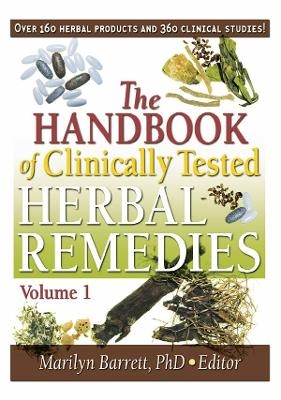
The Handbook of Clinically Tested Herbal Remedies, Volumes 1 & 2
Routledge
9780415652469 (ISBN)
A single source for accurate scientific information on herbal remedies!
This comprehensive handbook (comprised of two volumes of 700+ pages each) provides a snapshot of 160 herbal products that have been tested in clinical trials. Details of the products and the clinical trials they underwent are here in an easy-to-read, at-a-glance format.
Each botanical profile in The Handbook of Clinically Tested Herbal Remedies contains a summary section (table, text and references), followed by product information and clinical trials for that particular product. An evaluation of the strength of the evidence from the trials, along with the context for therapeutics is included to give you a complete picture of each remedy and its usefulness or lack thereof. If there is more than one product based on a particular botanical then the trials are grouped according to the product.
This valuable book also makes purchasing easy with manufacturer contact information. With over 30 individual botanicals and 10 multi-ingredient formulas, 160 products and 360 clinical studies, The Handbook of Clinically Tested Herbal Remedies is the book you need to make an informed selection of herbal products. Not only does it list proprietary herbal products that have been tested in controlled clinical studies and provide a rating of the quality of those trials, but, it also describes the fundamentals of herbal medicine, including regulation, characterization, standardization, bioavailability, efficacy, safety, pharmacopoeial monographs as well as incentives, or lack of incentive, for US and European manufacturers to conduct clinical studies.
Contributors to the chapters describing the fundamentals of herbal medicine include:
* the late Dr. Varro Tyler, Distinguished Professor Emeritus at Purdue University and co-author of Tyler's Honest Herbal, Rational Phytotherapy, and Tyler's Herbs of Choice
* Loren Israelsen, JD, president of the LDI group
* Tieraona Low Dog, MD, Chair of the USP Dietary Supplement Information Committee
* Joerg Grünwald, PhD, co-author of the Physicians Desk Reference (PDR) for Herbal Medicines, and Stefan Spiess, RPh, President of Grünwalder GmbH
* Anton Biber, PhD, and Friedrich Lang, PhD, experts in the bioavailability of herbal medicine at Dr. Willmar Schwabe GmbH & Co., Germany
* Anthony Almada, MSc, founder and Chief Scientific Officer of IMAGINutrition, Inc.
* Joseph M. Betz, PhD, Director of the Dietary Supplements Methods and Reference Materials Program at the NIH Office of Dietary Supplements
* Ezra Bejar, PhD, president of Plant Bioassay
* Uwe Koetter, PhD, Director of New OTC and Dietary Supplement Product Development at GlaxoSmithKline
* Srini Srinivasan, PhD, Vice President of the Dietary Supplement Verification Program of the United States Pharmacopeia (USP)
* Roy Upton, Executive Director of the American Herbal Pharmacopoeia.
All of the clinical trials in The Handbook of Clinically Tested Herbal Remedies were rated as to their Level of Evidence according to a system designed by Tieraona Low Dog, MD, Chair of the United States Pharmacopoeia Dietary Supplements/Botanicals Expert Panel and a member of the White House Commission on Complementary and Alternative Medicine. The reviewers of the clinical trials included Karriem Ali, MD; Richard Aranda, MD; Elliot Fagelman, MD; Mary Hardy, MD; David Heber, MD, PhD, FACP, FACN; John Trimmer Hicks, MD, FACP, FACR; Hannah Kim, MD; Franklin C. Lowe, MD, MPH; Richard D. O'Connor, MD; Barry S. Oken, M.D; Lynn Shinto, ND; and Keith Wesnes, PhD.
Marilyn Barrett
VOLUME 1
About the Editor
Contributors
Preface
Acknowledgments
Editor’s Note
PART I: FUNDAMENTALS OF HERBAL MEDICINE
Chapter 1. History and Regulation of Botanicals in the United States (Loren D. Israelsen and Marilyn Barrett)
Introduction
History
DSHEA Explained
Drugs: OTC and Rx
Prospectus
Chapter 2. Product Definition Deficiencies in Clinical Studies of Herbal Medicines (Varro E. Tyler)
Chapter 3. Identifying and Characterizing Botanical Products (Marilyn Barrett)
Identifying Plants by Name
Means of Assuring Plant Identity
Preparations and Formulations
Dose
Bioavailability
Guidelines
Appendix: Preparations and Formulations
Chapter 4. Standardization of Botanical Preparations: What It Does and Does Not Tell Us (Uwe Koetter and Marilyn Barrett)
Introduction
Standardization of Therapeutic Activity
Standardization to Meet a Chemical Norm
Standardization As a Reflection of Quality Assurance Programs
Guidance
Situation in the Marketplace
Perspective
Chapter 5. The Importance and Difficulty in Determining the Bioavailability of Herbal Preparations (Anton Biber and Friedrich Lang)
Chapter 6. Borrowed Science and Phytoequivalence: Can Two Herbal Products Be Judged Equivalent? (Marilyn Barrett)
Chemical or Pharmaceutical Equivalency
Bioequivalency or Therapeutic Equivalency
Application of the Concepts, Ginkgo As an Example
Meta-Analyses
Perspective
Chapter 7. Determining Efficacy of Herbal Preparations (Tieraona Low Dog)
Observational Medicine
Evidence-Based Medicine
Summary
Chapter 8. Evaluating Safety of Herbal Preparations (Ezra Béjar, Joseph M. Betz, and Marilyn Barrett)
Evaluation of Safety
Adverse Reactions
Adverse-Event Reporting Systems
Categorization According to the Degree of Safety
Product Quality As an Aspect of Safety
Contraindications
Drug-Herb Interactions
Improving Our Knowledge of Safety
Chapter 9. Conducting Clinical Trials on Herbal Dietary Supplements in North America: Commercialization, Confidence, and Conflicts (Anthony L. Almada)
The Spirit to Sponsor: Is There an Adequate Economic Incentive to Fund Research?
Extracting Value from Science
Competitor Kevlar: Preventing Piracy of Product-Specific Data
How Much Data Is Enough?
We Have DataNow What?
Who Has Science and How Did They Acquire It?
Conclusion
Chapter 10. Motives for Conducting Clinical Trials on Botanicals in Europe: A Focus on Germany (Joerg Gruenwald and Stefan Spiess)
Chapter 11. Pharmacopoeias and Botanical Monographs (Marilyn Barrett, Roy Upton, and V. Srini Srinivasan)
United States Pharmacopeia and National Formulary (USP-NF)
American Herbal Pharmacopoeia (AHP) and Therapeutic Compendium
European Pharmacopoeia (EP)
British Herbal Pharmacopoeia (BHP) and British Herbal Compendium (BHC)
German Commission E
European Scientific Cooperative of Phytotherapy (ESCOP)
Chinese Pharmacopoeia
African Pharmacopoeia
The Pharmacopoeia of Japan
The Pharmacopoeias of India
World Health Organization (WHO)
Other Pharmacopoeias
Summary and Perspective
Sources of Pharmacopoeias
PART II: METHODS
Chapter 12. Methods of Product and Trial Inclusion and Evaluation (Marilyn Barrett)
Gathering Information on Products and Trials
| Verlagsort | London |
|---|---|
| Sprache | englisch |
| Maße | 152 x 229 mm |
| Gewicht | 2018 g |
| Themenwelt | Schulbuch / Wörterbuch ► Lexikon / Chroniken |
| Medizin / Pharmazie ► Medizinische Fachgebiete ► Pharmakologie / Pharmakotherapie | |
| Medizin / Pharmazie ► Naturheilkunde | |
| ISBN-13 | 9780415652469 / 9780415652469 |
| Zustand | Neuware |
| Informationen gemäß Produktsicherheitsverordnung (GPSR) | |
| Haben Sie eine Frage zum Produkt? |
aus dem Bereich