


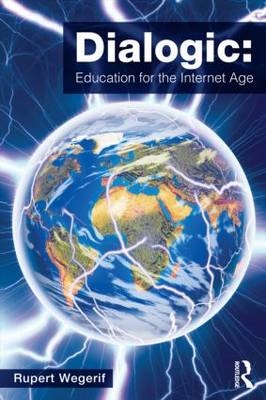
Dialogic: Education for the Internet Age
Seiten
2012
Routledge (Verlag)
978-0-415-53679-0 (ISBN)
Routledge (Verlag)
978-0-415-53679-0 (ISBN)
In Dialogic: Education for the Internet Age, Rupert Wegerif argues that the traditional model of schooling, is built on the logic of print and tends to assume that there is a single true representation of reality, which schools exist to transmit to new generations.
Dialogic: Education for the Internet Age argues that despite rapid advances in communications technology, most teaching still relies on traditional approaches to education, built upon the logic of print, and dependent on the notion that there is a single true representation of reality. In practice, the use of the Internet disrupts this traditional logic of education by offering an experience of knowledge as participatory and multiple.
This new logic of education is dialogic and characterises education as learning to learn, think and thrive in the context of working with multiple perspectives and ultimate uncertainty. The book builds upon the simple contrast between observing dialogue from an outside point of view, and participating in a dialogue from the inside, before pinpointing an essential feature of dialogic: the gap or difference between voices in dialogue which is understood as an irreducible source of meaning. Each chapter of the book applies this dialogic thinking to a specific challenge facing education, re-thinking the challenge and revealing a new theory of education.
Areas covered in the book include:
dialogical learning and cognition
dialogical learning and emotional intelligence
educational technology, dialogic ‘spaces’ and consciousness
global dialogue and global citizenship
dialogic theories of science and maths education
The challenge identified in Wegerif’s text is the growing need to develop a new understanding of education that holds the potential to transform educational policy and pedagogy in order to meet the realities of the digital age. Dialogic: Education for the Internet Age draws upon the latest research in dialogic theory, creativity and technology, and is essential reading for advanced students and researchers in educational psychology, technology and policy.
Dialogic: Education for the Internet Age argues that despite rapid advances in communications technology, most teaching still relies on traditional approaches to education, built upon the logic of print, and dependent on the notion that there is a single true representation of reality. In practice, the use of the Internet disrupts this traditional logic of education by offering an experience of knowledge as participatory and multiple.
This new logic of education is dialogic and characterises education as learning to learn, think and thrive in the context of working with multiple perspectives and ultimate uncertainty. The book builds upon the simple contrast between observing dialogue from an outside point of view, and participating in a dialogue from the inside, before pinpointing an essential feature of dialogic: the gap or difference between voices in dialogue which is understood as an irreducible source of meaning. Each chapter of the book applies this dialogic thinking to a specific challenge facing education, re-thinking the challenge and revealing a new theory of education.
Areas covered in the book include:
dialogical learning and cognition
dialogical learning and emotional intelligence
educational technology, dialogic ‘spaces’ and consciousness
global dialogue and global citizenship
dialogic theories of science and maths education
The challenge identified in Wegerif’s text is the growing need to develop a new understanding of education that holds the potential to transform educational policy and pedagogy in order to meet the realities of the digital age. Dialogic: Education for the Internet Age draws upon the latest research in dialogic theory, creativity and technology, and is essential reading for advanced students and researchers in educational psychology, technology and policy.
Rupert Wegerif is Professor of Education and Director of Research at the Graduate School of Education, University of Exeter, UK.
Chapter 1: The Challenge Chapter 2: Educating Dialogue Chapter 3: Educating Reason Chapter 4: Educating Creativity Chapter 5. Educating Technology Chapter 6: Educating Science Chapter 7: Educating the Planet Chapter 8: Education into Dialogue
| Erscheint lt. Verlag | 6.12.2012 |
|---|---|
| Zusatzinfo | 1 Tables, black and white; 7 Line drawings, black and white; 2 Halftones, black and white; 9 Illustrations, black and white |
| Verlagsort | London |
| Sprache | englisch |
| Maße | 155 x 235 mm |
| Gewicht | 317 g |
| Themenwelt | Schulbuch / Wörterbuch ► Unterrichtsvorbereitung ► Unterrichts-Handreichungen |
| Geisteswissenschaften ► Psychologie ► Pädagogische Psychologie | |
| Sozialwissenschaften ► Pädagogik | |
| ISBN-10 | 0-415-53679-0 / 0415536790 |
| ISBN-13 | 978-0-415-53679-0 / 9780415536790 |
| Zustand | Neuware |
| Informationen gemäß Produktsicherheitsverordnung (GPSR) | |
| Haben Sie eine Frage zum Produkt? |
Mehr entdecken
aus dem Bereich


aus dem Bereich
praxiserprobte Arbeitshilfen für Mentorinnen und Mentoren
Buch (2025)
Raabe (Verlag)
CHF 48,85
Flugsimulation mit Microsoft Flight Simulator, X-Plane, AeroflyFS und …
Buch | Softcover (2024)
Springer Fachmedien Wiesbaden (Verlag)
CHF 41,95


