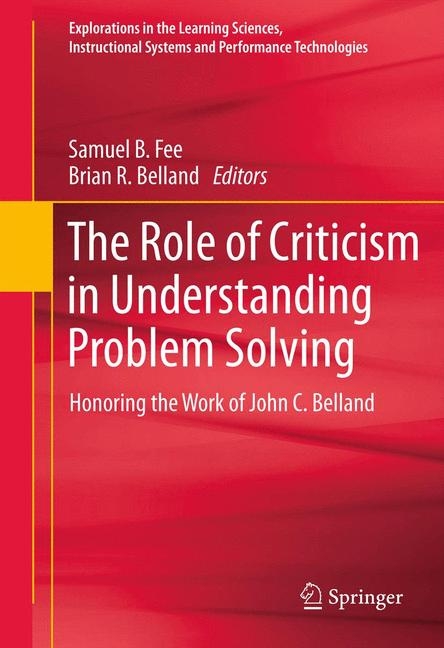
The Role of Criticism in Understanding Problem Solving (eBook)
VIII, 264 Seiten
Springer New York (Verlag)
978-1-4614-3540-2 (ISBN)
In 1991, Denis Hlynka and John Belland released Paradigms Regained, a well received reader for graduate students in the field of educational technology. The Role of Criticism in Understanding Problem Solving updates some of those ideas initially proposed in Paradigms Regained, and extends the conversation into the contemporary discourse regarding problem based learning (PBL). Paradigms proposed the idea of criticism as a third method for the conduction of educational research, the first two being qualitative and qualitative. The concept of criticism as a tool for research is not well established in educational technology, although it is well established in other educational research traditions such as Curriculum Studies. Unfortunately, it is not always clear how criticism can be applied. This book views criticism as a way to step back and look at an educational intervention within educational technology through a particular critical lens. Criticism is viewed as a valuable approach to guiding meta analyses and theoretical studies, serving to prevent the proverbial "e;spinning of the wheels"e; that often happens in educational research. By indicating new potential research questions and directions, criticism approaches can invigorate educational research. This book revisits the ideals of criticism in order to establish their usefulness for studying educational technology interventions to support problem based learning. First, a few foundational chapters set the stage for the conversations on criticism. Then, the role criticism can play in enhancing analysis and interpretation of the PBL literature is explored. Finally, case studies addressing the central concepts of the text are presented and dissected. This book represents a complete overhaul and rethinking of the use of criticism as a method for understanding and furthering the research area of PBL within the field of Educational technology.
-1. Argumentation, Critical Reasoning and Problem Solving. -2. Postmodernism: A 21st Century Primer to Problem-based Learning.-3.What Does a Connoisseur Connaît?-4. Developing a Critical Stance as an E-Learning Specialist: A Primer for New Professionals.-5. Critical Theory and the Mythology of Learning with Technology.-6. Habitus, Scaffolding, and Problem-based Learning: Why Teachers' Experiences as Students Matter.-7.The Aesthetics of Game-based Learning: Applying John C. Belland’s Connoisseurship Model as a Mode of Inquiry.-8. Integrating Metacognitive Prompts and Critical Inquiry Process Display to Scaffold Learners’ Development of Problem Solving Skills.-9. A Models and Modeling Perspective on Complex Reasoning Contrasted with Problem-Based Learning.-10. Problem-Based Learning in Online Teacher Education.-11. The Fallacies of Problem-Based Learning Viewed as in a Hermeneutic Perspective of Better Teaching Practices.-12. Design for Media (D4M): Nurturing the Transition of Media Arts Students from Consumers to Producers through the Application of Design and Color Theory.-13. Genetic Literacy and Problem-Based Learning.-14. Correlating Problems throughout an Interdisciplinary Curriculum.-15. Ethical angles on service learning.-16. Conclusions: Critical Theory, PBL, and Educational Technology.
| Erscheint lt. Verlag | 26.5.2012 |
|---|---|
| Reihe/Serie | Explorations in the Learning Sciences, Instructional Systems and Performance Technologies | Explorations in the Learning Sciences, Instructional Systems and Performance Technologies |
| Zusatzinfo | VIII, 264 p. |
| Verlagsort | New York |
| Sprache | englisch |
| Themenwelt | Schulbuch / Wörterbuch ► Unterrichtsvorbereitung ► Unterrichts-Handreichungen |
| Geisteswissenschaften | |
| Sozialwissenschaften ► Pädagogik ► Schulpädagogik / Grundschule | |
| Schlagworte | Critical theory in Educational Technology • Criticism for educational research • Denis Hlynka • Educational Intervention • Educational Technology applications in support of PBL • Instructional design in PBL • John C. Belland • Learning and Instruction • Paradigms regained • PBL • Problem Based Learning • Using criticism to guide meta analysis |
| ISBN-10 | 1-4614-3540-4 / 1461435404 |
| ISBN-13 | 978-1-4614-3540-2 / 9781461435402 |
| Informationen gemäß Produktsicherheitsverordnung (GPSR) | |
| Haben Sie eine Frage zum Produkt? |
 PDF (Wasserzeichen)
DRM: Digitales Wasserzeichen
Dieses eBook enthält ein digitales Wasserzeichen und ist damit für Sie personalisiert. Bei einer missbräuchlichen Weitergabe des eBooks an Dritte ist eine Rückverfolgung an die Quelle möglich.
Dateiformat: PDF (Portable Document Format)
Mit einem festen Seitenlayout eignet sich die PDF besonders für Fachbücher mit Spalten, Tabellen und Abbildungen. Eine PDF kann auf fast allen Geräten angezeigt werden, ist aber für kleine Displays (Smartphone, eReader) nur eingeschränkt geeignet.
Systemvoraussetzungen:
PC/Mac: Mit einem PC oder Mac können Sie dieses eBook lesen. Sie benötigen dafür einen PDF-Viewer - z.B. den Adobe Reader oder Adobe Digital Editions.
eReader: Dieses eBook kann mit (fast) allen eBook-Readern gelesen werden. Mit dem amazon-Kindle ist es aber nicht kompatibel.
Smartphone/Tablet: Egal ob Apple oder Android, dieses eBook können Sie lesen. Sie benötigen dafür einen PDF-Viewer - z.B. die kostenlose Adobe Digital Editions-App.
Buying eBooks from abroad
For tax law reasons we can sell eBooks just within Germany and Switzerland. Regrettably we cannot fulfill eBook-orders from other countries.
aus dem Bereich