


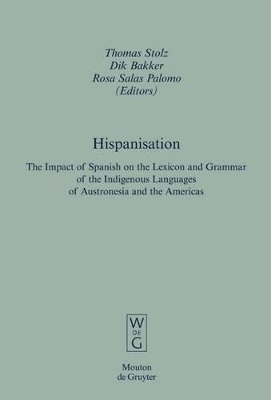
Hispanisation
The Impact of Spanish on the Lexicon and Grammar of the Indigenous Languages of Austronesia and the Americas
Seiten
| Ausstattung: Hardcover & eBook
2008
de Gruyter Mouton
978-3-11-916743-7 (ISBN)
de Gruyter Mouton
978-3-11-916743-7 (ISBN)
- Titel leider nicht mehr lieferbar
- Artikel merken
The series is a platform for contributions of all kinds to this rapidly developing field. General problems are studied from the perspective of individual languages, language families, language groups, or language samples. Conclusions are the result of a deepened study of empirical data. Special emphasis is given to little-known languages, whose analysis may shed new light on long-standing problems in general linguistics.
Literally hundreds of languages world-wide have experienced direct or indirect Hispanisation during the heyday of the Spanish colonial empire. The number of languages which continue to borrow from Spanish on a daily basis is considerable especially in Latin America. This volumegives the reader a better idea of the range of contact constellations in which Spanish functions as the donor language. Moreover, the contributions to this collection of articles demonstrate that it is not only possible to compare the contact-induced processes in the (Hispanised) languages of Austronesia and the Americas. It is emphasized that one can draw far-reaching conclusions from the presented borrowing facts for the theory of language contact in general. The volume is divided into two sections according to geographical principles: section I is devoted to contacts of Spanish in Latin America. Two contributions look at the Hispanisation of varieties of Nahuatl (Classical Nahuatl studied by Anne Jensen and modern varieties studied by José Antonio Flores Farfán). Martina Schrader-Kniffki discusses Spanish-Zapotec contacts and their relations to language mixing and purism. Luciano Giannelli and Raoul Zamponi address the issue of Hispanisms in Kuna, a language from Panama. For South America, Jorge Gómez-Rendón discusses whether or not there are constraints on lexical borrowing from Spanish into Imbabura Quichua. Suzanne Dikker studies the intertwined language Media Lengua in her attempt at redefining the notion of relexification. Section II focuses on the impact of Spanish on the languages of Austronesia and South-East Asia. Steven Roger Fischer shows that the heavy Hispanisation of Rapanui is currently being reverted. Steve Pagel compares Hispanisation processes and their results in the Mariana Islands and on Rapa Nui. The second comparative study is by Patrick O. Steinkrüger who reviews a variety of Philippinian languages and their degrees of Hispanisation. The attitudes of native speakers of Chamorro as to Hispanisms is the topic of the study by Rosa Salas Palomo and Thomas Stolz. The volume is especially interesting for students of language contact. But also scholars with a background in Romance linguistics or Hispanic philology will find the assembled articles very useful, as well as Austronesianists and Amerindianists.
Literally hundreds of languages world-wide have experienced direct or indirect Hispanisation during the heyday of the Spanish colonial empire. The number of languages which continue to borrow from Spanish on a daily basis is considerable especially in Latin America. This volumegives the reader a better idea of the range of contact constellations in which Spanish functions as the donor language. Moreover, the contributions to this collection of articles demonstrate that it is not only possible to compare the contact-induced processes in the (Hispanised) languages of Austronesia and the Americas. It is emphasized that one can draw far-reaching conclusions from the presented borrowing facts for the theory of language contact in general. The volume is divided into two sections according to geographical principles: section I is devoted to contacts of Spanish in Latin America. Two contributions look at the Hispanisation of varieties of Nahuatl (Classical Nahuatl studied by Anne Jensen and modern varieties studied by José Antonio Flores Farfán). Martina Schrader-Kniffki discusses Spanish-Zapotec contacts and their relations to language mixing and purism. Luciano Giannelli and Raoul Zamponi address the issue of Hispanisms in Kuna, a language from Panama. For South America, Jorge Gómez-Rendón discusses whether or not there are constraints on lexical borrowing from Spanish into Imbabura Quichua. Suzanne Dikker studies the intertwined language Media Lengua in her attempt at redefining the notion of relexification. Section II focuses on the impact of Spanish on the languages of Austronesia and South-East Asia. Steven Roger Fischer shows that the heavy Hispanisation of Rapanui is currently being reverted. Steve Pagel compares Hispanisation processes and their results in the Mariana Islands and on Rapa Nui. The second comparative study is by Patrick O. Steinkrüger who reviews a variety of Philippinian languages and their degrees of Hispanisation. The attitudes of native speakers of Chamorro as to Hispanisms is the topic of the study by Rosa Salas Palomo and Thomas Stolz. The volume is especially interesting for students of language contact. But also scholars with a background in Romance linguistics or Hispanic philology will find the assembled articles very useful, as well as Austronesianists and Amerindianists.
Thomas Stolz, Universität Bremen, Germany; Dik Bakker, Universiteit Amsterdam, The Netherlands; Rosa Salas Palomo, Micronesean Language Center, Guam.
| Reihe/Serie | Empirical Approaches to Language Typology [EALT] ; 39 |
|---|---|
| Zusatzinfo | Includes a print version and an ebook |
| Verlagsort | Berlin/Boston |
| Sprache | englisch |
| Themenwelt | Schulbuch / Wörterbuch ► Wörterbuch / Fremdsprachen |
| Geisteswissenschaften ► Sprach- / Literaturwissenschaft ► Romanistik | |
| Geisteswissenschaften ► Sprach- / Literaturwissenschaft ► Sprachwissenschaft | |
| Schlagworte | Language contact, language change, language typology, Spanish. • Spanisch • Sprachkontakt • Sprachwandel |
| ISBN-10 | 3-11-916743-6 / 3119167436 |
| ISBN-13 | 978-3-11-916743-7 / 9783119167437 |
| Zustand | Neuware |
| Informationen gemäß Produktsicherheitsverordnung (GPSR) | |
| Haben Sie eine Frage zum Produkt? |


