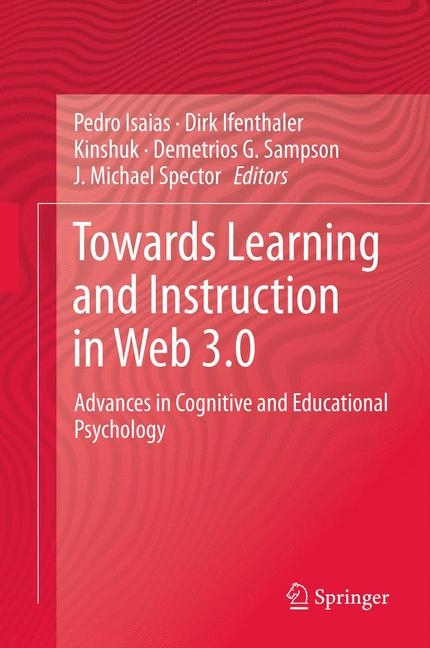
Towards Learning and Instruction in Web 3.0 (eBook)
326 Seiten
Springer New York (Verlag)
978-1-4614-1539-8 (ISBN)
Towards Learning and instruction in Web 3.0, which includes selected expanded papers from CELDA (Cognition and Exploratory Learning in the Digital Age) 2010 (http://www.celda-conf.org/) addresses the main issues concerned with evolving learning processes, innovative pedagogies, and technology-based educational applications in the digital age. The convergence of these two disciplines continues to increase and in turn, affects the academic and professional spheres in numerous ways. Towards Learning and Instruction in Web 3.0 addresses paradigms such as just-in-time learning, constructivism, student-centered learning and collaborative approaches which have emerged and are being supported by technological advancements such as simulations,virtual reality and multi-agents systems. This volume touches on both technological as well as psychological and pedagogical issues related to the developments of Web 3.0.
Towards Learning and instruction in Web 3.0, which includes selected expanded papers from CELDA (Cognition and Exploratory Learning in the Digital Age) 2010 (http://www.celda-conf.org/) addresses the main issues concerned with evolving learning processes, innovative pedagogies, and technology-based educational applications in the digital age. The convergence of these two disciplines continues to increase and in turn, affects the academic and professional spheres in numerous ways. Towards Learning and Instruction in Web 3.0 addresses paradigms such as just-in-time learning, constructivism, student-centered learning and collaborative approaches which have emerged and are being supported by technological advancements such as simulations,virtual reality and multi-agents systems. This volume touches on both technological as well as psychological and pedagogical issues related to the developments of Web 3.0.
-1. SQAR: An Annotation-Based Study Process to Enhance the Learner's Personal Learning.-2. Integrating Digital Games into School Curriculum: A Field Experiment in Math Education.-3. The Need of Full-Featured Web-Based Formative Assessment In a Medical PBL-Curriculum: Students', Lecturers' and Theory's View.-4. The Stringprinter: First Steps Toward Child-Friendly Fabrication Devices.-5. Beyond Playing with Lego Bricks: Modeling Interaction between Behavioral Artifacts.-6. Collaborative Language Learning as a Device Independent Application.-7. Epistemological Beliefs and Ill-Defined Problem-Solving in Solo and Duo Contexts.-8. Aligning Technologies and the Curriculum: A Snapshot of Academic Practice.-9. Real World, Student Selectable Data for Education – Learning Graph Algorithms.-10. E-Mentoring in Vocational Teacher Education.-11. An Architecture for Dynamic Student Modelling of Learning Styles in Learning Systems and its Application for Adaptivity.-12. Individual Differences in Different Level Mental Rotation Tasks: An Eye Movement Study.-13. Assessing the Effictiveness of Prompts for Self-regulated Learning.-14. Assessment of Motivation in Gaming Based E-Learning.-15. A Creation of the Message Transformation from Movie into Information Design.-16. An Analysis of Answer Selection Patterns from Multiple choice Items.-17. Robot Technology and Numbers in the Classroom.
| Erscheint lt. Verlag | 16.12.2011 |
|---|---|
| Zusatzinfo | XXVI, 326 p. |
| Verlagsort | New York |
| Sprache | englisch |
| Themenwelt | Schulbuch / Wörterbuch ► Unterrichtsvorbereitung ► Unterrichts-Handreichungen |
| Geisteswissenschaften ► Psychologie ► Allgemeine Psychologie | |
| Geisteswissenschaften ► Psychologie ► Pädagogische Psychologie | |
| Geisteswissenschaften ► Psychologie ► Verhaltenstherapie | |
| Sozialwissenschaften ► Pädagogik ► Schulpädagogik / Grundschule | |
| Schlagworte | CELDA Conference • Collaborative Language Learning • educational simulation games • Information and Communications Technology • mental models • modeling interaction • Multi-agents systems • technology-based educational applications • Virtual Reality • Web 3.0 instructional design |
| ISBN-10 | 1-4614-1539-X / 146141539X |
| ISBN-13 | 978-1-4614-1539-8 / 9781461415398 |
| Informationen gemäß Produktsicherheitsverordnung (GPSR) | |
| Haben Sie eine Frage zum Produkt? |
 PDF (Wasserzeichen)
Größe: 6,8 MB
DRM: Digitales Wasserzeichen
Dieses eBook enthält ein digitales Wasserzeichen und ist damit für Sie personalisiert. Bei einer missbräuchlichen Weitergabe des eBooks an Dritte ist eine Rückverfolgung an die Quelle möglich.
Dateiformat: PDF (Portable Document Format)
Mit einem festen Seitenlayout eignet sich die PDF besonders für Fachbücher mit Spalten, Tabellen und Abbildungen. Eine PDF kann auf fast allen Geräten angezeigt werden, ist aber für kleine Displays (Smartphone, eReader) nur eingeschränkt geeignet.
Systemvoraussetzungen:
PC/Mac: Mit einem PC oder Mac können Sie dieses eBook lesen. Sie benötigen dafür einen PDF-Viewer - z.B. den Adobe Reader oder Adobe Digital Editions.
eReader: Dieses eBook kann mit (fast) allen eBook-Readern gelesen werden. Mit dem amazon-Kindle ist es aber nicht kompatibel.
Smartphone/Tablet: Egal ob Apple oder Android, dieses eBook können Sie lesen. Sie benötigen dafür einen PDF-Viewer - z.B. die kostenlose Adobe Digital Editions-App.
Buying eBooks from abroad
For tax law reasons we can sell eBooks just within Germany and Switzerland. Regrettably we cannot fulfill eBook-orders from other countries.
aus dem Bereich