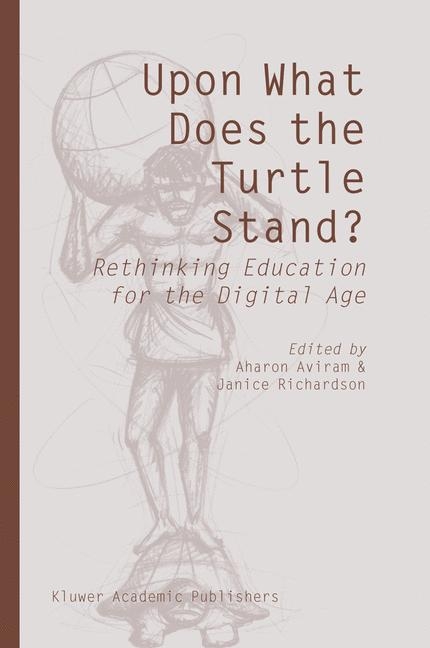
Upon What Does the Turtle Stand? (eBook)
XV, 256 Seiten
Springer Netherland (Verlag)
978-1-4020-2799-4 (ISBN)
This book brings together the reflections of independent researchers from around the world. Sixteen authors from fourteen countries present their views on the use of information and communication technology (ICT) in education, offering valuable insights through the examination of current issues relevant to the future of education. What will education be in tomorrow's world? How can ICT be used without rendering education a purely technical process? How can we succeed the renovation of educational subjects without transforming them into technical objects? The introductory chapter of this publication guides us into the essays through a classification organized by the editors to illustrate different attitudes to technologies: * The 'Globalizers' see the integration of ICT and education as a means of enhancing the competitiveness of their society in a global economy; * The 'Reformists' see it as a means of bringing about significant change in didactics in the various disciplines, and even in the 'basics' of education; * The 'Humanists' consider technologies as possible catalysts for changing the aims and values of education from learni- oriented to humanistic; * The 'Heretic' sees values and aims as being determined exclusively by technology, and economy and culture as s- products of the technology-guided process. He therefore does not see any sense in interrogations as to which aims should guide us in integrating technology with education. Obviously, some arguments stretch across all four categories without completely matching any so-called type.
Table of Contents List of Contributors Foreword; Viviane Reding Prologue; Walt Tremer Acknowledgements Introduction Part One: The Globalizers.- ICT-in-Education Policies and Implementation in Singapore and Other Asian Countries; Chee-Kit Looi and W.L. David Hung.- Confronting the Challenge of the Information and Knowledge Society in Developing Countries; Najat Rochdi.- Part Two: The Reformists.- The Turtle Stands on the Basis of an Emerging Educational Paradigm; Willem J. Pelgrum and Tjeerd Plomp.- Portable Computing Challenges Schooling ; C. Paul Newhouse.- Thus Spake Venitia*; Robert Bibeau.- Professional Development for Teachers and Quality in School Education; Nikitas Kastis.- Literacy, or the Art of Integration; Janice Richardson.- Part Three: The Humanists.- Recreation; Daniel Deberghes*.- What Kind of Technologies for What Kind of Education?; Juana M. Sancho.- Policy, Practice and the 'Space' in Between; Rosemary Naughton.- Why Should Children Go to School?; Aharon Aviram.- Digital Inclusion in Brazil; Pedro Roberto Jacobi.- Towards a New Canon in Education; Wiktor Kulerski and Terry Ryan.- Part Four: The Heretic.- Visions, Values, Technologies and Schools; Jim Dator.- About the Contributors.
| Erscheint lt. Verlag | 6.3.2006 |
|---|---|
| Zusatzinfo | XV, 256 p. |
| Verlagsort | Dordrecht |
| Sprache | englisch |
| Themenwelt | Schulbuch / Wörterbuch ► Unterrichtsvorbereitung ► Unterrichts-Handreichungen |
| Geisteswissenschaften | |
| Mathematik / Informatik ► Informatik | |
| Sozialwissenschaften ► Pädagogik ► Allgemeines / Lexika | |
| Sozialwissenschaften ► Pädagogik ► Bildungstheorie | |
| Sozialwissenschaften ► Politik / Verwaltung | |
| Schlagworte | Education • Inclusion • Integration • Literacy • school • University |
| ISBN-10 | 1-4020-2799-0 / 1402027990 |
| ISBN-13 | 978-1-4020-2799-4 / 9781402027994 |
| Informationen gemäß Produktsicherheitsverordnung (GPSR) | |
| Haben Sie eine Frage zum Produkt? |
 PDF (Wasserzeichen)
DRM: Digitales Wasserzeichen
Dieses eBook enthält ein digitales Wasserzeichen und ist damit für Sie personalisiert. Bei einer missbräuchlichen Weitergabe des eBooks an Dritte ist eine Rückverfolgung an die Quelle möglich.
Dateiformat: PDF (Portable Document Format)
Mit einem festen Seitenlayout eignet sich die PDF besonders für Fachbücher mit Spalten, Tabellen und Abbildungen. Eine PDF kann auf fast allen Geräten angezeigt werden, ist aber für kleine Displays (Smartphone, eReader) nur eingeschränkt geeignet.
Systemvoraussetzungen:
PC/Mac: Mit einem PC oder Mac können Sie dieses eBook lesen. Sie benötigen dafür einen PDF-Viewer - z.B. den Adobe Reader oder Adobe Digital Editions.
eReader: Dieses eBook kann mit (fast) allen eBook-Readern gelesen werden. Mit dem amazon-Kindle ist es aber nicht kompatibel.
Smartphone/Tablet: Egal ob Apple oder Android, dieses eBook können Sie lesen. Sie benötigen dafür einen PDF-Viewer - z.B. die kostenlose Adobe Digital Editions-App.
Buying eBooks from abroad
For tax law reasons we can sell eBooks just within Germany and Switzerland. Regrettably we cannot fulfill eBook-orders from other countries.
aus dem Bereich