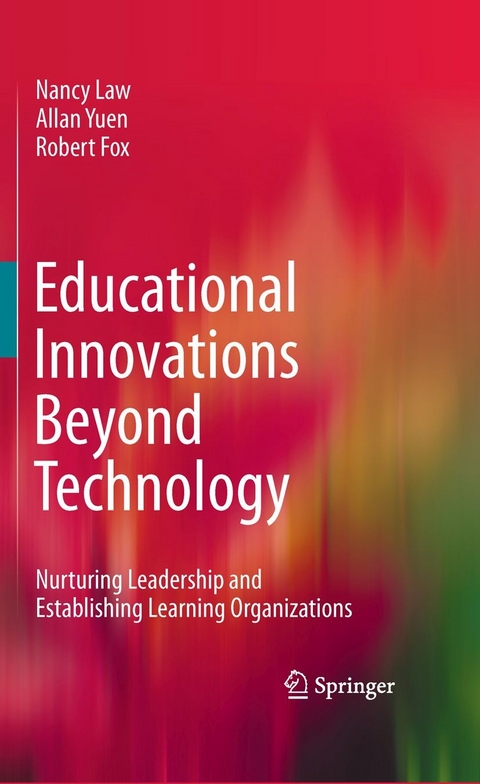
Educational Innovations Beyond Technology (eBook)
XVIII, 243 Seiten
Springer US (Verlag)
978-0-387-71148-5 (ISBN)
The text explores the concept of innovation, and analyse and compare different dimensions of innovation found in the various case studies; the transfer of innovation and the mechanisms of change; on an innovative online case study database on education innovations that has been designed to be used by education practitioners to support organizational leadership, international collaboration and reflective practice in the Asia Pacific Economic Cooperation (APEC) eEducation Leadership initiative; on a project aimed to support the establishment of communities of practice for education practitioners facilitated through an extendable online database that can be used to contribute and share case studies of their own ICT-supported pedagogical innovations. It discusses roles of the teacher and the anticipated changes to the education profession at a system level, in the coming decade on the basis of emerging changes observed in the case studies, and leadership issues at the school level. The book analyses change mechanisms for different kinds of innovation and how different contextual and cultural factors interact to bring about the changes observed.
Dr. Nancy Law is the Director of the Centre for Information Technology in Education and Associate Dean of the Faculty of Education at the University of Hong Kong. Dr. Law obtained her BSc and MPhil in Physics as well as her teaching qualification from the University of Hong Kong, and received her PhD in Science Education from the University of London Institute of Education. Her research interest include international comparative studies of pedagogical innovations and information technology, models of ICT integration in schools and change leadership, computer supported collaborative learning and the use of expressive and exploratory computer-based learning environments. Dr. Law has served on various advisory committees on IT in education within and outside of the University of Hong Kong, and is currently a member of the Steering Committee on Strategic Development of Information Technology in Education of the HKSAR government. She has served on the International Steering Committee of the Second International Information Technology in Education Study (SITES) and the Steering Committee of the APEC Cyber Education Consortium. She has conducted numerous evaluative studies as well as research and development projects related to Information Technology in schools.
Allan H.K. Yuen, Ph.D. is an Associate Professor and Head of Division, Division of Information and Technology Studies, Faculty of Education, The University of Hong Kong. He has engaged in a number of research and development projects on information technology in education. His research interests include managing and leading information technology in schools, computer supported collaborative learning, and technology acceptance in education.
Dr Bob Fox, Prior to assuming his current position as Deputy Director, Centre for Information Technology in Education (CITE) and Associate Professor in the Faculty of Education, the University of Hong Kong in December 2000, Dr Fox was an Associate Director and Senior Lecturer in the Centre for the Advancement of Education, Curtin University of Technology, Australia. He has a doctoral degree which focussed on pedagogical practice and change in education through the use of information and communication technology (ICT); masters and bachelor degrees in education and has worked in educational technology, instructional design and distance education for over twenty-eight years. At the University of Hong Kong, he is the Program Director of the Master of Science in IT in Education (MSc[ITE]) and is presently engaged with Dr Law and Dr Yuen in research into assessing the impact of ICTs on schools, curricula, teachers, and students in Hong Kong. His research interests concern staff development for educational change through the use of ICT. He has conducted national and international courses and workshops on a variety of topics including, information technology in and for education, elearning, online education, distance and flexible learning, staff development, instructional design and the selection, design and use of multimedia. He has been a course designer, coordinator and presenter for a number of international specialist programs and has worked in Australia, China, Germany, Great Britain, Hong Kong, Indonesia, Malaysia, the Middle East, the Philippines, Singapore, Spain and Thailand.
The text explores the concept of innovation, and analyse and compare different dimensions of innovation found in the various case studies; the transfer of innovation and the mechanisms of change; on an innovative online case study database on education innovations that has been designed to be used by education practitioners to support organizational leadership, international collaboration and reflective practice in the Asia Pacific Economic Cooperation (APEC) eEducation Leadership initiative; on a project aimed to support the establishment of communities of practice for education practitioners facilitated through an extendable online database that can be used to contribute and share case studies of their own ICT-supported pedagogical innovations. It discusses roles of the teacher and the anticipated changes to the education profession at a system level, in the coming decade on the basis of emerging changes observed in the case studies, and leadership issues at the school level. The book analyses change mechanisms for different kinds of innovation and how different contextual and cultural factors interact to bring about the changes observed.
Dr. Nancy Law is the Director of the Centre for Information Technology in Education and Associate Dean of the Faculty of Education at the University of Hong Kong. Dr. Law obtained her BSc and MPhil in Physics as well as her teaching qualification from the University of Hong Kong, and received her PhD in Science Education from the University of London Institute of Education. Her research interest include international comparative studies of pedagogical innovations and information technology, models of ICT integration in schools and change leadership, computer supported collaborative learning and the use of expressive and exploratory computer-based learning environments. Dr. Law has served on various advisory committees on IT in education within and outside of the University of Hong Kong, and is currently a member of the Steering Committee on Strategic Development of Information Technology in Education of the HKSAR government. She has served on the International Steering Committee of the Second International Information Technology in Education Study (SITES) and the Steering Committee of the APEC Cyber Education Consortium. She has conducted numerous evaluative studies as well as research and development projects related to Information Technology in schools.Allan H.K. Yuen, Ph.D. is an Associate Professor and Head of Division, Division of Information and Technology Studies, Faculty of Education, The University of Hong Kong. He has engaged in a number of research and development projects on information technology in education. His research interests include managing and leading information technology in schools, computer supported collaborative learning, and technology acceptance in education. Dr Bob Fox, Prior to assuming his current position as Deputy Director, Centre for Information Technology in Education (CITE) and Associate Professor in the Faculty of Education, the University of Hong Kong in December 2000, Dr Fox was an Associate Director and Senior Lecturer in the Centre for the Advancement of Education, Curtin University of Technology, Australia. He has a doctoral degree which focussed on pedagogical practice and change in education through the use of information and communication technology (ICT); masters and bachelor degrees in education and has worked in educational technology, instructional design and distance education for over twenty-eight years. At the University of Hong Kong, he is the Program Director of the Master of Science in IT in Education (MSc[ITE]) and is presently engaged with Dr Law and Dr Yuen in research into assessing the impact of ICTs on schools, curricula, teachers, and students in Hong Kong. His research interests concern staff development for educational change through the use of ICT. He has conducted national and international courses and workshops on a variety of topics including, information technology in and for education, elearning, online education, distance and flexible learning, staff development, instructional design and the selection, design and use of multimedia. He has been a course designer, coordinator and presenter for a number of international specialist programs and has worked in Australia, China, Germany, Great Britain, Hong Kong, Indonesia, Malaysia, the Middle East, the Philippines, Singapore, Spain and Thailand.
Foreword 6
Acknowledgement 8
Contents 10
List of Figures 16
List of Tables 18
Chapter 1: An Ecological Metaphor for Researching Technology Use and Pedagogical Innovations 20
ICTs in Learning and Teaching: Are They Sustaining or Transforming Technologies? 23
Pedagogical Practices as Competing “Species” in the Ecology of School Education 26
Outline of This Book 30
Chapter 2: Research Design and Methods 33
Case Study Design in SITES-M2 34
Case “Boundaries” in SITES-M2 35
Case Selection 35
Data Collection 36
Case Report Format 37
Selection of Cases for the Ecological Study 37
Chapter 3: Examining Innovativeness at the Classroom Level 46
Dimensions of Pedagogical Innovation 48
Developing a Scale of Innovativeness 49
Case Study Comparisons of Innovativeness “Profiles” 62
Variations Across and Correlations Between Different Innovation Dimensions 72
Regional Comparisons of Innovation Profiles 74
Discussion 75
Chapter 4: Student and Teacher Roles in ICT-Supported Innovations 78
Student Learning Activities and Roles 79
Student Roles and Extent of Pedagogical Innovation 89
Teacher Pedagogical Activities and Roles 90
Teacher-Role Clusters 92
Teacher Roles and Extent of Pedagogical Innovation 100
Teacher and Student Roles: How Related Are They? 103
Chapter 5: Pedagogical Practices, Technology Use, and Teacher Competence 105
Characterizing Pedagogical Practice 107
Pedagogical Practice Type and ICT Use 115
Innovativeness of Different Pedagogical Practices 117
Teachers’ Roles, Students’ Roles and Pedagogical Practice Types: Consistency and Anomalies 119
Teacher Competence and Pedagogical Innovation 120
Discussion: Teacher Professional Development and Policy Implications 126
Chapter 6: The Nature of Innovation Schools 128
Innovation Implementation and Educational Change 128
School Contextual Factors: Understanding the Nature of Innovative Schools 131
School Background 132
Schools’ Implementation Strategies 134
Principal Leadership 136
ICT Infrastructure 138
Government and Community Support 139
Summary 142
Chapter 7: Organizational Learning in Innovation Schools 145
Schools as Learning Organizations 146
Analysis of Four Innovation Schools 149
Summary and Discussion 164
Chapter 8: Pedagogical Innovations as Systemic Change: The Challenge of Sustainability and Scalability1 168
The Need for Systemic Change in Education 169
Exploring Systemicity and Change Through Exemplars of ICT-Supported Emergent Pedagogical Practices 171
Scalability and Pedagogical Innovation 172
Transferability of Innovations 175
Scalability and Leadership 178
Scalability and Government Support 181
Summary and Conclusions: The Need for Re-culturing 183
Chapter 9: Research into Practice: Using Case Studies in Professional Development 187
Case Studies: Different Types and How They Are Used 188
Case Study Examples in ICT Leadership and Professional Development 190
Comparison of the Content of The Two Databases 192
A Closer Look at The Utility of The Hong Kong Database 194
Using The Web-Based Case Studies in Professional Development 196
Usefulness of The Case Studies with Respect to Professional Development 204
Summary and Conclusions 205
Chapter 10: Changing Leadership Roles in Changing Times 206
Networks as Architecture for Learning and Educational Transformation 206
Leaders and the Changing Concept of Leadership 208
Using SITES-M2 Case Studies to Support MultilevelLeadership Development 211
Summary and Conclusion 224
Chapter 11: Education Innovations Beyond Technology 227
Ecological Niches and Context Dependence of the Innovations 229
The Crop and Keystone Species: Students’ Rolesand Teachers’ Roles 230
Types of Innovative Pedagogical Practices as a Species in the Classroom Ecology and Relative to Teacher Competence 232
Characteristics of Innovation Schools and Level of Innovativeness at the Classroom Level 233
Organizational Learning and Pedagogical Innovations 234
Sustaining and Scaling Pedagogical Innovations 235
Research into Practice: Ecologically Inspired Case-Study-Based Professional Development for Innovation 237
Using the SITES-M2 Case Studies to Build Professional Development Networks for Innovation and E-Leadership 238
Summary and Reflections 241
References 243
Index 251
| Erscheint lt. Verlag | 15.1.2011 |
|---|---|
| Zusatzinfo | XVIII, 243 p. |
| Verlagsort | New York |
| Sprache | englisch |
| Themenwelt | Schulbuch / Wörterbuch ► Unterrichtsvorbereitung ► Unterrichts-Handreichungen |
| Geisteswissenschaften | |
| Sozialwissenschaften ► Pädagogik ► Schulpädagogik / Grundschule | |
| Schlagworte | Educational change • Educational technology • leadership development • Learning and Instruction |
| ISBN-10 | 0-387-71148-1 / 0387711481 |
| ISBN-13 | 978-0-387-71148-5 / 9780387711485 |
| Informationen gemäß Produktsicherheitsverordnung (GPSR) | |
| Haben Sie eine Frage zum Produkt? |
 PDF (Wasserzeichen)
DRM: Digitales Wasserzeichen
Dieses eBook enthält ein digitales Wasserzeichen und ist damit für Sie personalisiert. Bei einer missbräuchlichen Weitergabe des eBooks an Dritte ist eine Rückverfolgung an die Quelle möglich.
Dateiformat: PDF (Portable Document Format)
Mit einem festen Seitenlayout eignet sich die PDF besonders für Fachbücher mit Spalten, Tabellen und Abbildungen. Eine PDF kann auf fast allen Geräten angezeigt werden, ist aber für kleine Displays (Smartphone, eReader) nur eingeschränkt geeignet.
Systemvoraussetzungen:
PC/Mac: Mit einem PC oder Mac können Sie dieses eBook lesen. Sie benötigen dafür einen PDF-Viewer - z.B. den Adobe Reader oder Adobe Digital Editions.
eReader: Dieses eBook kann mit (fast) allen eBook-Readern gelesen werden. Mit dem amazon-Kindle ist es aber nicht kompatibel.
Smartphone/Tablet: Egal ob Apple oder Android, dieses eBook können Sie lesen. Sie benötigen dafür einen PDF-Viewer - z.B. die kostenlose Adobe Digital Editions-App.
Buying eBooks from abroad
For tax law reasons we can sell eBooks just within Germany and Switzerland. Regrettably we cannot fulfill eBook-orders from other countries.
aus dem Bereich