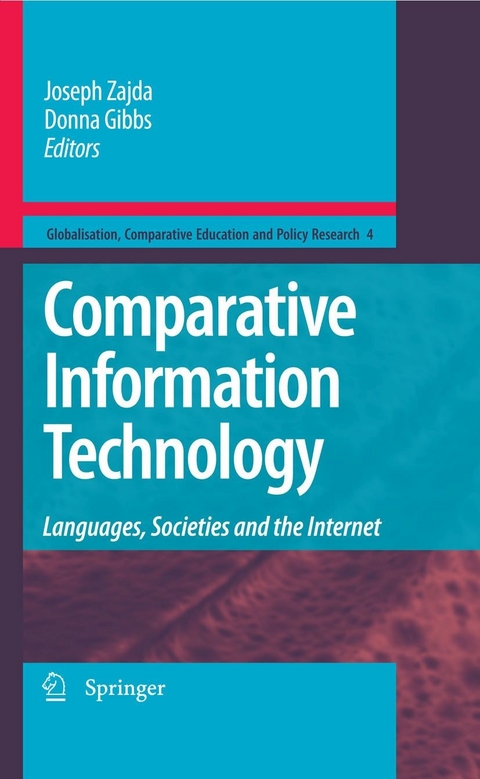
Comparative Information Technology (eBook)
200 Seiten
Springer Netherland (Verlag)
978-1-4020-9426-2 (ISBN)
Comparative Information Technology: Languages, Societies and the Internet, which is the fourth volume in the 12-volume series Globalisation, Comparative Education and Policy Research, offers a critique of the nexus between ICT and its impact on society, individuals and educational institutions. One of the most signification dimensions of globalisation has been the rapid development of information and communications technologies (ICTs). Our lives have been changed by this in numerous ways and the implications for education are en- mous. The ICTs have transformed the linguistic, cognitive and visual dim- sions of human communication, as well as our perceptions of the self, and social identity in the global culture. The ICTs have facilitated the development of new dimensions of digital literacy, such as blogging and sms messaging. In this sense, cyberlanguage continues to evolve by borrowing and adapting familiar words, coining new expressions, and embracing particular styles (Gibbs & Krause, 2006, 2007). However, information technology can be both empowering and disempowering. Individuals use the Internet, notebooks, and their BlackBerries and communicate via email. If clothing is an extension of one's skin, then the ICT has become an extension of our bodies. In a globalised world, linked through the Internet, a n- formed identity can lead to a multiplicity of identities, some contradictory to each other, and some taking place primarily in the virtual communities of cyberspace.
Preface 7
References 8
Acknowledgements 9
Contents 11
Contributors 13
Comparative Information Technology: Languages, Societies and the Internet 17
1.1 Information Technologies, Virtual Identities and Global Learning 17
1.2 ICTs and Hegemony 18
References 25
Abstract Tools and Technologies of Learning: An Evolving Partnership 27
2.1 Tools, Mental Tools, and Teaching Tools 27
2.2 From Homo Habilis to Contemporary Teaching 29
2.3 Innovation 31
2.4 From Literacy to ‘Technacy’ 32
2.5 Teaching for Mental Tools 34
2.6 The Semantic Choreography of Teachers 36
2.7 Typology and Rhetorical Strategy 38
2.8 Testing Claims in Classroom Discourse 41
2.9 Japan: A Global Future? 43
2.10 Conclusion 45
References 46
E-Learning in Schools: Making Successful Connections 48
3.1 Making Connections in Schools 48
3.2 School Partner Project in Online Learning 49
3.3 Macquarie ICT Innovations Centre Projects 52
3.4 The Use of the Learning Activities Management System in Schools 56
3.5 Conclusion 60
References 61
What Is Needed for Global E-Learning in Higher Education 63
4.1 Introduction 63
4.2 Operating Globally 63
4.3 Approaches to Online Learning 66
4.4 Representing Designs 71
4.5 What Is Needed for Global Learning 75
4.6 Conclusion 77
References 77
Mobile Learning: The Significance of New Mobile and Wireless Communications Technologies for Education 79
5.1 Why Have Mobiles Been Neglected in Education? 79
5.2 Overview of the History of Mobile Phone Development 81
5.3 Uses of Mobiles in Education 83
5.4 The Distinctive Contribution of Mobile Learning 87
5.5 Conclusion: Major Issues in M-Learning for Educational Theory and Practice 89
References 90
Connecting Schools to Their Communities: The South- East Asian Experience 93
6.1 Technologies and School Reform 93
6.2 Schools and the Internet in South-East Asia 93
6.3 Taking Up the Opportunities of the Internet 95
6.4 Benefits of Linkages Between School and Community in South- East Asian Schools 96
6.5 Conclusion 100
References 100
Digital Literacy and Activity Systems in Adolescents 102
7.1 The Setting for Digital Literacies 102
7.2 The Pedagogy and Digital Technology Debate 103
7.3 Digital Literacies as Forms of Social Practice 105
7.4 Research Design 106
7.5 Results 107
7.6 Adolescent Digital Practices 110
7.7 Discussion: The Contradictory Digital Experience 113
7.8 Conclusion 115
References 115
Digital Literacy and Using Online Discussions: Reflections from Teaching Large Cohorts in Teacher Education 116
8.1 Online Application of Preservice Teachers’ Beliefs About Teaching and Learning Literacy 116
8.2 Preservice Teachers’ Beliefs About Teaching and Learning 117
8.3 Online Teaching and Learning 118
8.4 The Investigation 122
8.5 Results and Discussion 125
8.6 Conclusion 131
References 131
Development of IT-Infrastructure for Rural Connectivity: A Pro- poor Approach to E- Governance for Rural Development in India 134
9.1 Globalization and ICT: Introduction 134
9.2 IT-Led Penetration in Rural Areas and Knowledge Management 135
9.3 ICT for Rural Development in India: Governmental and NGO Initiatives 140
9.4 Evaluation 147
9.5 Conclusion 150
References 150
Context Is Everything: An International Perspective of, and Its Challenges to, Research and the Evaluation of Educational Technology 152
10.1 Situating Educational Technology Policy: The Need for a Paradigmatic Shift and ICT Skills 152
10.2 ICT Paradigm Shift 153
10.3 ICT Skills in the Global Culture 156
10.4 Recurrent Educational Technology Policy Themes 158
10.5 Finding the Intersection of Educational Technology and Evaluation Among the Disciplines 160
10.6 Toward Evaluation of Glocalization, Information Technology Development, and Implementation 161
10.7 Conclusion 164
References 164
Name Index 173
Subject Index 176
| Erscheint lt. Verlag | 21.4.2009 |
|---|---|
| Reihe/Serie | Globalisation, Comparative Education and Policy Research | Globalisation, Comparative Education and Policy Research |
| Zusatzinfo | 200 p. |
| Verlagsort | Dordrecht |
| Sprache | englisch |
| Themenwelt | Schulbuch / Wörterbuch ► Unterrichtsvorbereitung ► Unterrichts-Handreichungen |
| Geisteswissenschaften | |
| Mathematik / Informatik ► Informatik | |
| Naturwissenschaften | |
| Sozialwissenschaften ► Pädagogik ► Schulpädagogik / Grundschule | |
| Schlagworte | Communication • Cultural Identity • cyberlanguage • digital • Digital Literacy • Education • Educational technology • e-government • E-Learning • Evaluation • Human Communication • ICT • information and communications technologies • Internet • Literacy • Mobile Learning • Online • Pedagogy • Technology • Wireless |
| ISBN-10 | 1-4020-9426-4 / 1402094264 |
| ISBN-13 | 978-1-4020-9426-2 / 9781402094262 |
| Informationen gemäß Produktsicherheitsverordnung (GPSR) | |
| Haben Sie eine Frage zum Produkt? |
 PDF (Wasserzeichen)
DRM: Digitales Wasserzeichen
Dieses eBook enthält ein digitales Wasserzeichen und ist damit für Sie personalisiert. Bei einer missbräuchlichen Weitergabe des eBooks an Dritte ist eine Rückverfolgung an die Quelle möglich.
Dateiformat: PDF (Portable Document Format)
Mit einem festen Seitenlayout eignet sich die PDF besonders für Fachbücher mit Spalten, Tabellen und Abbildungen. Eine PDF kann auf fast allen Geräten angezeigt werden, ist aber für kleine Displays (Smartphone, eReader) nur eingeschränkt geeignet.
Systemvoraussetzungen:
PC/Mac: Mit einem PC oder Mac können Sie dieses eBook lesen. Sie benötigen dafür einen PDF-Viewer - z.B. den Adobe Reader oder Adobe Digital Editions.
eReader: Dieses eBook kann mit (fast) allen eBook-Readern gelesen werden. Mit dem amazon-Kindle ist es aber nicht kompatibel.
Smartphone/Tablet: Egal ob Apple oder Android, dieses eBook können Sie lesen. Sie benötigen dafür einen PDF-Viewer - z.B. die kostenlose Adobe Digital Editions-App.
Buying eBooks from abroad
For tax law reasons we can sell eBooks just within Germany and Switzerland. Regrettably we cannot fulfill eBook-orders from other countries.
aus dem Bereich