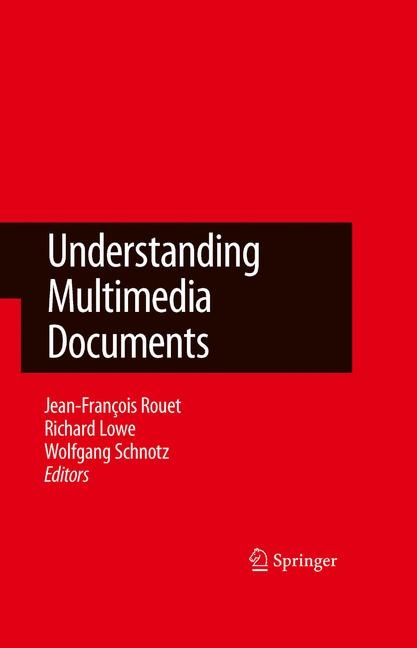
Understanding Multimedia Documents (eBook)
XII, 290 Seiten
Springer US (Verlag)
978-0-387-73337-1 (ISBN)
Professionals who use multimedia documents as a tool to communicate concepts will find this a hugely illuminating text. It provides a comprehensive and up to date account of relevant research issues, methodologies and results in the area of multimedia comprehension. More specifically, the book draws connections between cognitive research, instructional strategies and design methodologies. It includes theoretical reviews, discussions of research techniques, ad original experimental contributions. The book highlights essential aspects of current theories, and trends for future research on the use of multimedia documents.
Professionals who use multimedia documents as a tool to communicate concepts will find this a hugely illuminating text. It provides a comprehensive and up to date account of relevant research issues, methodologies and results in the area of multimedia comprehension. More specifically, the book draws connections between cognitive research, instructional strategies and design methodologies. It includes theoretical reviews, discussions of research techniques, ad original experimental contributions. The book highlights essential aspects of current theories, and trends for future research on the use of multimedia documents.
Understanding Multimedia Documents 2
Foreword 5
Contents 6
Contributors 8
Understanding Multimedia Documents: An Introduction 11
1.1 Introduction 11
1.2 A general Framework for the Study of Complex Document Comprehension 13
1.3 Memory Processes in Multimedia Comprehension (Section 1) 14
1.4 Contextual Strategies in Document-Based Learning (Section 2) 17
1.5 Multimedia Research in Perspective (Section 3) 20
1.6 Conclusions and Perspectives 22
References 23
Why Multimedia Learning is not Always Helpful 26
2.1 Introduction 26
2.2 Cognitive Load in Multimedia Learning 27
2.2.1 Types of Cognitive Load 28
2.2.2 Differential Effects of Multimedia Presentations 29
2.3 Animation in Multimedia Learning 31
2.3.1 Differential Effects in Learning from Static and Animated Pictures 33
2.3.2 Learning from Different Kinds of Animations 36
2.4 A Closer Look on the Enabling and Facilitating Function of Multimedia 39
2.4.1 The Zone of Proximal Development from a Cognitive Load Perspective 39
2.4.2 Cognitive Load Effects of Manipulation and Simulation Pictures 43
2.4.3 Constraints on Germane Cognitive Load 45
2.5 Conclusions 47
References 49
Text and Picture Integration in Comprehending and Memorizing Spatial Descriptions 51
3.1 Introduction 51
3.2 Theoretical Framework 52
3.2.1 Spatial Mental Models and the Role of Imagery in the Comprehension of Spatial Texts 52
3.2.2 Visuo-Spatial Working Memory in Comprehending Spatial Descriptions 53
3.2.3 Discourse-Picture Integration in Spatial Descriptions: An Empirical Study 55
3.3 Experiment 1 57
3.3.1 Method 57
3.3.1.1 Participants 57
3.3.1.2 Materials 57
3.3.1.3 Procedure 58
3.3.2 Results and Discussion 58
3.4 Experiment 2 60
3.4.1 Objectives 60
3.4.2 Method 61
3.4.2.1 Participants 61
3.4.2.2 Materials and Procedure 61
3.4.3 Results and Discussion 61
3.5 Conclusions 63
References 64
Display of Key Pictures from Animation: Effects on Learning 68
4.1 Introduction 68
4.2 Multimedia Instruction for Understanding Dynamic Systems 69
4.2.1 Multimedia Animations as Instructional Devices 69
4.2.2 Does Animation Improve Learning? 70
4.2.3 Cognitive Load and the Design of Multimedia Instruction 73
4.2.4 Research Hypotheses 75
4.3 Experiment 75
4.3.1 Method 75
4.3.1.1 Participants and Design 75
4.3.1.2 Material and Apparatus 76
4.3.1.3 Procedure 77
4.3.2 Results and Discussion 77
4.3.2.1 Study Time 77
4.3.2.2 Time Spent in the Retention and Transfer Tests 78
4.3.2.3 Score for Retention and Transfer Tests 78
4.3.2.4 Subjective Evaluation 79
4.3.3 Discussion 80
4.4 Conclusion 82
References 83
Levels of Verbal Redundancy, Note-Taking and Multimedia Learning 86
5.1 Introduction 86
5.2 Theoretical Background 87
5.2.1 The Cognitive Load Theory 87
5.2.2 The Generative Theory of Multimedia Learning 88
5.2.3 Redundancy in Document Comprehension 88
5.2.3.1 Redundancy Defined as Superfluous Information 89
5.2.3.2 Redundancy and Learners’ Prior Knowledge 89
5.2.3.3 Redundancy Associated with Multiple Presentation Formats 90
5.2.4 Study Objectives 91
5.3 Experiment 1 93
5.3.1 Method 94
5.3.1.1 Subjects 94
5.3.1.2 Materials 94
5.3.1.3 Dependent Measures 96
5.3.1.4 Procedure 97
5.3.2 Results 97
5.3.2.1 Performance 97
5.3.2.2 Subjective Evaluation 98
5.3.3 Discussion 99
5.4 Experiment 2 100
5.4.1 Objectives 100
5.4.2 Method 102
5.4.3 Results 102
5.4.3.1 Learning Outcomes 102
5.4.3.2 Analyses of Students’ Impressions 102
5.4.4 Discussion 103
5.5 Discussion and General Conclusion 104
5.6 Appendix 106
References 106
Learning from a Multimedia Explanation: A Comparison of Static Pictures and Animation 109
6.1 Introduction 109
6.2 Constructing Mental Models from Multimedia Documents 110
6.2.1 Constructing Mental Models from Texts and Pictures 110
6.2.2 Processing Static and Dynamic Illustrations 111
6.2.3 Auditory Presentation of Verbal Information 114
6.3 Experiment 115
6.3.1 Rationale 115
6.3.2 Method 116
6.3.2.1 Participants 116
6.3.2.2 Materials 116
6.3.2.3 Procedure 119
6.3.3 Results 120
6.3.3.1 Data analysis 120
6.4 Discussion and Conclusions 121
References 123
Search and Comprehension Processes in Learning from Text 126
7.1 Introduction 126
7.2 Theoretical Background 127
7.2.1 Cognitive Processes in Searching for Information in Documents to Answer Questions 127
7.2.2 Differential Processes Involved in Answering Questions 129
7.2.3 The Role of Strategic Monitoring and Comprehension in Answering Questions from Text 131
7.3 Empirical Studies of Text Search 133
7.3.1 Experiment 1: Reading a Text and Answering Questions 134
7.3.1.1 Method 134
7.3.1.2 Results 139
7.3.1.3 Discussion 142
7.3.2 Experiment 2: Searching for Information to Answer Questions 143
7.3.2.1 Method 144
7.3.2.2 Results 144
7.3.2.3 Discussion 147
7.4 General Discussion and Conclusions 149
References 151
Searching User-Controllable Animations During Learning 153
8.1 Introduction 153
8.1.4 Negative Effects of Animation 155
8.1.4 Searching Animation 156
8.2 Using User Control 157
8.2.1 Is User Control Effective? 157
8.2.2 Methodological Challenges in Characterizing User Control 158
8.3 Investigating User Control 160
8.3.1 Integrating Multiple Data Sources 161
8.3.2 Data and Analysis 162
8.3.3 User Control Strategies and Tactics 165
8.3.4 Example Results 167
8.4 Conclusion 169
References 170
Studying Eye Movements in Multimedia Learning 172
9.1 Introduction 172
9.2 The Added Value of Studying Eye Movements in Multimedia Learning 173
9.3 The GazeTrackerTM Software 175
9.4 Experiment 176
9.4.1 Objectives 176
9.4.2 Method 179
9.4.2.1 Participants and Design 179
9.4.2.2 Apparatus 179
9.4.2.3 Materials 179
9.4.2.4 Procedure 181
9.4.3 Results and Discussion 182
9.5 General Discussion and Conclusions 184
References 186
The Interaction of Verbal and Pictorial Information in Comprehension and Memory 188
10.1 Introduction 188
10.2 Experiment 1 190
10.2.1 Objectives 190
10.2.2 Method 191
10.2.2.1 Participants 191
10.2.2.2 Materials and Procedure 191
10.2.3 Results and Discussion 193
10.2.3.1 Comprehension Times of Results Sections 193
10.2.3.2 Interest Ratings 194
10.2.3.3 Recognition of Results Description in Text 194
10.2.3.4 Recognition of Results Depiction in Graph 195
10.2.3.5 Confidence in Text Recognition 195
10.2.3.6 Confidence in Graph Recognition 195
10.3 Experiment 2 196
10.3.1 Objectives 196
10.3.2 Method 196
10.3.2.1 Participants 196
10.3.2.2 Materials, Procedure, Apparatus, and Design 196
10.3.3 Results and Discussion 197
10.3.3.1 Comprehension Times of Results Sections 197
10.3.3.2 Gaze Durations on Text 197
10.3.3.3 Gaze Durations on Graphs 198
10.3.3.4 Eye Movements Between Text and Graph 199
10.3.3.5 Interest Ratings 199
10.3.3.6 Recognition of Results Description in Text 199
10.3.3.7 Recognition of Results Depiction in Graph 199
10.3.3.8 Confidence in Text Recognition 200
10.3.3.9 Confidence in Graph Recognition 200
10.4 General Discussion and Conclusions 200
10.1 Appendix 202
References 203
Hypertext Was Born Around 1200 205
11.1 Introduction 205
11.2 Analyzing Reading Tools of Ancient Books: Methodological Aspects 207
11.2.1 Documentation Sources 207
11.2.2 Study Limitations 207
11.3 A Short History of Book Reading Tools 208
11.3.1 The Linear Codex: A Device to Memorize Orally Transmitted Knowledge 208
11.3.1.1 The Codex as a Major Shift in the Structuring of Textual Materials 208
11.3.1.2 Links Between Written Text and Orality 208
11.3.1.3 Oral Tradition vs. Written Memory 209
11.3.2 The Birth of Non-linearity in the Written Text 209
11.3.2.1 Reading Tools Needed Page as a Crucible to Develop 209
11.3.2.2 Divisions and Marks in Greater Variety 210
11.3.2.3 An ‘‘Embryo’’ of Non-linearity in Text and Reading 210
11.3.2.4 Written Text to Transmit the Fixed Word of God 212
11.3.3 How Written Text Became an Efficient Non-linear Artifact 212
11.3.3.1 Reading Tools Were Made for Readers 212
11.3.3.2 A New, ‘‘Radical’’ Reading Activity During the 13th Century 213
11.3.3.3 Reading Tools to Support Non-linear Reading 214
11.3.3.4 Two Important Tools: Index and Table of Contents 214
11.3.4 The Generalisation of Non-linearity 215
11.3.4.1 Text Secularization Increased the Need for Reading Tools 215
11.3.4.2 New Systematic Reading Tools to Renew Knowledge 216
11.3.4.3 Xylography and Gutenberg’s Press Allowed the Generalisation of Non-linear Books 217
11.4 Going Back to Non-linearity Principles 217
11.4.1 Standardized Reading Tools Made Non-linear Reading Efficient 217
11.4.2 Linear vs. Non-linear Documents 218
11.4.3 Linear vs. Non-linear Uses of Text and Hypertext 220
11.5 Conclusions 221
References 222
From Film and Television to Multimedia Cognitive Effects 225
12.1 Introduction 225
12.2 Medium Specificity and Television Comprehension 226
12.2.1 Early Studies of Film Viewers’ Attitude 226
12.2.2 Theories and Empirical Evidence About TV Viewers 228
12.2.3 Towards a Functional Definition of Mental Effort 229
12.2.4 A Comparability Problem 233
12.3 Comparisons Focused on Similar Cognitive Text Requirements 235
12.3.1 Experiment 1: Restoring Coherence in Television Viewing and in Reading 235
12.3.1.1 Hypotheses 236
12.3.1.2 Method 236
12.3.1.3 Results 238
12.3.2 Experiment 2: Comparison Between a Literary and a Film Creative Text Comprehension 239
12.3.2.1 Hypotheses 239
12.3.2.2 Method 240
12.3.2.3 Results and Discussion 241
12.4 Text Comprehension and Multimedia Comprehension 242
12.5 Conclusion and Research Perspectives 244
Notes 246
References 247
How Should We Evaluate Multimedia Learning Environments? 250
13.1 Introduction 250
13.2 First Generation Experiments 251
13.2.1 Positive Features 252
13.2.2 Negative Features 253
13.3 The Need for Alternative Approaches to Evaluating Multimedia Learning 256
13.3.1 Who Benefits from Learning with (Specific Forms of) Multimedia? 257
13.3.2 How do People Learn with Multimedia? 259
13.3.3 How does Learning with Multimedia Change Over Time? 261
13.3.4 How does the Wider Context Influence Learning with Multimedia? 262
13.4 Conclusion 263
References 264
Memory Processes in Text and Multimedia Comprehension: Some Reflections and Perspectives 267
14.1 Introduction 267
14.2 Comprehension as a Complex Task Involving Costly Components 268
14.2.1 Comprehension is Goal-Directed 268
14.2.2 Comprehension is a Real-Time Activity 269
14.2.3 Comprehension as a Strategic Activity 271
14.3 On the Coordination of Components Skills in Comprehension 272
14.3.1 Two Different Coordination Mechanisms 272
14.3.2 Automaticity and its Limits 274
14.3.3 Adapting the Processing/Comprehension Rhythm 275
14.4 Challenges and Perspectives for Multimedia Research 276
14.4.1 Interventions in Textual Formulations and Document Design 276
14.4.2 Improving Readers’ Processing of Texts and Documents? 277
References 278
Author Index 281
Subject Index 288
| Erscheint lt. Verlag | 17.7.2008 |
|---|---|
| Mitarbeit |
Stellvertretende Herausgeber: Richard Lowe, Wolfgang Schnotz |
| Zusatzinfo | XII, 290 p. |
| Verlagsort | New York |
| Sprache | englisch |
| Themenwelt | Schulbuch / Wörterbuch ► Unterrichtsvorbereitung ► Unterrichts-Handreichungen |
| Geisteswissenschaften | |
| Mathematik / Informatik ► Informatik ► Grafik / Design | |
| Sozialwissenschaften ► Pädagogik ► Schulpädagogik / Grundschule | |
| Schlagworte | Documents • Education • learning • Learning and Instruction • Multimedia • quality • Rouet • Understanding |
| ISBN-10 | 0-387-73337-X / 038773337X |
| ISBN-13 | 978-0-387-73337-1 / 9780387733371 |
| Informationen gemäß Produktsicherheitsverordnung (GPSR) | |
| Haben Sie eine Frage zum Produkt? |
 PDF (Wasserzeichen)
DRM: Digitales Wasserzeichen
Dieses eBook enthält ein digitales Wasserzeichen und ist damit für Sie personalisiert. Bei einer missbräuchlichen Weitergabe des eBooks an Dritte ist eine Rückverfolgung an die Quelle möglich.
Dateiformat: PDF (Portable Document Format)
Mit einem festen Seitenlayout eignet sich die PDF besonders für Fachbücher mit Spalten, Tabellen und Abbildungen. Eine PDF kann auf fast allen Geräten angezeigt werden, ist aber für kleine Displays (Smartphone, eReader) nur eingeschränkt geeignet.
Systemvoraussetzungen:
PC/Mac: Mit einem PC oder Mac können Sie dieses eBook lesen. Sie benötigen dafür einen PDF-Viewer - z.B. den Adobe Reader oder Adobe Digital Editions.
eReader: Dieses eBook kann mit (fast) allen eBook-Readern gelesen werden. Mit dem amazon-Kindle ist es aber nicht kompatibel.
Smartphone/Tablet: Egal ob Apple oder Android, dieses eBook können Sie lesen. Sie benötigen dafür einen PDF-Viewer - z.B. die kostenlose Adobe Digital Editions-App.
Buying eBooks from abroad
For tax law reasons we can sell eBooks just within Germany and Switzerland. Regrettably we cannot fulfill eBook-orders from other countries.
aus dem Bereich