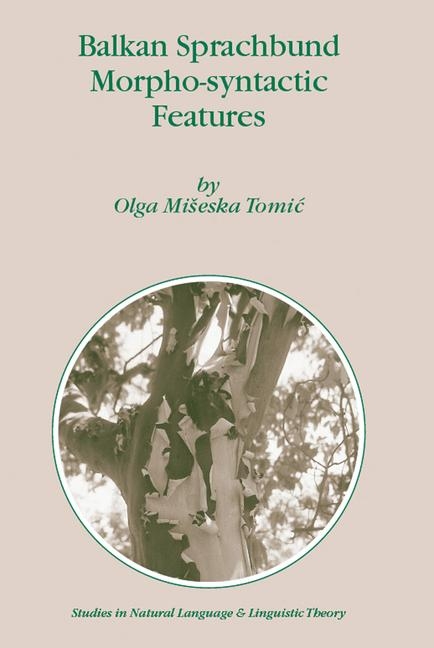
Balkan Sprachbund Morpho-Syntactic Features (eBook)
XXII, 750 Seiten
Springer Netherlands (Verlag)
978-1-4020-4488-5 (ISBN)
This book discusses the morpho-syntactic Balkan Sprachbund features in nine languages in which they are most numerous. It contains a wealth of Balkan linguistic material. The focus is on displaying similarities and differences in the representation of the most widely acknowledged Balkan Sprachbund morpho-syntactic features and their interaction with other features in the structure of the DP or the sentence of individual languages.
At the end of 1998, Professor Pieter Muysken was awarded the Spinoza prize of the Netherlands Organization of Scientific Research (NOW) and set up a research program entitled "e;Lexicon and Syntax"e;. The implementation of the Program started in the autumn of 1999 with research on the lexicon and syntax in a number of areas where contacts between 1 different languages are intensive. For the languages of many of the areas selected, basic data had to be collected. For most of the languages of the Balkan Sprachbund area, however, there are grammars and dictionaries. Moreover, quite a number of studies of the Balkan Spra- bund features have been published. Accordingly, when I joined the team of the Project, I aimed at a description of the state of art in the field. After several months of research, I realized that Balkanists have mainly been concerned with compiling lists of similarities and making parallels between the lexical and grammatical forms of the Balkan languages, while analyses of the interaction of the Balkan Sprachbund morpho-syntactic features with other features in the structure of the DP or the sentence of a given language/dialect are scarce. This oriented me towards descriptions of Balkan Spra- bund morpho-syntactic features in the context of individual sub-systems in nine Balkan language to which they relate - the Slavic languages Macedonian, Bulgarian and Serbo-C- atian; the Romance languages Romanian, Aromanian and Megleno-Romanian; Albanian; Modern Greek; and the Arli Balkan Romani dialect.
Table of Contents 7
Preface 13
Less Common Alphabet Symbols 18
Abbreviations and Symbols 19
Chapter One INTRODUCTION 22
1. The Balkan Sprachbund phenomenon 22
2. Which features count as Balkan Sprachbund features? 24
3. How did the Balkan Sprachbund features develop? 48
4. The Balkan Sprachbund features in this book 50
Chapter Two ETHNO-HISTORICAL CONSIDERATIONS 56
1. The Balkan peninsula 56
2. Ethnic Balkans 56
3. Greek in retrospective 57
4. Origin of the Balkan Romance languages 59
5. Albanian and Illyrian 61
6. The Balkan Slavic languages 63
7. Balkan Romani 66
8. Turkey and Turkish on the Balkans 67
Chapter Three CASES AND ARTICLES 70
1. Macedonian 70
2. Bulgarian 107
3. Serbo-Croatian 129
4. The South-Eastern Serbian dialects 139
5. Romanian 146
6. Megleno-Romanian 173
7. Aromanian 188
8. Albanian 207
9. Modern Greek 224
Chapter Four CLITIC CLUSTERS AND CLITIC DOUBLING 260
1. Macedonian 263
2. Bulgarian 280
3. Serbo-Croatian 292
4. Romanian 300
5. Megleno-Romanian 313
6. Aromanian 320
7. Albanian 328
8. Modern Greek 336
9. Arli Balkan Romani 350
Chapter Five THE PERFECT AND THE EVIDENTIAL 354
1. Macedonian 357
2. Bulgarian 372
3. Serbo-Croatian 382
4. Romanian 390
5. Megleno-Romanian 397
6. Aromanian 404
7. Albanian 410
8. Northern Geg Albanian 418
9. Modern Greek 421
10. Arli Balkan Romani 428
Chapter Six INFINITIVES AND SUBJUNCTIVES 434
1. Macedonian 437
2. Bulgarian 477
3. Serbo-Croatian 505
4. Romanian 532
5. Megleno-Romanian 561
7. Albanian 602
8. Northern Geg Albanian 630
9. Modern Greek 634
10. Arli Balkan Romani 657
Appendix One CORE VOCABULARIES 678
Appendix Two SAMPLES TEXTS 704
Appendix Three LANGUAGES SPOKEN ON THE BALKANS 718
References 728
Subject Index 742
Index of languages, dialects, ethnonyms and toponyms 762
Author Index 768
Chapter Two ETHNO-HISTORICAL CONSIDERATIONS (p. 35-36)
1. The Balkan peninsula
The Balkan peninsula derives its name from the Turkish word for the Slavic toponym Stara Planina – the mountain range in Northern Bulgaria, to the south of the Danube.1 The first person to use the term Balkan Peninsula was the German geographer Zeune (1808), who replaced the former reference to the peninsula as "European Turkey" with this term, stating that there was une répugnance évidente ‘evident repulsion’ at the description of the Balkans as "Turkey in Europe" (cf. Cviji 1918:2). The name Balkan Peninsula was readily accepted since it was parallel to the names of the other two peninsulas in Southern Europe, the Pyrenean and the Apennine one, which were also named after mountain ranges.
1.1. While the eastern, southern and western boundaries of the peninsula are defined by the borders of the Adriatic, Ionian, Mediterranean, Aegean and Black seas, its northern boundary is defined by two mighty rivers: the Sava, from its head-waters in the Alps, north of the Gulf of Trieste, to its junction with the Danube, and the Danube from here on, to its estuary in the Black Sea (cf. Cviji 1918:2, Kati i 1976:11). Thus, unlike the northern boundaries of the Pyrenean and the Apennine peninsula, which are closed by high mountains – the Pyrenees and the Alps, respectively, the northern boundaries of the Balkan Peninsula are not sharply separated from the rest of continental Europe. Because of this, the Balkan peninsula has been very open to invasion from the north, and it is from the north that numerous invasions have come.2 The invasions have driven into the peninsula a diversity of tribes and have turned it into a conglomeration of peoples and languages.
1.2 With the exception of Stara Planina and the Rhodope ranges, which are moderately high and have numerous mountain passes, the major mountain chains in the Balkans run north-south, so, the invaders have been able to penetrate deep into the peninsula. Having settled, the individual tribes were isolated, however, the high mountains hindering the creation of common states and encouraging linguistic localisms.
2. Ethnic Balkans
The modern Balkan states share a geographical unity and historical heritage dating back to inhabitation during the Lower Paleolithic times, 200,000-100,000 B.C. (cf. Carter 1977:1). In the course of the first millenium of the modern era, however, due to the uneven influence of Rome in the territories in and around the Balkans, which the empire had conquered, two different civilizations developed on the peninsula. Balkanhalbinsel. Over a hundred years later, the Serbian geographer Cviji supported
2.1 During the period before Christ, Roman influence on the Balkans was chiefly along the Adriatic and Ionic coast, concentrating in coastal towns. In the first century A.D. the Romans began pushing their frontiers inland across the Balkans. As they adv- anced, they established forts and small towns and built roads to connect them with the coast. The countryside beyond the forts and the towns remained populated with indigenous population, however, and experienced little or no Roman influence.
2.2 In 324, the emperor Constantine chose to live in the east and established a new center there, Constantinople. This marked the beginning of the end of the centralized Roman rule, which was precipitated after the death of emperor Theodosius I, who divided the empire between his two sons, into Old Rome in the west and New Rome in the east.
| Erscheint lt. Verlag | 13.9.2006 |
|---|---|
| Reihe/Serie | Studies in Natural Language and Linguistic Theory | Studies in Natural Language and Linguistic Theory |
| Zusatzinfo | XXII, 750 p. |
| Verlagsort | Dordrecht |
| Sprache | englisch |
| Themenwelt | Literatur ► Romane / Erzählungen |
| Sachbuch/Ratgeber | |
| Schulbuch / Wörterbuch ► Wörterbuch / Fremdsprachen | |
| Geisteswissenschaften ► Sprach- / Literaturwissenschaft ► Sprachwissenschaft | |
| Schlagworte | Alphabet • Comparative • grammar • Grammatical features • Index • Infinitive • Linguistics • perfect • Subject • Symbol • syntactic |
| ISBN-10 | 1-4020-4488-7 / 1402044887 |
| ISBN-13 | 978-1-4020-4488-5 / 9781402044885 |
| Informationen gemäß Produktsicherheitsverordnung (GPSR) | |
| Haben Sie eine Frage zum Produkt? |
 PDF (Wasserzeichen)
DRM: Digitales Wasserzeichen
Dieses eBook enthält ein digitales Wasserzeichen und ist damit für Sie personalisiert. Bei einer missbräuchlichen Weitergabe des eBooks an Dritte ist eine Rückverfolgung an die Quelle möglich.
Dateiformat: PDF (Portable Document Format)
Mit einem festen Seitenlayout eignet sich die PDF besonders für Fachbücher mit Spalten, Tabellen und Abbildungen. Eine PDF kann auf fast allen Geräten angezeigt werden, ist aber für kleine Displays (Smartphone, eReader) nur eingeschränkt geeignet.
Systemvoraussetzungen:
PC/Mac: Mit einem PC oder Mac können Sie dieses eBook lesen. Sie benötigen dafür einen PDF-Viewer - z.B. den Adobe Reader oder Adobe Digital Editions.
eReader: Dieses eBook kann mit (fast) allen eBook-Readern gelesen werden. Mit dem amazon-Kindle ist es aber nicht kompatibel.
Smartphone/Tablet: Egal ob Apple oder Android, dieses eBook können Sie lesen. Sie benötigen dafür einen PDF-Viewer - z.B. die kostenlose Adobe Digital Editions-App.
Buying eBooks from abroad
For tax law reasons we can sell eBooks just within Germany and Switzerland. Regrettably we cannot fulfill eBook-orders from other countries.
aus dem Bereich