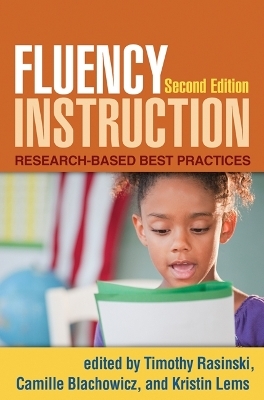
Fluency Instruction, Second Edition
Guilford Press (Verlag)
978-1-4625-0441-1 (ISBN)
- Titel z.Zt. nicht lieferbar
- Versandkostenfrei
- Auch auf Rechnung
- Artikel merken
Timothy Rasinski, PhD, is Professor Emeritus of Literacy Education in the Reading and Writing Center at Kent State University, where he directed the award-winning university reading clinic for more than 20 years. Dr. Rasinski has written extensively in articles, chapters, and books on working with children who struggle in acquiring full literacy. A former editor of The Reading Teacher and the Journal of Literacy Research, he currently serves on the editorial review boards for Reading Research Quarterly, Literacy Research and Instruction, and Reading Psychology. Dr. Rasinski is a member of the International Reading Hall of Fame. Camille Blachowicz, PhD, is Research Professor at National Louis University, where she has directed the Reading Specialist Program and the Reading Center. Her research and publications focus on vocabulary and comprehension instruction and on working with at-risk readers. Dr. Blachowicz was a Fulbright Scholar in Italy and is Co-Principal Investigator of the federally funded Multiphase Comprehensive Vocabulary Instruction Project. Kristin Lems, EdD, is Professor of English as a Second Language/Bilingual Education at National Louis University, where she teaches graduate courses for practicing teachers. She has published a number of books, chapters, and articles in both the ESL and reading fields. Dr. Lems was a Fulbright Scholar in Algeria for 2 years and is an English Language Specialist with the Office of English Language Programs at the U.S. State Department.
I. Fluency Theory, Fluency Research 1. Reading Fluency: Its Past, Present, and Future, S. Jay Samuels 2. Developing Fluency in the Context of Effective Literacy Instruction, Timothy Shanahan 3. Reading Expressiveness: The Neglected Aspect of Reading Fluency, Paula J. Schwanenflugel and Rebekah George Benjamin 4. The Importance of Adolescent Fluency, David D. Paige 5. Reading Fluency Revisited: Much More Than Fast and Accurate Reading, Barbara J. Walker, Kouider Mokhtari, and Stephan Sargent 6. Fluency: The Link between Decoding and Comprehension for Struggling Readers, David J. Chard, John J. Pikulski, and Sarah H. McDonagh 7. "Hey Teacher, When You Say ‘Fluency,’ What Do You Mean?": Developing Fluency in Elementary Classrooms, D. Ray ReutzelII. Best Programs, Best Practices 8. Battling on Two Fronts: Creating Effective Oral Reading Instruction, Melanie R. Kuhn, Gwynne E. Ash, and Megan Gregory
9. "Jonathon Is 11 but Reads LikeaStruggling 7-Year-Old": Providing Assistance for Struggling Readers with Audio-Assisted Reading Programs, Meryl-Lynn Pluck
10. The Fluency Development Lesson: A Model of Authentic and Effective Fluency Instruction, Belinda Zimmerman and Timothy Rasinski 11. Paired Reading: Impact of a Tutoring Method on Reading Accuracy, Comprehension, and Fluency, Keith J. Topping 12. "Everybody Reads": Fluency as a Focus for Staff Development, Camille L. Z. Blachowicz, Mary Kay Moskal, Jennifer R. Massarelli, Connie M. Obrochta, Ellen Fogelberg, and Peter Fisher 13. Hijacking Fluency and Instructionally Informative Assessments, Danielle L. Dennis, Kathryn L. Solic, and Richard L. AllingtonIII. Special Topics, Special Populations 14. Teaching Fluency (and Decoding) through Fast Start: An Early Childhood Parental Involvement Program, Timothy Rasinski, Nancy Padak, and Bruce Stevenson 15. Reading Fluency and Comprehension in English Language Learners, Kristin Lems 16. Fluency Instruction in Reading in a Second or Foreign Language, Etsuo Taguchi and Greta Gorsuch 17. Fluency Scores of English Language Learners: What Can They Tell Us?, Becky McTague, Kristin Lems, Dana Butler, and Elsa Carmona 18. Curious George and Rosetta Stone: The Role of Texts in Supporting Automaticity in Beginning Reading, Elfrieda H. Hiebert
19. Building a Focus on Oral Reading Fluency into Individual Instruction forStruggling Readers, Jerry Zutell, Randal Donelson, Jessica Bevans, and Patsy Todt
| Erscheint lt. Verlag | 12.6.2012 |
|---|---|
| Verlagsort | New York |
| Sprache | englisch |
| Maße | 152 x 229 mm |
| Themenwelt | Schulbuch / Wörterbuch |
| Geisteswissenschaften ► Sprach- / Literaturwissenschaft ► Sprachwissenschaft | |
| Sozialwissenschaften ► Pädagogik | |
| ISBN-10 | 1-4625-0441-8 / 1462504418 |
| ISBN-13 | 978-1-4625-0441-1 / 9781462504411 |
| Zustand | Neuware |
| Informationen gemäß Produktsicherheitsverordnung (GPSR) | |
| Haben Sie eine Frage zum Produkt? |
aus dem Bereich