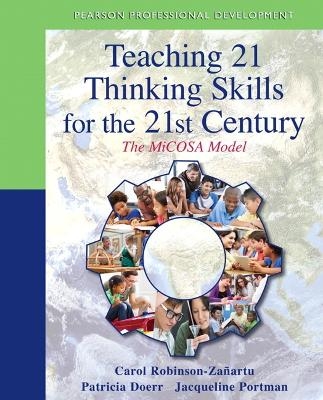
Teaching 21 Thinking Skills for the 21st Century
Pearson
978-0-13-269844-3 (ISBN)
- Titel ist leider vergriffen;
keine Neuauflage - Artikel merken
Carol Robinson-Zañartu (Ph.D., University of Pittsburgh) has authored or co-authored over 50 professional publications largely devoted to issues of educational equity. She has written and directed over $11 million in federal grants to prepare graduate students to work with underserved students, especially Native American and bilingual Spanish- speaking youth. She has worked as a teacher, school psychologist, school principal, and university professor. Until recently, she served as chair of the Department of Counseling and School Psychology at San Diego State University. She has trained both teachers and school psychologists to assess for and create interventions in the classroom to help students develop thinking skills while considering their cultural background as well as content standards. Active in multiple professional associations, she currently serves on the Executive Board of the International Association for Cognitive Education and Psychology, and as a lead reviewer for NASP/NCATE. She is a former president of the California Association for Mediated Learning; consulted broadly across school districts and universities, and made close to 100 presentations to state, national, or international professional associations. At the university level, she teaches graduate courses in the dynamic assessment of cognitive skills and in developing classroom interventions to enhance student thinking. Patricia (Trish) Doerr (M.S., California Lutheran University) holds her master’s degree in special education and a Diploma in Education of Handicapped Children (London University). She has taught special and general education from elementary through secondary levels both in England and the United States, and was a university lecturer in reading. She has served as a district mentor in both special education and language arts, a county teacher-on-leave specialist in language arts, curriculum, and assessment; served as an educational therapist in private practice; and written numerous manuals in the area of language arts. She received the Amgen Award for Teacher Excellence. She has been a trainer for the California Reading and Literature Projects RESULTS and A Focused Approach to Frontloading EL Instruction; a presenter for and fellow of the South Coast Writing Project; a district level Trainer of Trainers for writing across the grade levels; and a consultant to the MindLadder Project. She was a member of the Board of the California Association for Mediated Learning, has studied a variety of models of thinking skill development, and has made numerous professional presentations on their usefulness in the classroom for professional associations, schools, and universities. Jacqueline (Jackie) Portman (BA Spanish, Nazareth College of Rochester) is a former National Board Certified bilingual teacher, and holds teaching credentials in multiple subjects with a bilingual emphasis in Spanish (San Diego State University). She has taught elementary grades 1–6, ELD/bilingual, and been a university lecturer in the mediation of thinking in the classroom. She has served as a district elementary curriculum specialist, providing district-wide staff development and coaching. She was a mentor teacher for international children’s literature in Spanish; initiated a Spanish as a Second Language Program; co-authored district writing curricula in English and Spanish; revised and translated district math curriculum; and presented bilingual workshops in language arts. She served as a consultant to the MindLadder Project, and as a member of the Board of the California Association for Mediated Learning. Over the past 15 years, she has made presentations on classroom and parent applications of cognitive education programs to state and national conferences and school districts. She currently teaches fifth grade and works at the district level to help integrate technology and assessment into the Common Core Standards. For the last decade, her classroom has become a practical laboratory for graduate students at San Diego State University to practice and apply their knowledge of the thinking skills.
&>
PART I: CONTEXTUAL AND CONCEPTUAL FRAMEWORKS
CHAPTER 1. THE MiCOSA MODEL and ITS 21ST CENTURY CONTEXTS
21st Century Contexts
Introducing the MiCOSA Model
Core Components of the MiCOSA Model
PART II: CRITICAL COMPONENTS OF THE MiCOSA MODEL
CHAPTER 2. PRIOR KNOWLEDGE and CULTURAL GROUNDING
The Power of Personal Narrative
Activating and Using Prior Knowledge and Cultural Grounding
Motivation, Mediation, and Meaning in Diverse Classrooms
Supporting the Development of Your Own Story
CHAPTER 3. MEDIATING CONVERSATIONS for ENHANCED THINKING
Intent and Reciprocity
Mediating Meaning
Bridging Thinking
Guiding Self-Regulation
Building Competence
CHAPTER 4. THINKING SKILLS for GATHERING INFORMATION
Systematic Search
Focus and Attention
Labels, Words, and Concepts
Multiple Sources
Position in Space
Position in Time
Precision and Accuracy
CHAPTER 5. THINKING SKILLS for TRANSFORMING INFORMATION
Goal Setting
Planning
Comparing
Ordering, Grouping, and Categorizing
Finding Connections and Relationships
Visualizing
Inferring
Cause and Effect -- Hypothesizing
Summarizing
CHAPTER 6. THINKING SKILLS for COMMUNICATING INFORMATION
Labels, Words, and Concepts
Precision and Accuracy
Appropriate Pragmatics
Feedback for Self-Regulation
Collaboration
PART III: IMPLEMENTING MiCOSA
CHAPTER 7. CONTENT, CURRICULUM, and STANDARDS: FINDING the THINKING SKILLS and WRITING OBJECTIVES
Locating Explicit Thinking Skills
Locating Implicit Thinking Skills
Thinking Skills Underlying Common Terms in Standards
Finding Patterns in Standards
From Standards to Thinking Skills and Content Objectives
CHAPTER 8. TEACHING for TRANSFER: GETTING to the BIG IDEAS
Differentiating Near and Far Transfer of Learning
Understanding and Using Big Ideas
Teaching for Transfer with MiCosa
CHAPTER 9 THE POWER of ASSESSMENT
What Assessments Inform Student Understanding?
Supporting Student Involvement in Assessment
Using Feedback in Formative Assessment
A Synthesis of the Assessment Components
CHAPTER 10 LESSON PLANNING: PULLING IT ALL TOGETHER
MiCOSA'S Teacher's Guide to Planning Instruction
MiCOSA Lesson Planning Formats
Self-Evaluation
PART IV: MOTIVATING TOMORROW'S LEARNING
CHAPTER 11 ENGAGING EXPECTATIONS and PROMOTING RESILIENCE
Teacher Expectations and Student Resilience
Raising Student Self-Expectations
Expectations of Parents: Re-Thinking Parent Involvement
APPENDIX A LIST OF STRATEGIES THAT SUPPORT the MiCOSA MODEL
APPENDIX B MiCOSA STUDENT THINKING SKILLS SURVEY
APPENDIX C STUDENT THINKING SKILLS ORGANIZER
APPENDIX D PARENT/TEACHER THINKING SKILLS INTERVIEW/QUESTIONNAIRE
| Erscheint lt. Verlag | 10.3.2014 |
|---|---|
| Sprache | englisch |
| Maße | 100 x 100 mm |
| Gewicht | 100 g |
| Themenwelt | Schulbuch / Wörterbuch |
| Geisteswissenschaften ► Psychologie ► Pädagogische Psychologie | |
| Geisteswissenschaften ► Sprach- / Literaturwissenschaft ► Anglistik / Amerikanistik | |
| Sozialwissenschaften ► Pädagogik ► Berufspädagogik | |
| ISBN-10 | 0-13-269844-7 / 0132698447 |
| ISBN-13 | 978-0-13-269844-3 / 9780132698443 |
| Zustand | Neuware |
| Informationen gemäß Produktsicherheitsverordnung (GPSR) | |
| Haben Sie eine Frage zum Produkt? |
aus dem Bereich