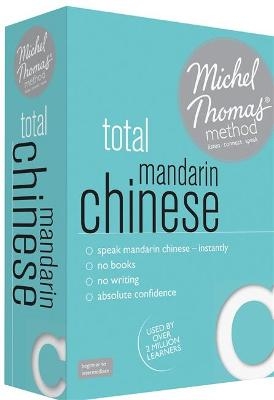
Total Mandarin Chinese Foundation Course: Learn Mandarin Chinese with the Michel Thomas Method
John Murray Learning (Verlag)
978-1-4441-3803-0 (ISBN)
- Titel erscheint in neuer Auflage
- Artikel merken
Looking for a convenient language course that fits your lifestyle and gets you speaking a new language in a matter of hours? The acclaimed audio-led Michel Thomas Method Total Mandarin Chinese course, endorsed by celebrities, executives and learners worldwide, will deliver the results you want.
How does it work?
During the course, you will join Michel Thomas Method teacher Harold Goodman and two students in a live lesson, learning from both their successes and their mistakes to keep you motivated and involved throughout the course. The revolutionary method for learning Mandarin tones used in this course links movement and colours and will enable you to effortlessly recall tones at the proper moment in your communication. Tested and refined on students without any previous knowledge of Mandarin, it is specifically designed to address all styles of language learning (visual, kinaesthetic, auditory, etc.). You learn through your own language, so there's no stress, and no anxiety. You'll stick with it because you'll love it.
Why is the method so successful?
The Michel Thomas Method was perfected over 50 years by celebrated psychologist and linguist Michel Thomas. This unique method works with your brain and draws on the principles of instructional psychology. Knowledge is structured and organised so that you assimilate the language easily and don't forget it. The method breaks down the language into building blocks that are introduced sequentially in such a way that you create your response and move on to ever-more-complex sentences. There is no need to stop for homework, additional exercises or vocabulary memorization, so you progress rapidly.
What's in the Course?
Total Mandarin Chinese with the Michel Thomas Method includes up to 8 hours of audio on CD and an interactive CD-ROM for practice and review.
*Note that the content is the same as the previously entitled Foundation course
Learn anywhere
Don't be tied to chunky books or your computer, Michel Thomas Method audio courses let you learn whenever you want: at home, in your car, or on the move with your MP3 player.
Where do I go next?
Perfect Mandarin Chinese follows on from the Total course with 6 hours of audio.
Dr Harold Goodman is a physician and surgeon, who had Michel Thomas as his teacher for nearly ten years. During this time Michel Thomas's goal was not to teach Dr Goodman a specific language (though he did instruct him in two of the languages he taught) but to train him to understand his method of teaching - which he then used to teach others, with great success. Dr Goodman teaches and practises in the United States. Michel Thomas (1914-2005) had an amazing life. Born in Poland, he spent his early years in Germany and then in France, where he studied psychology at the Sorbonne in Paris. When war broke out, he fought with the Resistance and suffered imprisonment in labour camps. At the end of the war he joined the US liberation army and later settled in the US where he established his world-famous language school. For more than 50 years he taught languages to the rich and famous and was the world's most sought-after language teacher. After creating several courses of his own, he passed on his method so that other teachers might use it too.
: Introduction. How to use this course. Background to Chinese languages.
: Tones in Mandarin
: The form of the verb in Chinese languages doesn’t change: e.g. shì (`to be’) also means `am, are, is, was, will be’
: wo = `I’ and also `me’: form of pronoun doesn’t change in Mandarin
: There is no word for `a’ or `an’
: ni = `you’
: ta = `he, him, she, her, it’
: Words for nationalities
: Add men to pronouns (`I, me’ etc.) to form plural (more than one): women = `we, us ’ etc.
: ma = question marker, to change a statement into a question’ Goes at the end of the statement.
: ne added to mean `how about ...?’
: Adjectives, such as `busy’, in Mandarin, are also verbs: máng means `to be busy’
: To form a negative, put bù = `no, not’ in front of the verb
: Add hen to fulfil the two-syllable meter rule (also means `very’)
: Greetings ni hao and ni hao ma (`hello’ = `you good’, `how are you’ = `you good (question)’
: In Chinese the character/word has the same form for both individual and plural form
: In front of another falling-tone word, bù (falling tone) becomes bú (rising tone)('trampoline' rule)
: Question with a question word, such as `why?’
: Use zài to emphasize `now, at this very moment’
: Word order in Chinese: who—when—what is happening
: xiang = `would like to’
: néng = `can’
: Add de to pronouns `I’ etc. to form `my, mine’ etc.: wode
: Words for languages
: xiang = `would like to’ in Mandarin can only be followed by a verb
: Word order in Chinese: who–when–how–what is happening
: Demonstrative pronouns `this’ and `that’
: Answering `yes’ and `no’ without repeating the verb in the question: shì = `is’, bù = `not’
: Chinese construction `too...to do’ is `too...no can do’
: Question word `what?’
: How to answer `What is this?’, and `What is that?’
: shuo = `to speak, say’
: huì = `to be able to’
: Question word `who?’
Use of universal `classifier’ gè in `this book’ (zhè ge shu), `that man’ (nà ge rén);: `a, an, one’ (
: yí ge)
: zài (= `at’ etc.) in Chinese can be used as and functions as a verb, so zài jia = `to be at home’
: Question word `where?’
: zhù (zài) = `live, stay’
: Prepositions (`on’ etc.) go after the noun in Mandarin: `[to be] at the table on’
: you = `to have, I have, he has, I had’ etc.
: Negative of `to have’ formed with méi: méi you = `not have’
: yào = `to want’ etc.; bú yào = `not want’
: qu = `go to’
jin tian: = `today’
: you (`to have’ etc.) also = `there is, there are’
: [zài ] zhèr, nàr = `[to be] here, there’
: mei tian = `every day’
: you de = `(there is) some’
: Three ways to say `yes’: repeat the verb; shì ( = `to be’ etc.); duì (= `correct’)
: yào shuo = `want to speak’
: néng shuo = `can speak’
: When to say xiè xie (= `thanks’)
: zài jiàn = `Good bye’ (= `again meet’)
: lái = `come’
| Erscheint lt. Verlag | 26.8.2011 |
|---|---|
| Sprache | englisch |
| Maße | 174 x 234 mm |
| Gewicht | 614 g |
| Themenwelt | Schulbuch / Wörterbuch ► Wörterbuch / Fremdsprachen |
| Geisteswissenschaften ► Sprach- / Literaturwissenschaft ► Sprachwissenschaft | |
| ISBN-10 | 1-4441-3803-0 / 1444138030 |
| ISBN-13 | 978-1-4441-3803-0 / 9781444138030 |
| Zustand | Neuware |
| Informationen gemäß Produktsicherheitsverordnung (GPSR) | |
| Haben Sie eine Frage zum Produkt? |
aus dem Bereich