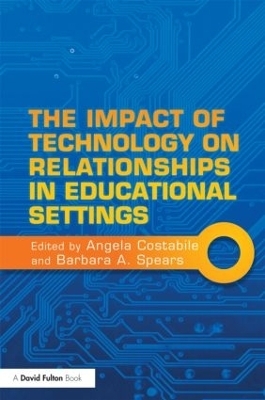
The Impact of Technology on Relationships in Educational Settings
Routledge (Verlag)
978-0-415-61008-7 (ISBN)
The Impact of Technology on Relationships in Educational Settings
sets out to explore the role of ICTs in relationship forming, social networking and social relationships within our schools and has grown out of the European Cooperation in Science and Technology (COST); Action on cyberbullying, involving 28 participating countries, and two non-COST countries, of which Australia is one.This cutting edge international text offers cross-cultural, psychological perspectives on the positive uses of new and emerging technologies to improve social relationships and examples of best practice to prevent virtual bullying. This comes at a time when much of the focus in current writings has been on the more negative aspects which have emerged as new technologies evolved: cyberbullying, cyber-aggression and cybersafety concerns.
This text is ideally suited to researchers and practiitioners in the fields of Educational and developmental psychology, as well as those specialising in educational technology and the sociology of education.
Angela Costabile is Professor of Developmental and Educational Psychology at the University of Calabria in Italy. Her research centres on network relationships between children of school age and revealed behavioural categories. Barbara A. Spears is Senior Lecturer in the School of Education at the University of South Australia. A founder member of the Australian Universities’ Anti-Bullying Research Alliance (AUARA), her research has examined girls, peer relationships, and covert and cyberbullying practices.
Peter K. Smith- Preface
Introduction: Angela Costabile and Barbara Spears
Part 1: Positive uses of ICTs: Background Issues
Positive uses of social networking sites: Youth voice perspectives. Barbara Spears, Jette Kofoed, Maria Giuseppina Bartolo, Anna Lisa Palermiti, Angela Costabile
Secure Net Addresses: Secure internet and responsibility. Haukur Arnþórsson
Media Education: A new academic curriculum. Enrico De Santo, Angela Costabile
Part 2: Positive uses of ICTs: Scholarly Settings
ICT and relationships: Promoting positive peer interactions. Antonella Brighi, Manuela Fabbri. Luigi Guerra, Elena Pacetti
The use of interpersonal communication technologies to establish and maintain peer relationships. Maili Pörhölä, Henna Lahti
Prosocial use of the internet in adolescence. Rosario Del Rey, Virginia Sánchez y Rosario Ortega
Using the internet positively in schools: The case for notebooks. Vera Popper, Dagmar Strohmeier and Christiane Spiel
The Digital Generation Gap Revisited: constructive and dysfunctional patterns of social media usage. Jacek Pyżalski
Kids in the Fast Lane: Achieving well being through online support. Amichai-Hamburger Yair
Online support in psychological and pedagogical practices. Bassam Aouil
Online counselling for enhancing relationships. Kevin Glasheen, Marilyn A. Campbell
Part 3: Positive uses of ICTs: Prevention of cyberbullying:
Peer education intervention: face-to-face versus online. Ersilia Menesini, AnnaLaura Nocentini
Cybermentoring. J. von Kaenel-Flatt and Thaddaeus Douglas
Bullies’ and victims’ experiences of the anti-bullying game from the KiVa- programme. Elisa Poskiparta, Ari Kaukiainen, Virpi Pöyhonen, and Christina Salmivalli, University of Turku, Finland
Fear not: an innovative interdisciplinary virtual intervention to reduce bullying and victimisation. Dieter Wolke and Maria Sapouna for the eCircus team
Using mobile phones to counter cyberbullying: An innovative project. Alison Wotherspoon, Greg Cox, Phillip Slee
A Review of initiatives using technology to promote cybersafety and digital citizenship. Barbara Spears
Conclusions, Angela Costabile, Barbara Spears
| Erscheint lt. Verlag | 2.2.2012 |
|---|---|
| Zusatzinfo | 5 Tables, black and white; 8 Illustrations, black and white |
| Verlagsort | London |
| Sprache | englisch |
| Maße | 156 x 234 mm |
| Gewicht | 385 g |
| Themenwelt | Schulbuch / Wörterbuch ► Unterrichtsvorbereitung ► Unterrichts-Handreichungen |
| Geisteswissenschaften ► Psychologie ► Pädagogische Psychologie | |
| Sozialwissenschaften ► Pädagogik | |
| ISBN-10 | 0-415-61008-7 / 0415610087 |
| ISBN-13 | 978-0-415-61008-7 / 9780415610087 |
| Zustand | Neuware |
| Informationen gemäß Produktsicherheitsverordnung (GPSR) | |
| Haben Sie eine Frage zum Produkt? |
aus dem Bereich