


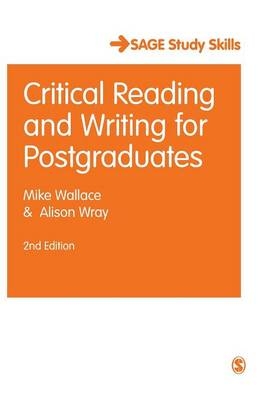
Critical Reading and Writing for Postgraduates
SAGE Publications Ltd (Verlag)
978-1-84920-561-0 (ISBN)
- Titel erscheint in neuer Auflage
- Artikel merken
Lecturers, why waste time waiting for the post to arrive? Request and receive your e-inspection copy today!
′Written in a clear and straightforward fashion that is guaranteed to make you think, as well as encouraging constructive and engaging modes of writing that will improve your connection to your audience.′ - Professor Graham Crow, University of Southampton
How do you respond to adverts? Do you believe what they say, or look for a hidden agenda?
Reading critically, and writing using critical techniques, are crucial skills you need to apply to your academic work. It may seem difficult at first, but you may already be a more critical reader than you think!
This guide helps you develop both the ability to critically ask questions, and a reflective and critical approach to your own research and writing. Broken down into three parts, it builds up your skills and confidence through focused activities that progressively develop your ability to critically read and write.
New to this 2nd edition:
A range of subject specific examples from areas including linguistics, education, business and management
Commentaries on using e-resources and features of e-research
New online resources including worksheet templates, chapter activities and free access to journal articles.
Look at the RESOURCES TAB to view and download the additional materials.
SAGE Study Skills are essential study guides for students of all levels. From how to write great essays and succeeding at university, to writing your undergraduate dissertation and doing postgraduate research, SAGE Study Skills help you get the best from your time at university. Visit the SAGE Study Skills website for tips, quizzes and videos on study success!
Mike Wallace is a Professor of Public Management at Cardiff Business School, Cardiff University. From 2009 to 2012 he was the Economic and Social Research Council’s Strategic Adviser for Researcher Development. His research on managing change in the public services is reported in many books and academic journals. He is co-author, with Eric Hoyle, of the book Educational Leadership: Ambiguity, Professionals, and Managerialism (Sage, 2005), lead editor, with Michael Fertig and Eugene Schneller, of the book Managing Change in the Public Services (Blackwell, 2007), and lead co-author, with Michael Reed, Dermot O′Reilly, Jonathan Morris, Michael Tomlinson and Rosemary Deem, of the book Developing Public Service Leaders: Elite Orchestration, Change Agency, Leaderism, and Neoliberalization (Oxford University Press, 2023). His contribution to teaching at Cardiff centres on the design of postgraduate research programmes incorporating research methods training. Alison Wray is Emerita Research Professor of Language and Communication at Cardiff University. One of her main research areas is lexical storage and processing, particularly formulaic expressions, applied to language learning, evolution of language and language disability. She has also extensively researched communication in the context of dementia. Her major monographs, Formulaic Language and the Lexicon (Cambridge University Press, 2002), Formulaic Language: Pushing the Boundaries (Oxford University Press, 2008), and The Dynamics of Dementia Communication (Oxford University Press, 2020), are internationally acclaimed and award-winning. She has also written the scripts for three animated films used for training dementia carers. She has a longstanding commitment to researcher training and the development of academic expertise and is lead author of the popular undergraduate textbook Projects in Linguistics and Language Studies (Hodder, 2012).
PART ONE: BECOMING A CRITICAL READER AND SELF-CRITICAL WRITER
What It Means to Be Critical
Making a Critical Choice
Getting Started on Critical Reading
Getting Started on Self-Critical Writing
Creating a Comparative Critical Summary
PART TWO: DEVELOPING AN IN-DEPTH ANALYSIS
The Key to a Mental Map for Exploring the Literature
The Argument Component of Your Mental Map
More Components: Knowledge, Literature, Intellectual Projects
Developing a Critical Analysis of a Text
A Worked Example of a Critical Analysis
Developing Your Argument in Writing a Critical Review of a Text
PART THREE: PUTTING YOUR CRITICAL REVIEWS TO WORK
Focusing and Building up your Critical Literature Review
Integrating Critical Literature Reviews into Your Dissertation
Tools for Structuring a Dissertation
Using the Literature in Research Papers and Oral Presentations
Appendices
Abridged article: ′One word or two?′
Abridged article: ′Sharing leadership of schools through teamwork′
Blank form for the Critical Analysis of a text
Logic Checklist: developing a logical overall argument in a dissertation
| Erscheint lt. Verlag | 13.1.2011 |
|---|---|
| Reihe/Serie | Sage Study Skills Series |
| Verlagsort | London |
| Sprache | englisch |
| Maße | 170 x 242 mm |
| Gewicht | 600 g |
| Themenwelt | Schulbuch / Wörterbuch ► Wörterbuch / Fremdsprachen |
| Geisteswissenschaften ► Sprach- / Literaturwissenschaft ► Sprachwissenschaft | |
| ISBN-10 | 1-84920-561-2 / 1849205612 |
| ISBN-13 | 978-1-84920-561-0 / 9781849205610 |
| Zustand | Neuware |
| Informationen gemäß Produktsicherheitsverordnung (GPSR) | |
| Haben Sie eine Frage zum Produkt? |
aus dem Bereich


