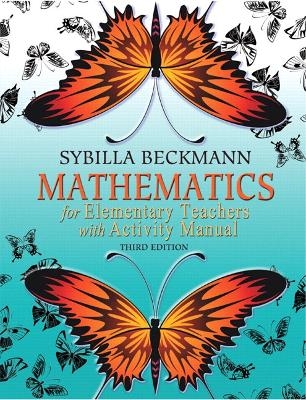
Mathematics for Elementary Teachers with Activity Manual
Pearson
978-0-321-65427-4 (ISBN)
- Titel erscheint in neuer Auflage
- Artikel merken
Sybilla Beckmann earned her undergraduate degree in mathematics from Brown University and a PhD in mathematics from the University of Pennsylvania. She taught and did research in mathematics at Yale University for two years. Since then, she has been at the University of Georgia. When she had children, she became very interested in helping prospective teachers understand and appreciate the mathematics they will teach. This interest led to her book. In her spare time, she enjoys playing the piano, weaving, attending classical music concerts, and traveling with her family.
Chapter 1: Numbers and the Decimal System
1.1 The Counting Numbers
1.2 Decimals and Negative Numbers
1.3 Comparing Numbers in the Decimal System
1.4 Rounding Numbers
Chapter 2: Fractions
2.1 The Meaning of Fractions
2.2 Interlude: Solving Problems and Explaining Solutions
2.3 Fractions as Numbers
2.4 Fractions as numbers
2.4 Equivalent Fractions
2.5 Comparing Fractions
2.6 Percent
Chapter 3: Addition and Subtraction
3.1 Interpretations of Addition and Subtraction
3.2 The Commutative and Associative Properties of Addition, Mental Math, and Single-Digit Facts
3.3 Why the Common Algorithms for Adding and Subtracting Numbers in the Decimal System Work
3.4 Adding and Subtracting Fractions
3.5 Adding and Subtracting Negative Numbers
Chapter 4:Multiplication
4.1 Interpretations of Multiplication
4.2 Why multiplying Numbers by 10 is Easy in the Decimal System
4.3 The Commutative and Associative Properties of Multiplication
4.4 The Distributive Property
4.5 Properties of Arithmetic, Mental Math, and Single-Digit Multiplication Facts
4.6 Why the Common Algorithm for Multiplying Whole Numbers Works
Chapter 5: Multiplication of Fractions, Decimals, and Negative Numbers
5.1 Multiplying Fractions
5.2 Multiplying decimals
5.3 Multiplying Negative numbers
5.4 Powers and Scientific Notation
Chapter 6: Division
6.1 Interpretations of Division
6.2 Division and Fractions and Division with Remainder
6.3 Why the Common Long Division Algorithm Works
6.4 Fraction Division from the “How Many Groups?” Perspective
6.5 Fraction Division from the “How Many in One Group?” Perspective
6.6 Dividing Decimals
Chapter 7: Combining Multiplication and Division: Proportional Reasoning
7.1 The Meanings of Ratio, Rate, and Proportion
7.2 Solving Proportion Problems by Reasoning with Multiplication and Division
7.3 Connecting Ratios and Fractions
7.4 When You Can Use a Proportion and When You Cannot
7.5 Percent Revisited: Percent Increase and Decrease
Chapter 8: Number Theory
8.1 Factors and Multipliers
8.2 Greatest Common Factor and Least Common Multiple
8.3 Prime Numbers
8.4 Even and Odd
8.5 Divisibility Tests
8.6 Rational and Irrational Numbers
8.7 Looking Back at the Number Systems
Chapter 9:Algebra
9.1 Mathematical Expressions and Formulas
9.2 Equations
9.3 Solving Equations
9.4 Solving Algebra Story Problems with Strip Diagrams and with Algebra
9.5 Sequences
9.6 Series
9.7 Functions
9.8 Linear Functions
Chapter 10: Geometry
10.1 Visualization
10.2 Angles
10.3 Angles and Phenomena in the World
10.4 Circles and Spheres
10.5 Triangles, Quadrilaterals, and Other Polygons
10.6 Constructions with Straightedge and Compass
Chapter 11: Measurement
11.1 Fundamentals of Measurement
11.2 Length, Area, Volume, and Dimension
11.3 Error and Precision in Measurements
11.4 Converting from One unit of Measurement to Another
Chapter 12: Area of Shapes
12.1 Areas of Rectangles Revisited
12.2 Moving and Additivity Principles about Area
12.3 Areas of Triangles
12.4 Areas of Parallelograms and Other Polygons
12.5 Cavalieri’s Principle about Shearing and Area
12.6 Areas of Circles and the Number Pi
12.7 Approximating Areas of Irregular Shapes
12.8 Contrasting and Relating the Perimeter and Area of Shape
12.9 Using moving and Additivity Principles to Prove the Pythagorean Theorem
Chapter 13: Solid Shapes and Their Volume and Surface Area
13.1 Polyhedra and Other Solid Shapes
13.2 Patterns and Surface Area
13.3 Volumes of Solid Shapes
13.4 Volume of Submersed Objects versus Weight of Floating Objects
Chapter 14: Geometry of Motion and Change
14.1 Reflections, Translations, and Rotations
14.2 Symmetry
14.3 Congruence
14.4 Similarity
14.5 Areas, Volumes, and Scaling
Chapter 15:Statistics
15.1 Formulating Questions, Designing Investigations, and Gathering Data
15.2 Displaying Data and Interpreting Data Displays
15.3 The Center of Data: Mean, Median, and Mode
15.4 The Distribution of Data
Chapter 16: Probability
16.1 Basic Principles of Probability
16.2 Counting the Number of Outcomes
16.3 Calculating Probabilities in Multi-Stage Experiments
16.4 Using Fraction Arithmetic to Calculate Probabilities
| Erscheint lt. Verlag | 12.4.2010 |
|---|---|
| Sprache | englisch |
| Maße | 216 x 276 mm |
| Gewicht | 2880 g |
| Themenwelt | Schulbuch / Wörterbuch |
| Mathematik / Informatik ► Mathematik | |
| Sozialwissenschaften ► Pädagogik ► Schulpädagogik / Grundschule | |
| ISBN-10 | 0-321-65427-7 / 0321654277 |
| ISBN-13 | 978-0-321-65427-4 / 9780321654274 |
| Zustand | Neuware |
| Informationen gemäß Produktsicherheitsverordnung (GPSR) | |
| Haben Sie eine Frage zum Produkt? |
aus dem Bereich