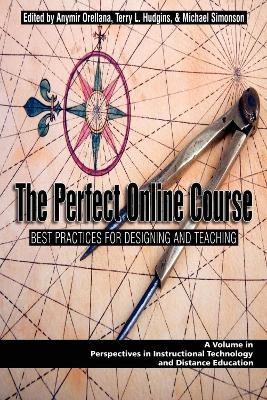
The Perfect Online Course
Information Age Publishing (Verlag)
978-1-60752-121-1 (ISBN)
- Titel z.Zt. nicht lieferbar
- Versandkostenfrei
- Auch auf Rechnung
- Artikel merken
The Perfect Online Course: Best Practices for Designing and Teaching was edited under the assumption that a perfect online course can be delivered following different instructional methods and models for design and for instruction, and by implementing different teaching or instructional strategies. Such methods, models, and strategies are framed within quality educational guidelines and must be aimed towards attaining the online course’s learning goals.
The book seeks to make a contribution to the existing body of literature related to best practices and guidelines for designing and teaching distance courses, specifically online education. The process of selecting works suitable for this compilation included an extensive review of the journals Quarterly eview of Distance Education and Distance Learning. The book begins by covering literature related to general approaches and guidelines, continues with proposed methods and models for designing and instruction, and ends with instructional strategies to achieve engagement through interaction. The book is divided into four independent, yet interrelated, parts and a concluding section: Part I: Introduction; Part II: Best Guidelines and Standards; Part III: Best Instructional Methods and Models; Part IV: Best Engagement Strategies; and the concluding section, And Finally…, with words from Simonson who delineates the structure of a perfect online course.
Preface: In Search of Perfection; Anymir Orellana and Terry L. Hudgins.
Part I. Introduction.
Chapter 1. We Need a Plan: An Instructional Design Approach for Distance Education Course; Michael Simonson and Charles Schlosser.
Chapter 2. Does it Matter? Analyzing the Results of Three Different Learning Delivery Methods; William N. Chernish, Agnes L. DeFranco, James R. Lindner, and Kim E. Dooley.
Part II. Best Guidelines and Standards.
Chapter 3. In Search of Quality: An Analysis of e-Learning Guidelines and Specifications; Atsusi Hirumi.
Chapter 4. Learning Online: Adapting the Seven Principles of Good Practice to a Web-Based Instructional Environment; Christine K. Sorensen and Danilo M. Baylen.
Chapter 5. Instructors' Self-Perceived Pedagogical Principle Implementation in the Online Environment; Jinsong Zhang and Richard T. Walls.
Chapter 6. Key Instructional Design Elements for Distance Education; Lihua Zheng and Sharon Smaldino.
Chapter 7. Class Size and Interaction in Online Courses; Anymir Orellana.
Chapter 8. What Works: Student Perceptions of Effective Elements in Online Learning; Marcy Reisetter and Greg Boris.
Chapter 9. Design and Implementation of a Web-Based Learning Environment: Lessons Learned; Alaa Sadik and Sorel Reisman.
Chapter 10. A Framework for Analyzing, Designing, and Sequencing Planned e-Learning Interactions; Atsusi Hirumi.
Chapter 11. Designing Effective e-Learning: Guidelines for Practitioners; Angelene C. McLaren.
Part III. Best Instructional Methods and Models.
Chapter 12. An Analysis of Team vs. Faculty-Based Online Course Development: Implications for Instructional Design; Mark Hawkes and Dan O. Coldeway.
Chapter 13. Getting it Right Gradually: An Iterative Method for Online Instruction Development; Douglas A. Kranch.
Chapter 14. Towards a Person-Centered Model of Instruction: Can an Emphasis on the Personal Enhance Instruction in Cyberspace? Christopher Miller and Joan M. Mazur.
Chapter 15. Enhancing Web-Based Instruction Using a Person-Centered Model of Instruction; Christopher T. Miller.
Chapter 16. Evaluating College Students' Efforts in Asynchronous Discussion: A Systematic Process; Dave S. Knowlton.
Chapter 17. Pragmatic Methods to Reduce Dishonesty in Web-Based Course; Newell Chiesl.
Chapter 18. Organizing Instructional Content for Web-Based Courses: Does a Single Model Exist? Joi L. Moore, Richard E. Downing, and David L. York.
Chapter 19. An Instructional Design Approach for Effective Shovelware: Modifying Material for Distance Education; Gary R. Morrison and Gary J. Anglin.
Chapter 20. Investigating the Use of Advance Organizers as an Instructional Strategy for Web-Based Distance Education; Baiyun Chen, Atsusi Hirumi, and Ning Jackie Zhang.
Chapter 21. Streamlining the Online Course Development Process by Using Project Management Tools; M'hammed Abdous and Wu He.
Chapter 22. The Learning Contract Process: Scaffolds for Building Social, Self-Directed Learning; Naomi R. Boyer.
Part IV. Best Engagement Strategies.
Chapter 23. Interaction in Online Learning Environments: A Review of the Literature; Constance E. Wanstreet.
Chapter 24. Interaction Online: A Reevaluation; John Battalio.
Chapter 25. Online Learner's Preferences for Interaction; Pamela T. Northrup.
Chapter 26. Learner Support Needs in Online Problem-Based Learning; Steve Wheeler.
Chapter 27. Deep Learning: The Knowledge, Methods, and Cognition Process in Instructor-Led Online Discussion; Byron Havard, Jianxia Du, and Anthony Olinzock.
Chapter 28. It's the Same Only Different: The Effect the Discussion Moderator Has on Student Participation in Online Class Discussions; Vance A. Durrington and Chien Yu.
Chapter 29. Does Sense of Community Matter? An Examination of Participants' Perception of Building Learning Communities in Online Courses; Xiaonjing Liu, Richard J. Magjuka, Curtis J. Bonk, and Seung-hee Lee.
Conclusion
Chapter 30. And Finally... Designing the Perfect Online Course; Michael Simonson.
About the Authors.
| Erscheint lt. Verlag | 30.10.2009 |
|---|---|
| Reihe/Serie | Perspectives in Instructional Technology and Distance Education |
| Mitarbeit |
Herausgeber (Serie): Charles Schlosser |
| Sprache | englisch |
| Maße | 156 x 234 mm |
| Gewicht | 979 g |
| Themenwelt | Schulbuch / Wörterbuch ► Unterrichtsvorbereitung ► Unterrichts-Handreichungen |
| Sozialwissenschaften ► Pädagogik | |
| ISBN-10 | 1-60752-121-0 / 1607521210 |
| ISBN-13 | 978-1-60752-121-1 / 9781607521211 |
| Zustand | Neuware |
| Informationen gemäß Produktsicherheitsverordnung (GPSR) | |
| Haben Sie eine Frage zum Produkt? |
aus dem Bereich