World History in Brief
Pearson (Verlag)
978-0-205-70974-8 (ISBN)
- Titel erscheint in neuer Auflage
- Artikel merken
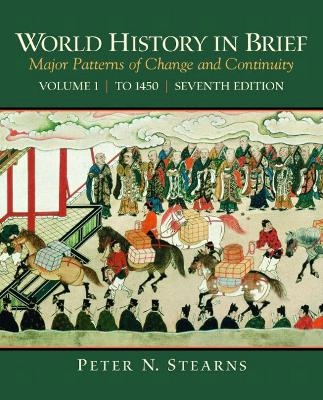
Rather than overwhelm students with minutia, the primary goal of World History in Brief is to present the big picture by highlighting the major developments in world history. The text emphasizes the global interactions among major civilizations, enabling students to compare and assess changes in the patterns of interaction and the impact of global forces, such as migration and technological exchange. The compact size of this text allows instructors to take advantage of supplementary readings in their courses.
Peter N. Stearns is Provost and Professor of History at George Mason University. He has taught previously at Harvard, the University of Chicago, Rutgers, and Carnegie Mellon; he was educated at Harvard University. He has published widely in modern social history, including the history of emotions, and in world history. Representative works in world history include World History: A Survey, The Industrial Revolution in World History, Gender in World History, Consumerism in World History, and Growing Up: The History of Childhood in Global Context. His publications in social history include Old Age in Preindustrial Society, Anxious Parents: A History of Modern American Childrearing, American Cool: Developing the Twentieth-Century Emotional Style, Fat History: Bodies and Beauty in Western Society, American Fear: The Causes and Consequences of High Anxiety, Revolutions in Sorrow: A History of American Experiences and Policies Toward Death in Global Context, From Alienation to Addiction: Modern American Work in Global Historical Perspective, and Educating Global Citizens in Colleges and Universities: Challenges and Opportunities. While under Dr. Stearns’s leadership, George Mason University was awarded the 2006 Andrew Heiskell Award for Innovation in International Education. He has also edited encyclopedias of world and social history, and since 1967 has served as editor-in-chief of The Journal of Social History. In most of his research and writing, Dr. Stearns pursues three main goals. As a social historian he is eager to explore aspects of the human experience that are not generally thought of in historical terms, and with attention to ordinary people as well as elites. Second, he seeks to use an understanding of historical change and continuity to explore patterns of behavior and social issues. Finally he is concerned with connecting new historical research with wider audiences, including of course classrooms. Dr. Stearns is also eager to promote comparative analysis and the assessment of modern global forces—for their own sake and as they illuminate the American experience and impact.
Part I Early World History: From Origins to Agriculture and New Forms of Human Organization
Chapter 1 From Human Prehistory to the Rise of Agriculture
Getting Started Is Always Hard
Human Development and Change
Solving Problems: Dealing with Death
The Neolithic Revolution
History Debate: People in the Americas
The Nature of Agricultural Societies
Agriculture and Change
Paths to the Present
Chapter 2 Early Civilizations 3500 – 1000 B.C.E.
Civilization
Solving Problems The Use of Culture
Egypt and Mesopotamia Compared
History Debate:Women in Patriarchal Societies
Transitions: The End of the River Valley Period
The Heritage of the River Valley Civilizations
New States and Peoples Around 1000 B.C.E.
Paths to the Present
Chapter 3 Nomadic Societies
Early Nomadic Societies
Nomadic Society and Culture
Nomads and Civilizations
History Debate: The Contributions of Nomads
Nomads and Global Patterns
Paths to the Present
Part I Retrospective The Rise of Agriculture and Agricultural Civilizations
Part II The Classical Period, 1000 B.C.E.– 500 C.E.
Chapter 4 Classical Civilization: China
Patterns in Classical China
Political Institutions
History Debate:War
Religion and Culture
World Profiles: Confucius, or Kong Fuzi (c. 551–479 B.C.E.)
Economy and Society
World Profiles: Ban Zhao (c. 48–117 C.E.)
How Chinese Civilization Fit Together
Paths to the Present
Chapter 5 Classical Civilization: India
The Framework for Indian History: Geography and a Formative Period
Patterns in Classical India
Political Institutions
History Debate: Interpreting Civilization, Round Two
Religion and Culture
Economy and Society
Solving Problems: Dealing with Inequality
Indian Influence
China and India
Paths to the Present
Chapter 6 Classical Civilization in the Mediterranean and Middle East: Persia, Greece, and Rome
The Persian Tradition
Patterns of Greek and Roman History
Greek and Roman Political Institutions
World Profiles:Julius Caesar (100–44 B.C.E.)
Solving Problems: Cultural Encounters
Religion and Culture
Economy and Society in the Mediterranean
History Debate: Mediterranean Civilization and “Western” Civilization
Toward the Fall of Rome
Paths to the Present
Chapter 7 The Classical Period: Directions, Diversities, and Declines by 500 C.E.
Decline in China and India
Decline and Fall in Rome
The New Religious Map
History Debate: What Caused Decline and Fall?
World Profiles:Saint Paul (Paul of Tarsus)
The World Around 500 C.E.
Paths to the Present
Part II Retrospective The Classical Period, 1000 B.C.E.–500 C.E.
Part III The Postclassical Period, 500–1450 C.E.
Chapter 8 The Rise of Islam: Civilization in the Middle East
The Advent of Islam
World Profiles: Muhammad (570–632 C.E.)
Patterns of Islamic History
Islamic Political Institutions
History Debate: Political Implications of Islam
Islam and Middle Eastern Culture
World Profiles Omar Khayyam (c. 11th–12th Centuries)
Solving Problems: Religion and Trade
Economy and Society in the Middle East
The Decline of Middle Eastern Civilization
Paths to the Present
Chapter 9 Indiaand Southeast Asia Under the Impact of Islam
The Development of Indian Culture
History Debate: The Caste System
The Muslim Challenge in India
Southeast Asia
Paths to the Present
Chapter 10 Africaand Islam
Sub-Saharan Africa and the World Network
Solving Problems: Technology and Trade
The Great Kingdoms
World Profiles: Sundiata
History Debate: Handles for African History
Features of African Civilization
Paths to the Present
Chapter 11 East European Civilization: Byzantium and Russia
The Byzantine Phase
World Profiles:The Emperor Justinian (527–565 C.E.)
The Early Russian Phase: Kievan Rus’
History Debate: A Russian Civilization?
East European Political Institutions
East European Religion and Culture
East European Economy and Society
East European Civilization in Eclipse
Paths to the Present
Chapter 12 Western Civilization: The Middle Ages
Early Patterns in Western Civilization
Medieval Political Institutions
History Debate: Homosexuality and Religion
Medieval Religion and Culture
Economy and Society
Solving Problems: Population Growth
Women and Family Life
Tensions in the Later Middle Ages
Paths to the Present
Chapter 13 China’s Impact and the Spread of East Asian Civilization
Political and Cultural Developments in China
World Profiles:Taizong (626–649 C.E.)
Economy and Society in China
Civilization in Korea, Vietnam, and Japan
History Debate:East Asian Civilization?
Culture, Society, and Economy in Japan
World Profiles:Mugai Nyodai
East Asian Self-Confidence
Paths to the Present
Chapter 14 Centers of Civilization in the Americas
The Mayas and Aztecs
History Debate:What Happened to the Mayas?
The Issue of Isolation
Paths to the Present
Chapter 15 The Mongol Interlude and the End of the Postclassical Period
Mongol Empires
World Profiles: Chabi Khan
China and the West as New World Powers
History Debate: Causes of Global Change by 1450
The End of Transition: Postclassical to Early Modern
Paths to the Present
Part III Retrospective The Postclassical Period, 500–1450 C.E.
| Erscheint lt. Verlag | 25.8.2010 |
|---|---|
| Sprache | englisch |
| Maße | 187 x 232 mm |
| Gewicht | 417 g |
| Themenwelt | Schulbuch / Wörterbuch |
| Geschichte ► Allgemeine Geschichte ► Mittelalter | |
| ISBN-10 | 0-205-70974-5 / 0205709745 |
| ISBN-13 | 978-0-205-70974-8 / 9780205709748 |
| Zustand | Neuware |
| Informationen gemäß Produktsicherheitsverordnung (GPSR) | |
| Haben Sie eine Frage zum Produkt? |
aus dem Bereich