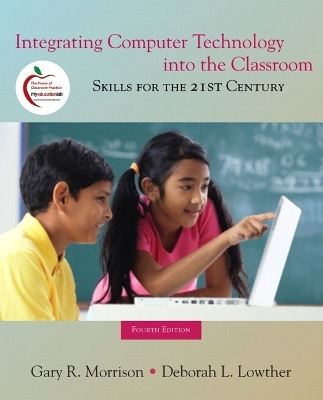
Integrating Computer Technology into the Classroom
Pearson
978-0-13-610134-5 (ISBN)
- Titel ist leider vergriffen;
keine Neuauflage - Artikel merken
Gary R. Morrison received his doctorate in Instructional Systems Technology from Indiana University. Since then, he has worked as instructional designer at the University of Mid-America, Solar Turbines International, General Electric Company's Corporate Consulting Group, and Tenneco Oil Company. As a professor at the University of Memphis, he taught courses in instructional design and served as a faculty associate in the Center of Academic Excellence. Presently, he is a professor in the Instructional Design and Technology Program at Old Dominion University, where he teaches courses in instructional design and distance learning. His credits include print projects, multimedia projects, and more than 30 hours of instructional video programs, including a rive-part series that was aired nationally on PBS-affiliated stations. Dr. Morrison has written more than 100 papers on topics related to instructional design and computer-based instruction and has contributed to several books and instructional software packages. He is co-author of Designing Effective Instruction with Steven M. Ross and Jerold E. Kemp. He is the associate editor of the research section of Educational Technology Research and Development and past president of AEC:T's Research and Theory Division, and Design and Development Division. Deborah L. Lowther received her Ph.D. in Educational Technology from Arizona State University. Before completing her doctoral work, she was a seventh-grade science teacher. She is currently an associate professor in the Department of Instruction and Curriculum Leadership at the University of Memphis. Her area of concentration is Instructional Design and Technology. She teaches courses primarily focused toward preparing preservice and inservice teachers to integrate computer technology into their curriculum. She also teaches courses that lead to state certification in instructional computing applications. Her research is centered on factors influencing the integration of technology into various learning environments. Over the past 8 years, Dr. Lowther has been very involved with technology integration from the international to the local level. Her involvement includes conference presentations; co-guest editing Technology in the K-12 Schools, a special edition of a national journal; working with multiple grants focused toward technology integration; providing professional development to K-12 schools across the nation. She is currently the Principal Investigator of Professional Development for the Appalachian Technology in Education Consortium.
Chapter 1 Rethinking Computers and Instruction 1
Chapter 2 NTeQ: Designing an Integrated Lesson 26
Chapter 3 Digital Tools in Today’s Classrooms 57
Chapter 4 Computer Software in Today’s Classrooms 91
Chapter 5 Think Sheets: Using Technology
for Higher-Order Learning 122
Chapter 6 Exploring the World Wide Web
in the Classroom 145
Chapter 7 Word Processing 172
Chapter 8 Spreadsheets 203
Chapter 9 Integrating Multimedia as a Tool 233
Chapter 10 Graphic Organizers 256
Chapter 11 Integrating Problem-Solving and
Educational Software 281
Chapter 12 Teacher, Technology, and the Classroom 302
| Erscheint lt. Verlag | 19.11.2010 |
|---|---|
| Sprache | englisch |
| Maße | 191 x 235 mm |
| Gewicht | 544 g |
| Themenwelt | Schulbuch / Wörterbuch ► Unterrichtsvorbereitung ► Unterrichts-Handreichungen |
| Sozialwissenschaften ► Pädagogik ► Berufspädagogik | |
| ISBN-10 | 0-13-610134-8 / 0136101348 |
| ISBN-13 | 978-0-13-610134-5 / 9780136101345 |
| Zustand | Neuware |
| Informationen gemäß Produktsicherheitsverordnung (GPSR) | |
| Haben Sie eine Frage zum Produkt? |
aus dem Bereich