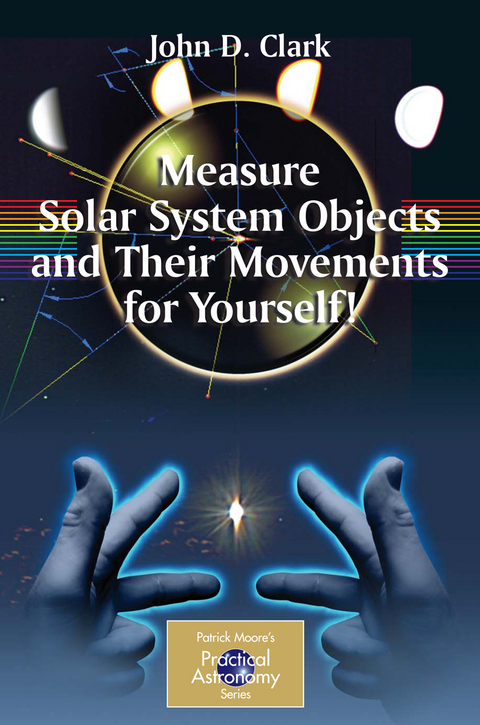
Measure Solar System Objects and Their Movements for Yourself!
Springer-Verlag New York Inc.
978-0-387-89560-4 (ISBN)
A basic knowledge of geometry is required, but it is amazing how simple the geometry can be. Readers are led through the geometry as gently as possible - and in a light-hearted way - presuming that most non-academics will have half-forgotten most of their mathematics.
The practical astronomical equipment recommended is no more than a typical commercially-made amateur telescope and a camera of some sort - these days a webcam works very well. Apart from that all the reader will need is access to a computer, the know-how to download free software, and an enthusiasm to expand his knowledge of the basis of scientific astronomy.
John Clark holds a Bachelor of Science, first class honors, in Physics, from London University, England, and a Ph. D. in Physics from Warwick University, England. He is a Fellow of the Institute of Physics, and spent two years as a post-doctoral researcher at Case Western Reserve University in the USA. Currently he is Managing Director of Fine R and D Limited. He has been an active amateur astronomer for many years.
How Do We Know That Venus Orbits The Sun?.- How Big is the Earth?.- How Far Away and How Big is the Moon?.- Jupiter's Moons: Where You Can Watch Gravity Do Its Thing.- Sunrise, Sunset.- Getting Further from the Sun: How do you Ride an Epicycle?.- Size Matters.
From the reviews:
“This delightful book … is really a breath of fresh air in popular science publishing, taking us back to astronomical basics and starting from the beginning. With the help of very clear diagrams and graphics, the text takes you through fully-worked examples, asking questions about sizes, distances and motions within the Solar System. It then sets about, always with simple, readily available and inexpensive equipment, to show you how to answer those questions for yourself. … Overall, this is a very worthwhile text … .” (John Rowlands, Astronomy Now, January, 2010)
| Reihe/Serie | The Patrick Moore Practical Astronomy Series |
|---|---|
| Zusatzinfo | 80 Illustrations, black and white; XV, 173 p. 80 illus. |
| Verlagsort | New York, NY |
| Sprache | englisch |
| Maße | 155 x 235 mm |
| Themenwelt | Sachbuch/Ratgeber ► Natur / Technik ► Weltraum / Astronomie |
| Naturwissenschaften ► Geowissenschaften | |
| Naturwissenschaften ► Physik / Astronomie ► Astronomie / Astrophysik | |
| ISBN-10 | 0-387-89560-4 / 0387895604 |
| ISBN-13 | 978-0-387-89560-4 / 9780387895604 |
| Zustand | Neuware |
| Informationen gemäß Produktsicherheitsverordnung (GPSR) | |
| Haben Sie eine Frage zum Produkt? |
aus dem Bereich