


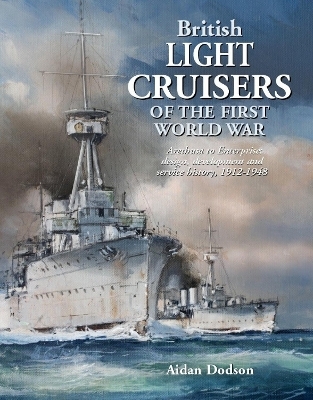
British Light Cruisers of the First World War
Arethusa to Enterprise: design, development and service history, 1912-1948
Seiten
2026
Pen & Sword Books Ltd (Verlag)
978-1-0361-3370-2 (ISBN)
Pen & Sword Books Ltd (Verlag)
978-1-0361-3370-2 (ISBN)
- Noch nicht erschienen (ca. September 2026)
- Versandkostenfrei
- Auch auf Rechnung
- Artikel merken
A wholly new kind of cruiser for the Royal Navy, intended to work with the fleet, was developed in 1912. With its first units completed during 1914–15 as the Arethusa class, the concept was developed during the war years through the ‘C’ and ‘D’ classes, culminating in the ‘E’ class, ordered in 1918, and which would be the fastest and most heavily torpedo-armed cruisers ever built for the Navy. Although intended for North Sea service, during the postwar years the survivors would be deployed all over the world, and play a significant role in every theatre of the Second World War. Today, one of their number, HMS Caroline, still survives, the last British ship left to have fought at Jutland. They were indeed valiant ships.
This new book explains their origins and technical development, their many modifications, and service in war and peace. During the First World War they were in the thick of the battles in the North Sea, before Cardiff had the honour of leading the High Seas Fleet into internment. Service against the Bolsheviks in the Baltic was followed by the routine of the peacetime navy, and then progressive disposals, before growing war clouds halted scrappings and initiated conversions into highly capable anti-aircraft ships.
They were in the thick of the fighting during the first years of the Second World War, while Coventry went on to become the Royal Navy’s top-scoring anti-aircraft ship; but they suffered horrific losses, especially in the Mediterranean. Peace brought the curtain down on three decades of service, and all survivors passed to the shipbreakers during 1946–48, except for Caroline.
The author has drawn both on archival and published material, and the book is extensively illustrated with photographs and drawings, covering all the significant changes in the ships’ appearances and armament during their long careers. It also provides a unique documentation of the guns and mountings fitted in the ships over their lives.
This new book explains their origins and technical development, their many modifications, and service in war and peace. During the First World War they were in the thick of the battles in the North Sea, before Cardiff had the honour of leading the High Seas Fleet into internment. Service against the Bolsheviks in the Baltic was followed by the routine of the peacetime navy, and then progressive disposals, before growing war clouds halted scrappings and initiated conversions into highly capable anti-aircraft ships.
They were in the thick of the fighting during the first years of the Second World War, while Coventry went on to become the Royal Navy’s top-scoring anti-aircraft ship; but they suffered horrific losses, especially in the Mediterranean. Peace brought the curtain down on three decades of service, and all survivors passed to the shipbreakers during 1946–48, except for Caroline.
The author has drawn both on archival and published material, and the book is extensively illustrated with photographs and drawings, covering all the significant changes in the ships’ appearances and armament during their long careers. It also provides a unique documentation of the guns and mountings fitted in the ships over their lives.
AIDAN DODSON has taught at the University of Bristol since 1996, and combines the disparate academic fields of naval history and Egyptology, being honorary Professor of the latter subject. He holds a BA from the University of Liverpool, and an MPhil and a PhD from the University of Cambridge, and was elected a Fellow of the Society of Antiquaries of London in 2003.. He is the author of some thirty books, covering both his academic disciplines, the present volume forming a companion to The British Hawkins class Cruisers, published by Seaforth in 2024.
| Erscheint lt. Verlag | 30.9.2026 |
|---|---|
| Zusatzinfo | 250 mono illustrations |
| Verlagsort | Barnsley |
| Sprache | englisch |
| Maße | 219 x 276 mm |
| Themenwelt | Natur / Technik ► Fahrzeuge / Flugzeuge / Schiffe ► Militärfahrzeuge / -flugzeuge / -schiffe |
| Sozialwissenschaften ► Politik / Verwaltung | |
| ISBN-10 | 1-0361-3370-2 / 1036133702 |
| ISBN-13 | 978-1-0361-3370-2 / 9781036133702 |
| Zustand | Neuware |
| Informationen gemäß Produktsicherheitsverordnung (GPSR) | |
| Haben Sie eine Frage zum Produkt? |
Mehr entdecken
aus dem Bereich
aus dem Bereich
von der frühen Neuzeit bis ins Computerzeitalter
Buch | Hardcover (2025)
De Gruyter (Verlag)
CHF 83,90
rockets, missiles, and drones as instruments of fear and coercion
Buch | Softcover (2025)
Oxford University Press Inc (Verlag)
CHF 34,90


