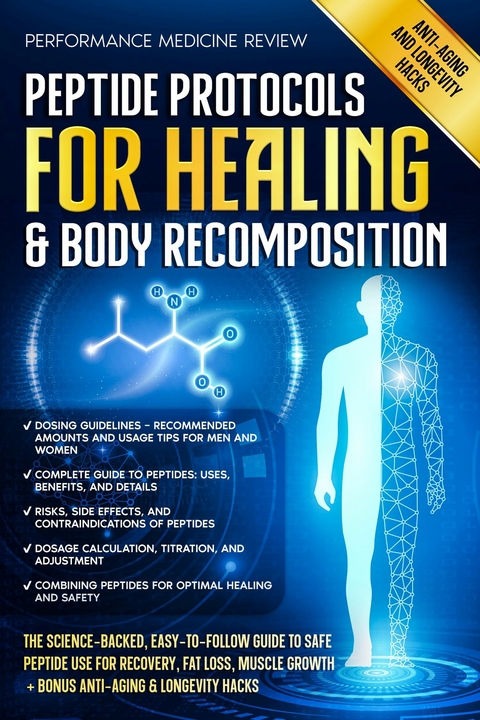
Peptide Protocols for Healing & Body Recomposition (eBook)
203 Seiten
Publishdrive (Verlag)
978-0-00-113584-0 (ISBN)
Heal Faster. Get Stronger. Rebuild Smarter.
Chapter 1: Peptide Protocols for Healing and Recomposition
Tip
For optimal results with peptide protocols, consistency and quality are key. Always source peptides from reputable suppliers to ensure purity and effectiveness. Pair your regimen with a balanced diet rich in protein, healthy fats, and complex carbs, and maintain a regular exercise routine. Consult a healthcare professional before starting any protocol to tailor dosages and monitor for side effects, ensuring your approach is both safe and effective.
Peptides are short chains of amino acids that serve as the fundamental building blocks of proteins and play a crucial role in numerous biological processes. In the context of healing and body recomposition, they have garnered significant attention for their capacity to influence various physiological functions. These small molecules function as signaling agents, instructing cells to perform specific tasks, which renders them highly adaptable for therapeutic applications. Their biological significance stems from their ability to mimic the body's natural processes, thereby PEPTIDE PROTOCOLS FOR HEALING & BODY RECOMPOSITION
enhancing recovery, facilitating fat loss, and promoting muscle growth.
To comprehend the role of peptides in healing and body recomposition, it is essential to first examine their structural composition and functional mechanisms. Peptides consist of two or more amino acids linked by peptide bonds, with the specific sequence and number of amino acids determining each peptide's unique function. Within the human body, these molecules can act as hormones, neurotransmitters, or growth factors, each fulfilling a distinct role in maintaining physiological health and supporting recovery. For instance, insulin is a well-known peptide hormone that regulates glucose metabolism, while endorphins function as neurotransmitters that alleviate pain and elevate mood.
Various categories of peptides are commonly utilized in the fields of healing and body recomposition. Growth hormone-releasing peptides (GHRPs), such as GHRP-2 and GHRP-6, stimulate the secretion of growth hormone, which is vital for muscle development and tissue repair. Collagen peptides represent another widely recognized type, known for their effectiveness in enhancing skin elasticity and facilitating joint recovery through the stimulation of collagen synthesis. Melanotan peptides are employed for their ability to increase melanin production, providing protective effects against ultraviolet radiation. Thymosin beta-4 has demonstrated promise in expediting wound healing and reducing inflammation.
The scientific mechanisms underlying peptide action in the body rely on their capacity to bind to specific receptors on cell PEPTIDE PROTOCOLS FOR HEALING & BODY RECOMPOSITION
membranes. This binding initiates a series of intracellular signaling events that culminate in the desired physiological response. For example, when growth hormone-releasing peptides interact with their respective receptors, they activate the pituitary gland to release growth hormone, which subsequently influences various tissues to promote growth and repair. This precise mechanism of action is what renders them effective in targeted therapeutic interventions.
Peptides can significantly enhance recovery, support fat loss, and stimulate muscle growth through their specific actions. In terms of recovery, BPC-157 and TB-500 have exhibited the ability to accelerate the healing of injuries by promoting cellular regeneration and reducing inflammatory responses. For fat loss, CJC-1295 and Ipamorelin can elevate metabolic rates and enhance lipolysis, the process of breaking down fats. Regarding muscle growth, IGF-1 and Follistatin can promote muscle protein synthesis while inhibiting myostatin, a protein that restricts muscle development.
The effectiveness of these molecules is heavily contingent upon their quality and proper administration. Acquiring high-quality peptides is essential, as contaminants or incorrect formulations can result in ineffective or potentially harmful outcomes. It is imperative to source them from reputable suppliers who adhere to stringent manufacturing standards. Consulting healthcare professionals prior to use is also crucial. They can provide guidance on appropriate dosages, potential interactions with other medications, and monitor for any adverse effects. This approach ensures that peptide use is both safe and effective, tailored to meet individual health needs and goals. A comprehensive understanding of the potential and limitations PEPTIDE PROTOCOLS FOR HEALING & BODY RECOMPOSITION
will empower individuals to make informed choices regarding their health and wellness strategies.
BPC-157, a peptide derived from a specific protein found in gastric juice, has gained recognition for its remarkable healing properties. It effectively promotes the repair of various tissues, including tendons, ligaments, and muscles. This peptide enhances angiogenesis, the formation of new blood vessels essential for delivering nutrients and oxygen to damaged tissues. Additionally, it modulates the production of growth factors and cytokines, which are critical components in the healing process. For optimal therapeutic outcomes, healthcare providers typically administer BPC-157 via subcutaneous or intramuscular injection, with a common dosage range of 200 to 500 micrograms per day. A cycling regimen of four weeks is often recommended, followed by a two-week break to mitigate the risk of receptor desensitization.
TB-500, another peptide recognized for its significant healing capabilities, is a synthetic variant of the naturally occurring protein thymosin beta-4. This compound is noted for its ability to reduce inflammation and promote tissue regeneration. TB-500 achieves these effects by upregulating actin, a protein crucial for cell movement and structural integrity. This upregulation enhances cell migration to the injury site, thereby accelerating the repair process. Healthcare providers commonly administer TB-500 through subcutaneous or intramuscular injection, with dosages typically ranging from 2 to 5 milligrams per week, divided into two or three doses. A typical treatment cycle lasts four to six weeks, depending on the severity of the injury and the individual's response.
PEPTIDE PROTOCOLS FOR HEALING & BODY RECOMPOSITION
Numerous case studies and anecdotal evidence support the efficacy of BPC-157 and TB-500 in expediting recovery from injuries and inflammation. For instance, athletes who have incorporated these peptides into their recovery protocols report substantial improvements in healing times, along with a notable reduction in pain and inflammation. One significant case involved a professional runner suffering from chronic Achilles tendonitis. After a six-week regimen of both peptides, the athlete experienced a considerable decrease in pain and was able to resume training at full capacity. Such accounts underscore the potential of these compounds to enhance recovery and improve overall athletic performance.
Despite their promising benefits, it is essential to recognize the potential side effects and contraindications associated with peptide use. While BPC-157 and TB-500 are generally well-tolerated, some individuals may experience mild side effects, including headaches, dizziness, or gastrointestinal discomfort. Monitoring for any adverse reactions is crucial, and consulting a healthcare professional is advisable if any concerns arise. Individuals with a history of cancer or those undergoing treatment should exercise caution, as the angiogenic properties of these peptides could potentially exacerbate tumor growth.
CJC-1295 is a synthetic peptide that functions as a growth hormone-releasing hormone (GHRH) analog. It is specifically engineered to stimulate the pituitary gland, thereby enhancing the secretion of growth hormone, which is essential for muscle hypertrophy and the reduction of adipose tissue. This peptide is frequently utilized in conjunction with Ipamorelin, a growth hormone-releasing peptide (GHRP), to amplify its effects. The combination of CJC-1295 and Ipamorelin is particularly PEPTIDE PROTOCOLS FOR HEALING & BODY RECOMPOSITION
effective as it ...
| Erscheint lt. Verlag | 29.12.2025 |
|---|---|
| Sprache | englisch |
| Themenwelt | Sachbuch/Ratgeber ► Gesundheit / Leben / Psychologie |
| ISBN-10 | 0-00-113584-8 / 0001135848 |
| ISBN-13 | 978-0-00-113584-0 / 9780001135840 |
| Informationen gemäß Produktsicherheitsverordnung (GPSR) | |
| Haben Sie eine Frage zum Produkt? |
 EPUB (Adobe DRM)
Größe: 1,7 MB
Kopierschutz: Adobe-DRM
Adobe-DRM ist ein Kopierschutz, der das eBook vor Mißbrauch schützen soll. Dabei wird das eBook bereits beim Download auf Ihre persönliche Adobe-ID autorisiert. Lesen können Sie das eBook dann nur auf den Geräten, welche ebenfalls auf Ihre Adobe-ID registriert sind.
Details zum Adobe-DRM
Dateiformat: EPUB (Electronic Publication)
EPUB ist ein offener Standard für eBooks und eignet sich besonders zur Darstellung von Belletristik und Sachbüchern. Der Fließtext wird dynamisch an die Display- und Schriftgröße angepasst. Auch für mobile Lesegeräte ist EPUB daher gut geeignet.
Systemvoraussetzungen:
PC/Mac: Mit einem PC oder Mac können Sie dieses eBook lesen. Sie benötigen eine
eReader: Dieses eBook kann mit (fast) allen eBook-Readern gelesen werden. Mit dem amazon-Kindle ist es aber nicht kompatibel.
Smartphone/Tablet: Egal ob Apple oder Android, dieses eBook können Sie lesen. Sie benötigen eine
Geräteliste und zusätzliche Hinweise
Buying eBooks from abroad
For tax law reasons we can sell eBooks just within Germany and Switzerland. Regrettably we cannot fulfill eBook-orders from other countries.
aus dem Bereich