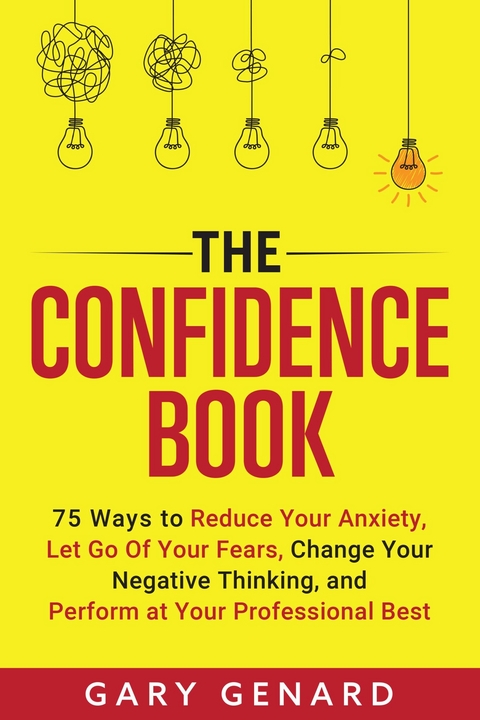
The Confidence Book (eBook)
296 Seiten
Cedar & Maitland Press (Verlag)
979-8-9918975-3-2 (ISBN)
GARY GENARD, Ph.D., is one of the world's leading confidence coaches. An actor, speech coach, and keynote speaker, he is the founder of Boston-based The Genard Method of performance-based communication training. His book on helping people overcome speech anxiety, Fearless Speaking, was named in 2019 by Book Authority as 'One of the 100 Best Confidence Books Of All Time.' He was named by Global Gurus for nine consecutive years as one of the world's top 30 communication professionals, and he has also been named as one of America's Top 5 Speech Coaches. Gary is the author of the popular blog, 'Speak for Success!'
Chapter 1
Calming Your Nerves and Relaxing the Body
Exercise 1: Stop — Breathe — Listen
We begin with a habit that’s essential for facing the world as a relaxed and confident individual: living in the present moment.
Are you doing that now? Are you mindful of the world as it is happening, moment by moment, while being aware of your part in it? Or are you like most of us, hurrying from task to task so that you can get to the next task?
This isn’t just a modern phenomenon—though it’s much worse than in centuries past. People throughout history have been juggling busy and challenging lives. But there’s something about 21st-century society that demands that we split our focus, and therefore our effectiveness in responding to the environment around us.
Take cell phones.
Dumb, flip, smart, or stuffed with AI—it doesn’t matter.
These computers-in-our-pockets are turning us into digitized slaves and zombies. And of course, they are only one of the tools that are pulling us away from the here-and-now. I’m sure you can name a ton of others from your own personal and professional lives.
I mention cell phones because lately I’ve been observing some new behavior. I’ll bet you have, too. Some delivery people (and even, I’m sorry to say, floor help and cashiers in retail establishments), can’t seem to do their job without at the same time having a private conversation on their cell phone. This amazes me. While I’m working in my home office, say, I’ll hear someone talking loudly outside (as people do in cell phone conversations). I know enough by now to say to myself, “Ah, that must be the mail deliverer, or the guy from Amazon or FedEx or UPS.” Are sure enough, a few seconds later I’ll hear the clank of my mailbox or the sound of a package being dropped onto the front porch or placed between the doors of my house.
The reason this seems strange to me, is that multitasking is a surefire way to split your focus and efficiency and diminish your ability to attend to the job at hand. Not to mention your relationship with the other parts of the equation. Other people, for instance. Think of how you feel when someone is, say, scrolling through their cell phone messages while having a conversation with you.
Yet nowadays, having a personal conversation on your cell phone while performing the job you’re being paid for seems to have become almost the new norm overnight! (Oh, I forgot to mention cab and ride-share drivers. Doesn’t that make that person’s driving dangerous?)
Of course, the problem isn’t the phone. It’s us. Take the cells out of the mix and it’s exactly the same. We’re the ones who are choosing to disrupt our response to the world and to the moment. And we do it all the time. So, if you want to show the world a person who is relaxed, confident, caring, attentive, and at ease with others, you need to be a focused and responsible user of the entity you have and are—yourself.
Just like me and everybody else, you need to start paying more attention to the world around you, moment by moment.
That’s why the very first directive in this book is STOP.
Doing this simple thing is a hugely important act if you are starting to feel anxious, are becoming fearful, or are sensing that you’re not connecting with others around you. It’s important that you put the brakes on what’s happening before things start to speed up and it becomes that much more difficult for you to take charge of your response.
But it also matters just generally, in terms of how you’re living your everyday life. Every moment of every day, there are things trying to pull you away from being focused and mindful. What are some of them? The breakneck speed of computer-based applications. Our over-scheduled lives: work, family, and personal. The 24-hour news cycles. (How about channels that have people talking to the camera while a separate news feed is scrolling across the bottom of the screen?) The beeps of mail or text messages coming in like tiny missiles. The constantly decreasing sound bites on news shows, demanding that we stop thinking about that, and go on to this. The ever-shortening camera shots and quick-takes in movies and commercials, substituting noise and movement for anything of value.
It has become so much a part of our lives, that it now may feel odd to take the time to stop the constant spinning of our minds and contemplate this moment in time. We’re out of practice.
So, stop.
Now breathe.
Breathing slowly and deeply tells the brain and adrenal glands to stop sending out adrenaline: the “fight-or-flight” response. It is the perfect way to bring yourself back into the here-and-now. Your very first breath was your initial moment of life outside the womb. It’s still the best tool you have for bringing yourself back into the world, from wherever you were a moment ago in your frenzied response to the whirlwind around you. When you focus on your breathing, you can’t be anywhere but in the present.
Next, listen. Listen to the sounds around you, of course. But I actually mean more than that. Listen with your whole being—take everything in with all of your senses. Become an open vessel. You’re hearing and seeing things; but you’re also taking in a whole universe of sensations: the air on your skin, the smell of the environment around you, the sensation of your feet on the ground or floor and the positions of different parts of your body. The air you’re breathing is refreshing and delicious. Taste it! Now go one step further in terms of your awareness, feeling how that inhaled breath moves down your throat and into your lungs, then out to every cell in your body.
You can do these three things—stop, breathe, and listen—for as short or long a time as you want, however many times a day you’d like. Take a few seconds to bring yourself back into the reality of the moment, or fifteen minutes if you can find a quiet place to relax and you’d like to connect with yourself before you reconnect with the world.
It’s amazing how much is happening within you AND without you when you make the effort to make nothing happen!
Exercise 2: Got 10 Minutes? — Relax!
“Easy does it.”
“Take it easy.”
“Easy as pie.”
We admire people who not only do things expertly, but who make them seem easy.
I believe one of the reasons we feel this way, is that when things are going smoothly—when we’re hitting on all cylinders—we’re functioning at peak efficiency. And that just feels right.
Some people call this level of performance achieving “flow,” or being in The Zone. Whatever name you attach to it, it’s a feeling of effortlessness—an intense pleasure that comes from focusing completely on the task at hand rather than the obstacles in your way.
Of course, you can’t really do this unless you’re relaxed and available for that task. I call this getting to a state of natural relaxation. Once you’re there, you can place your focus where it needs to be: on whatever you’re being called upon to do.
But given your probably demanding work schedule and personal obligations, you probably also need a way to help you relax quickly. So here’s a wonderful way to achieve a productive level of relaxation (yes, there is such a thing!) if you only have 10 minutes to spare. As an added benefit, you’ll “charge yourself up” at the end to introduce energy into your relaxed state. That way, you’ll experience the best of both worlds: a relaxed and energized state.
And it will only take you 10 minutes.
I’m grateful to my dear friend and colleague Jeannie Lindheim for allowing me to use the exercise below. It’s from her book Trusting the Moment, and it’s called “Liquid.”
- Lie down on a yoga mat, carpet, or other soft surface, with your feet uncrossed and hands at your sides. Imagine a liquid is being poured into the top of your head. Be aware of the liquid’s color, thickness, and texture as it fills up the inside of your head.
- It’s a very pleasant feeling as the liquid now flows down through your head and into your neck and shoulders. It continues flowing downward through your arms, relaxing each arm completely. Let some of the liquid trickle out through your fingers.
- The rest of the liquid goes slowly down into your chest and waist, hips and thighs. It continues down through the inside of your body, relaxing each part it touches. It flows into your calves and feet and dribbles out slowly through your toes.
- At this point, the liquid magically gathers on the floor underneath you and begins pouring in again through the top of your head. This time, go more slowly as you imagine (feel) the sensations. Allow the liquid to flow downward at your own pace, letting it relax each part of your body it touches. Let the liquid create small pools where you...
| Erscheint lt. Verlag | 5.1.2026 |
|---|---|
| Sprache | englisch |
| Themenwelt | Sachbuch/Ratgeber ► Gesundheit / Leben / Psychologie ► Psychologie |
| ISBN-13 | 979-8-9918975-3-2 / 9798991897532 |
| Informationen gemäß Produktsicherheitsverordnung (GPSR) | |
| Haben Sie eine Frage zum Produkt? |
 EPUB (Ohne DRM)
Größe: 1,9 MB
Digital Rights Management: ohne DRM
Dieses eBook enthält kein DRM oder Kopierschutz. Eine Weitergabe an Dritte ist jedoch rechtlich nicht zulässig, weil Sie beim Kauf nur die Rechte an der persönlichen Nutzung erwerben.
Dateiformat: EPUB (Electronic Publication)
EPUB ist ein offener Standard für eBooks und eignet sich besonders zur Darstellung von Belletristik und Sachbüchern. Der Fließtext wird dynamisch an die Display- und Schriftgröße angepasst. Auch für mobile Lesegeräte ist EPUB daher gut geeignet.
Systemvoraussetzungen:
PC/Mac: Mit einem PC oder Mac können Sie dieses eBook lesen. Sie benötigen dafür die kostenlose Software Adobe Digital Editions.
eReader: Dieses eBook kann mit (fast) allen eBook-Readern gelesen werden. Mit dem amazon-Kindle ist es aber nicht kompatibel.
Smartphone/Tablet: Egal ob Apple oder Android, dieses eBook können Sie lesen. Sie benötigen dafür eine kostenlose App.
Geräteliste und zusätzliche Hinweise
Buying eBooks from abroad
For tax law reasons we can sell eBooks just within Germany and Switzerland. Regrettably we cannot fulfill eBook-orders from other countries.
aus dem Bereich