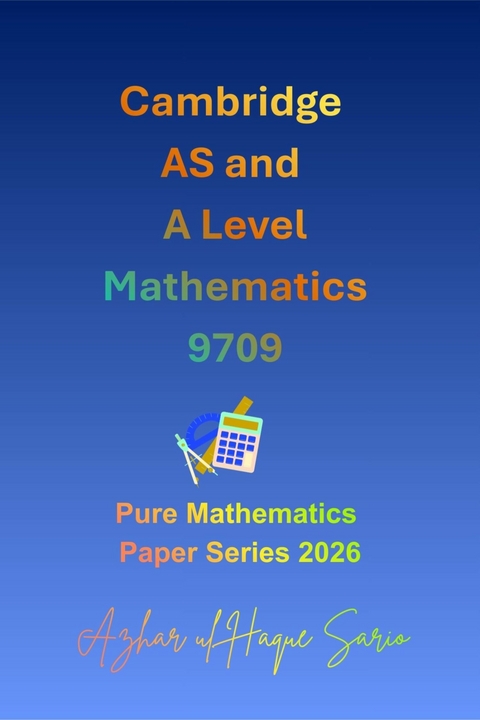
Cambridge AS and A Level Mathematics 9709 (eBook)
258 Seiten
Azhar Sario Hungary (Verlag)
978-3-384-79212-9 (ISBN)
Unlock the hidden architecture of the universe and master the mathematical tools that will define the technological landscape of 2026.
This comprehensive guide takes you on a complete journey through the Cambridge AS and A Level Mathematics 9709 syllabus. You will start with the foundations of Pure Mathematics 1, mastering Quadratics and Functions. We break down Coordinate Geometry and Circular Measure into simple concepts. You will visualize Trigonometry and Series like never before. The book guides you through the logic of Differentiation and Integration. Then, you move to Pure Mathematics 2, diving deep into Algebra and Logarithms. We explore the complexities of Numerical Solutions. Finally, Pure Mathematics 3 opens the door to Vectors and Differential Equations. You will even tackle the fascinating world of Complex Numbers. Every topic is covered. Every concept is explained. This is your roadmap to mathematical fluency.
What truly sets this book apart is its refusal to treat mathematics as a dead language of static rules. While other textbooks endlessly list formulas to memorize, this guide focuses on 'algorithmic intuition' and the 'why' behind the math. Written by a data scientist and Cambridge alumnus, it connects abstract calculus to the real-world engines of 2026, such as Machine Learning optimization, LIDAR technology in autonomous vehicles, and the geometry of 3D rendering. It bridges the gap between passing an exam and understanding the code of the physical world. Where others confuse you with dense jargon, this book speaks to you in a human, conversational tone, treating complex topics like 'The Snowball Effect' in differential equations or the 'Language of Change' in calculus as logical stories rather than rigid tests. It is designed not just to help you solve for 'x', but to help you understand what 'x' actually represents in the modern era.
Imagine having a tutor who doesn't just read the syllabus but understands the heartbeat of modern technology. That is the experience packed into these pages. We strip away the intimidation of 'imaginary numbers' to reveal the logic of complex roots. We demystify the 'chain rule' by showing you it is just a way of peeling an onion. From the geometry of vectors used in drone logistics to the logarithmic scales used in data science, every chapter is infused with relevance. This is not just about getting an A grade; it is about acquiring the analytical toolkit necessary for engineering, economics, and science in the late 2020s. You aren't just learning to calculate; you are learning to think like a mathematician in a digital age.
Disclaimer: This book is an independent educational resource produced by Azhar ul Haque Sario. It is not affiliated with, endorsed by, or connected to Cambridge Assessment International Education or the Cambridge University Press. All references to the syllabus and examination styles are made under the principle of nominative fair use for educational purposes only.
Series
Introduction: The Architecture of Algebra
Welcome to the comprehensive module on Series. As we step into the 2026 academic landscape, the study of sequences and series remains a cornerstone of mathematical fluency. Whether you are modeling compound interest in fintech algorithms, analyzing population decay in biological studies, or simply solving pure abstract problems, the tools you acquire here are fundamental.
This coursework is designed to break down the complexities of the Binomial Expansion, Arithmetic Progressions (AP), and Geometric Progressions (GP). We will move beyond rote memorization. We will explore the structure of numbers.
The following content is structured as a complete lecture series. It flows from basic definitions to advanced problem-solving techniques.
Part 1: The Binomial Expansion
1.1 The Concept of Expansion
In algebra, "expanding" usually means removing brackets. You are likely familiar with calculating (a+b)2. You know it equals a2+2ab+b2. But what happens when the power increases? What if you need to calculate (1+x)10 or (2x−3)5?
Multiplying the brackets out manually is tedious. It is prone to error. In 2026, we value efficiency. We use the Binomial Theorem. This theorem provides a shortcut. It creates a predictable pattern for the coefficients (the numbers in front of the variables) and the powers.
1.2 Factorials and Combinations
Before we write the full formula, we must define our tools. The Binomial Theorem relies on specific notation involving factorials.
The Factorial (n!) The notation n! (read as "n factorial") represents the product of all positive integers less than or equal to n.
n!=n×(n−1)×(n−2)×⋯×2×1
Example: 5!=5×4×3×2×1=120.
Special Case: By definition, 0!=1. This is crucial for the formula to work for the first and last terms.
The Binomial Coefficient ((rn)) This notation is often read as "n choose r". It tells us how many ways we can choose r items from a set of n distinct items. In the context of expansion, it tells us the coefficient of a specific term.
The formula is:
(rn)=r!(n−r)!n!
Example: Calculate (25).
(25)=2!(5−2)!5!=(2×1)×(3×2×1)5×4×3×2×1
Notice that the 3×2×1 cancels out from the top and bottom.
(25)=2×15×4=10
This calculation is fundamental. You will use it repeatedly. Modern calculators have a specific button for this (often labeled nCr), but showing your working using factorials is a key skill in A-Level exams.
1.3 The Binomial Theorem Formula
For any positive integer n, the expansion of (a+b)n is given by:
(a+b)n=(0n)anb0+(1n)an−1b1+(2n)an−2b2+⋯+(nn)a0bn
Let's simplify what this formula is actually saying in plain English:
Powers of a: Start at n and decrease by 1 in each term until they reach 0.
Powers of b: Start at 0 and increase by 1 in each term until they reach n.
Sum of Powers: In any single term, the powers of a and b always add up to n.
Coefficients: The number in front of each term follows the (rn) pattern.
A Simplified Form: Since (0n)=1 and b0=1, the first term is always just an. The last term is always bn.
(a+b)n=an+(1n)an−1b+(2n)an−2b2+⋯+bn
1.4 Worked Example: Expansions
Let us apply this to a real problem. Question: Expand (2x+3)4.
Step 1: Identify the components. Here, a=2x, b=3, and n=4.
Step 2: Set up the structure. We need terms for r=0,1,2,3,4.
(04)(2x)4(3)0+(14)(2x)3(3)1+(24)(2x)2(3)2+(34)(2x)1(3)3+(44)(2x)0(3)4
Step 3: Calculate the coefficients ((rn)).
(04)=1
(14)=4
(24)=6
(34)=4
(44)=1
Tip: You might recognize this row from Pascal's Triangle: 1, 4, 6, 4, 1.
Step 4: Substitute and simplify.
Term 1: 1⋅(16x4)⋅1=16x4
Term 2: 4⋅(8x3)⋅3=96x3
Term 3: 6⋅(4x2)⋅9=216x2
Term 4: 4⋅(2x)⋅27=216x
Term 5: 1⋅1⋅81=81
Final Answer:
(2x+3)4=16x4+96x3+216x2+216x+81
Important Note on Negatives: If the expression was (2x−3)4, you must treat b as −3. The powers of −3 will alternate signs. Odd powers (like (−3)1, (−3)3) will be negative. Even powers will be positive. This causes the terms in the final expansion to alternate: +−+−+.
Part 2: Arithmetic Progressions (AP)
2.1 Recognizing an Arithmetic Progression
We now shift our focus from expanding brackets to analyzing lists of numbers. A sequence is a list of numbers in a specific order. An Arithmetic Progression (AP) is the simplest type of sequence.
In an AP, the difference between consecutive terms is constant. We call this the common difference, denoted by d. The first term is denoted by a.
Example A: 2, 5, 8, 11...
Here, a=2.
The difference is 5−2=3. So, d=3.
Example B: 10, 8, 6, 4...
Here, a=10.
The difference is 8−10=−2. So, d=−2. (Note: d can be negative!)
2.2 The n-th Term Formula
How do we find the 100th term without writing out the whole list? We look for a pattern.
1st term: a
2nd term: a+d
3rd term: a+2d
4th term: a+3d
Notice that for the n-th term, we have added the difference (n−1) times.
un=a+(n−1)d
Application: Find the 20th term of the sequence 3, 7, 11, 15...
a=3
d=4
n=20
Calculation: u20=3+(20−1)4=3+(19×4)=3+76=79.
2.3 The Arithmetic Mean Property
A specific requirement of the A-Level syllabus is understanding the relationship between three consecutive terms. If three numbers a,b,c are in arithmetic progression, the middle term is the average of the outer two.
Since the gap between a and b is the same as the gap between b and c:
b−a=c−b
Rearranging this gives:
2b=a+c
This is a powerful tool for algebraic questions. Example: If x,x+3,2x+2 are in arithmetic progression, find x.
Using 2b=a+c:
2(x+3)=x+(2x+2)
2x+6=3x+2
4=x
So, x=4. The terms are 4, 7, 10. (Checking: diff is 3. Correct.)
2.4 The Sum of the First n Terms (Sn)
There is a famous story about the mathematician Carl Friedrich Gauss. As a child, he was asked to add the numbers from 1 to 100. He did it in seconds. He realized that if you pair the first and last numbers (1+100), the second and second-to-last (2+99), they all sum to 101.
This logic gives us the formula for the sum of an...
| Erscheint lt. Verlag | 3.1.2026 |
|---|---|
| Sprache | englisch |
| Themenwelt | Sachbuch/Ratgeber ► Beruf / Finanzen / Recht / Wirtschaft ► Bewerbung / Karriere |
| ISBN-10 | 3-384-79212-2 / 3384792122 |
| ISBN-13 | 978-3-384-79212-9 / 9783384792129 |
| Informationen gemäß Produktsicherheitsverordnung (GPSR) | |
| Haben Sie eine Frage zum Produkt? |
 EPUB (Adobe DRM)
Größe: 255 KB
Kopierschutz: Adobe-DRM
Adobe-DRM ist ein Kopierschutz, der das eBook vor Mißbrauch schützen soll. Dabei wird das eBook bereits beim Download auf Ihre persönliche Adobe-ID autorisiert. Lesen können Sie das eBook dann nur auf den Geräten, welche ebenfalls auf Ihre Adobe-ID registriert sind.
Details zum Adobe-DRM
Dateiformat: EPUB (Electronic Publication)
EPUB ist ein offener Standard für eBooks und eignet sich besonders zur Darstellung von Belletristik und Sachbüchern. Der Fließtext wird dynamisch an die Display- und Schriftgröße angepasst. Auch für mobile Lesegeräte ist EPUB daher gut geeignet.
Systemvoraussetzungen:
PC/Mac: Mit einem PC oder Mac können Sie dieses eBook lesen. Sie benötigen eine
eReader: Dieses eBook kann mit (fast) allen eBook-Readern gelesen werden. Mit dem amazon-Kindle ist es aber nicht kompatibel.
Smartphone/Tablet: Egal ob Apple oder Android, dieses eBook können Sie lesen. Sie benötigen eine
Geräteliste und zusätzliche Hinweise
Buying eBooks from abroad
For tax law reasons we can sell eBooks just within Germany and Switzerland. Regrettably we cannot fulfill eBook-orders from other countries.
aus dem Bereich