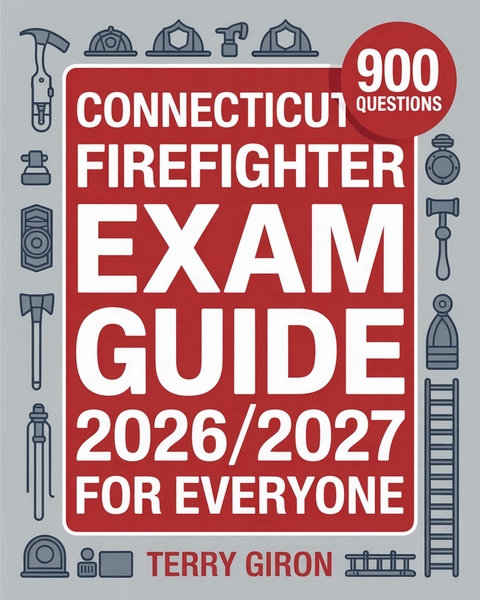
Connecticut Firefighter Exam Guide 2026/2027 for Everyone (eBook)
224 Seiten
Publishdrive (Verlag)
978-0-00-113083-8 (ISBN)
The Connecticut Firefighter Exam Guide 2026/2027 for Everyone is a structured learning resource designed to support candidates preparing for firefighter entrance and promotional examinations within the state of Connecticut. This guide presents core firefighting knowledge, aptitude concepts, and exam-relevant material in a clear and organized format suitable for learners at all stages of preparation.
The guide focuses on helping readers understand and apply commonly tested subject areas, including fire behavior, firefighting equipment, emergency response procedures, hazard recognition, safety practices, situational judgment, reading comprehension, mechanical reasoning, and basic mathematics. Explanations emphasize comprehension, practical understanding, and familiarity with exam-style questions to support effective preparation.
Designed for Everyone-including first-time applicants, career changers, and candidates seeking advancement-this guide serves as a comprehensive review and structured reference to help learners organize their study, build confidence, and approach the Connecticut firefighter exam with clarity and readiness.
Disclaimer: This exam guide is an independent educational resource created for general exam preparation purposes. It is not affiliated with, endorsed by, or sponsored by any Connecticut fire department, municipal agency, or official testing authority. All terminology and references are used solely for educational purposes.
Chapter 2 — Fire Prevention, Building Construction & Fire Behavior (Exam Topic Area)
Fire prevention, codes, hazard recognition, and inspection basics
- Explain how a performance-based fire code alternative could be justified during a plan review for a high-rise renovation and describe the key evidence an authority having jurisdiction (AHJ) would require to approve it.
- Describe the doctrine of code precedence when the Connecticut State Fire Safety Code, a local ordinance, and an international model code conflict; which applies and why?
- Outline a systematic approach to quantifying and comparing fire load in mixed-use occupancies for use in a risk-based inspection schedule.
- Explain how thermal inertia and compartment geometry interact to change flashover temperature predictions in legacy residential construction.
- Describe the inspection indicators that would suggest concealed vertical voids in an older mill building have become fire spread pathways and how you would verify them without destructive opening.
- Explain the risk assessment process for permitting hot work operations in a historic structure that contains undocumented combustible finishes.
- Describe how to evaluate the sufficiency of an existing sprinkler system when a building’s use changes from light manufacturing to high-density storage.
- Explain the limitations of using nominal fire-resistance ratings from old construction drawings when assessing current collapse risk.
- Discuss the legal elements the AHJ must demonstrate to revoke an occupancy permit for repeated fire code violations while avoiding arbitrary enforcement claims.
- Explain how smoke control systems alter life-safety calculations for egress time in multilevel atria and what inspection checkpoints validate functionality.
- Describe the differences between hazard recognition for combustible dust versus for flammable liquid vapor hazards in the same industrial space.
- Explain the role of building envelope tightness and mechanical ventilation changes on compartment fire behavior during a building retrofit.
- Outline the data collection and analysis required to convert historical inspection failure records into predictive analytics for targeted inspections.
- Explain how to interpret a thermal imaging scan of electrical switchgear to distinguish between normal load heating and insulation degradation that indicates imminent failure.
- Describe the evidence required to prove a code-compliant smoke alarm system still provides adequate protection in a house where the ceiling heights have been raised.
- Explain how to perform a triage inspection after limited fire damage to determine whether the building can be reoccupied and what documentation must accompany the decision.
- Describe the inspection protocol to validate passive fire protection penetrations (firestops) after an HVAC contractor runs new ducts through rated assemblies.
- Explain how vertical openings (chases, stairwells, elevator shafts) change compartmentation strategies and what code provisions control them.
- Describe how an inspector should evaluate the effectiveness of a tenant’s housekeeping program in a warehouse storing low-hazard commodities.
- Explain how to identify and document non-visible accumulations of combustible deposits (e.g., in ducts or roofs) that represent a latent hazard.
- Describe the process for reconciling conflicting manufacturer documents and code requirements when determining the permitted storage arrangement for lithium battery packs.
- Explain how to assess the adequacy of fire department access and water supply for a new development on a dead-end private roadway.
- Describe how to use smoke signatures and damage patterns to infer ventilation-limited versus fuel-limited fire growth in a post-fire investigation context.
- Explain the inspection considerations for mixed occupant loads in an assembly space that can change configuration frequently (e.g., convention center).
- Describe the technical basis and inspection steps to ensure that a fire alarm’s voice evacuation system provides intelligible messages under maximum ambient noise conditions.
- Explain how building construction type, as classified by modern codes, may misrepresent actual collapse risk in buildings with heavy timber elements and deteriorated connections.
- Describe the code and practical inspection checks for temporary electrical installations at construction sites that could create trip hazards and ignition sources.
- Explain how to evaluate whether a building’s means of egress illumination meets the effective illumination requirements at the time of an inspection.
- Describe the inspection evidence that would support a conclusion that a smoke partition has been compromised by undocumented penetrations.
- Explain the process for establishing an inspector’s chain of custody and documentation for hazardous materials found during a routine inspection.
- Describe how the presence of photovoltaic arrays affects attic fire behavior and what inspection protocols should be followed to assess associated hazards.
- Explain the elements of a defensible citation for a violation involving obstructed fire department connections (FDCs) on a multi-tenant commercial building.
- Describe how to inspect and verify the functionality of a building’s occupant notification appliance circuit when the notification appliances are powered through a backup generator.
- Explain how to prioritize inspection points in a facility where the production process introduces transient hot surfaces and intermittent flammable vapor releases.
- Describe how to evaluate the adequacy of a building’s compartmentation when recent renovations introduced open plan offices and removed rated walls.
- Explain the significance of smoke stratification in large volume spaces during a fire and how an inspector can test for conditions that promote it.
- Describe the indicators on mechanical and life-safety system plans that an inspector should flag as high risk during plan review for a change of occupancy.
- Explain how human factors and occupant familiarity with a space should be incorporated into fire prevention recommendations for a college dormitory.
- Describe how to assess and document the hazard posed by abandoned or dormant electrical equipment in an older commercial building.
- Explain the regulatory basis and inspection steps for enforcing limits on aggregate storage height for palletized commodity in a mixed-use building.
- Describe how to perform a holistic inspection of vertical transportation (elevators) to detect fire-service mode vulnerabilities that could impede firefighter operations.
- Explain how to reconcile manufacturer’s storage separation tables with on-site conditions where ceiling heights and sprinkler densities do not match test conditions.
- Describe how an inspector should verify compliance with code requirements for a cooking hood suppression system in a commercial kitchen that has undergone vendor modifications.
- Explain how to use buoyant flow principles to predict smoke migration paths in partially open floor plans and the implications for detector placement.
- Describe the inspection criteria to determine whether a building’s stair pressurization system maintains required pressure differentials under design fire conditions.
- Explain how to determine the expected performance degradation of an aging automatic sprinkler system due to sedimentation and pipe corrosion during an inspection.
- Describe how to assess for hidden fire loads introduced by tenant storage in interstitial spaces or above suspended ceilings.
- Explain how to evaluate whether an existing means of egress width is sufficient after a change that increases occupant load, referencing protestable assumptions.
- Describe how to inspect the interactions between HVAC smoke dampers and a fire alarm control panel to ensure proper default safe positions.
- Explain how to conduct a risk-based inspection of high-rise residential buildings to identify vulnerable populations during nighttime hours.
- Describe the technical rationale and inspection verification for limiting the storage of aerosols in a retail environment.
- Explain how to assess the reliability of passive detection systems (e.g., heat detectors) in high-temperature process spaces where detector spacing may have been exceeded.
- Describe the procedures for documenting and following up on uncooperative building owners during mandatory fire code inspections while preserving legal enforceability.
- Explain how to determine whether the addition of a new glazed curtain wall affects existing smoke control strategies and what inspection evidence you would require.
- Describe the method for quantifying egress time differences introduced when occupants use unsecured rooftop escape routes not approved in building plans.
- Explain the inspection steps and evidence needed to establish that a building’s fire command center remains functional after a partial water intrusion event.
- Describe how you would evaluate the adequacy and code compliance of an on-site flammable gas piping system installed prior to current code adoption.
- Explain how to use layered inspection observations (visual, instrumentation, historical records) to detect latent ignition sources in low-occupancy seasonal structures.
- Describe what constitutes an adequate corrective action plan for repeated failure to maintain required...
| Erscheint lt. Verlag | 30.12.2025 |
|---|---|
| Sprache | englisch |
| Themenwelt | Sachbuch/Ratgeber ► Beruf / Finanzen / Recht / Wirtschaft ► Bewerbung / Karriere |
| ISBN-10 | 0-00-113083-8 / 0001130838 |
| ISBN-13 | 978-0-00-113083-8 / 9780001130838 |
| Informationen gemäß Produktsicherheitsverordnung (GPSR) | |
| Haben Sie eine Frage zum Produkt? |
 EPUB (Adobe DRM)
Größe: 1,0 MB
Kopierschutz: Adobe-DRM
Adobe-DRM ist ein Kopierschutz, der das eBook vor Mißbrauch schützen soll. Dabei wird das eBook bereits beim Download auf Ihre persönliche Adobe-ID autorisiert. Lesen können Sie das eBook dann nur auf den Geräten, welche ebenfalls auf Ihre Adobe-ID registriert sind.
Details zum Adobe-DRM
Dateiformat: EPUB (Electronic Publication)
EPUB ist ein offener Standard für eBooks und eignet sich besonders zur Darstellung von Belletristik und Sachbüchern. Der Fließtext wird dynamisch an die Display- und Schriftgröße angepasst. Auch für mobile Lesegeräte ist EPUB daher gut geeignet.
Systemvoraussetzungen:
PC/Mac: Mit einem PC oder Mac können Sie dieses eBook lesen. Sie benötigen eine
eReader: Dieses eBook kann mit (fast) allen eBook-Readern gelesen werden. Mit dem amazon-Kindle ist es aber nicht kompatibel.
Smartphone/Tablet: Egal ob Apple oder Android, dieses eBook können Sie lesen. Sie benötigen eine
Geräteliste und zusätzliche Hinweise
Buying eBooks from abroad
For tax law reasons we can sell eBooks just within Germany and Switzerland. Regrettably we cannot fulfill eBook-orders from other countries.
aus dem Bereich