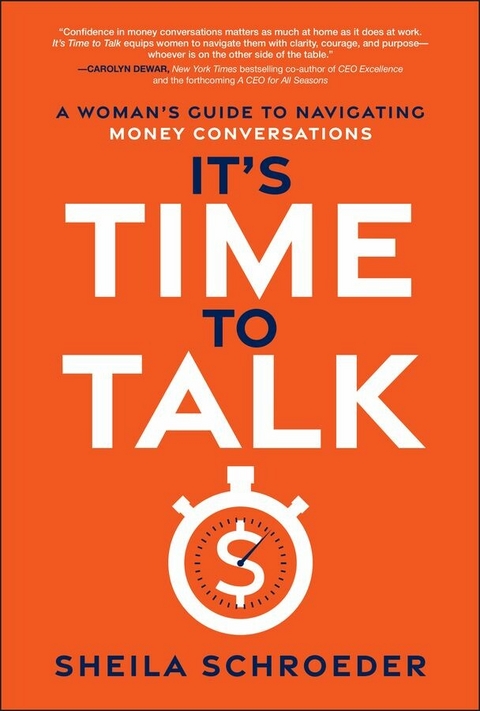
It's Time to Talk (eBook)
288 Seiten
Wiley (Verlag)
978-1-394-38082-4 (ISBN)
A step-by-step roadmap to confidence in financial management and money communication for women-written by a woman with decades of personal and professional experience in finance
In It's Time to Talk: A Woman's Guide to Navigating Money Conversations, experienced finance professional Sheila Schroeder delivers an inspiring and practical manual of women's finance and money communication. In 13 easy-to-follow chapters, the book provides essential, relatable guidance on managing your money and navigating tricky financial conversations with the people in your life. It's Time to Talk isn't just here to explain the difference between a 401(k) and an investment account. It empowers women to overcome the stigma and societal training that tells them they should feel uncomfortable or ashamed to talk about money, building confidence and independence along the way.
It's Time to Talk walks you through the steps to transform both your relationship to money and your relationships involving money, guiding you through personal finance decisions, plans for the future, money issues in your love life or family, and more. It combines real-life stories from the author's long and accomplished career with concise explanations of the financial concepts and communication principles you'll need to build financial security and tackle difficult money conversations authentically.
Inside the book:
- Conversational and intelligent advice on building a resilient and prosperous financial future
- Step-by-step guidance and suggested scripts for handling common financial communication challenges, such as asking for a raise at work, working through money tensions with a spouse or significant other, helping your kids understand money, navigating divorce and relationship changes, and assisting elderly parents in late-life and legacy planning.
- Useful checklists, sidebars, tips, techniques, and takeaways you can implement immediately for measurable, positive results
Perfect for all women doing their best to navigate the financial challenges of contemporary life, It's Time to Talk is a must-read roadmap to financial independence, security, resilience, and authentic relationships, written by a woman who has experienced - and conquered - the same obstacles you face every day.
SHEILA SCHROEDER is the Consultant, Regional Head of Business Development for Wealthspire Advisors. She's enjoyed a decades-long career in finance and is passionate about helping women everywhere navigate the financial challenges of contemporary life.
Introduction
“You always have to have your own money,” my mother said to me one evening when I was in my late twenties. Her tone made clear that this was no casual comment. It came from the depth of her experience—and it addressed what she knew had been considerable pain on my part.
Throughout my childhood, my mother had refrained from such strong pronouncements, and she had often deferred to my father on all manner of topics. But we were discussing one particularly hurtful area: discipline. In my adolescence, I had been a mouthy, opinionated kid who pushed the edge of what my parents considered acceptable behavior. I wanted to stay out late with friends and often talked back—in other words, I was a typical teenager.
But my father was a strict man with a temper, raised with the dictum Spare the rod, spoil the child. He did not spare the rod with me. If he was displeased with me (which he often was), he hit me with a belt. He never hit my mother or my sister; just me.
I don’t want to paint my father as a villain. He grew up on a farm in northern Indiana and built a life for us from a modest beginning. Later on, he was supportive of my career and proud of me. He was the guy who would go out in the middle of the night in the pouring rain to help you change a flat tire. I see him as a product of his time, doing what he thought was right and practicing what for many people was a standard child rearing method: corporal punishment. He was a good but flawed man, and I have long since forgiven him.
Still, the experience of being punished that way affected me deeply. It instilled in me an anti-authoritarian streak, and it left emotional scars I have had to work hard to heal.
That evening in my twenties, I had worked up the courage to talk to my mother about her acquiescence to my father. Why had she allowed this to go on? After all, from the beginning, my mother had challenged societal norms. She was the youngest daughter from a traditional family in southern Japan. In the 1950s, she moved to Tokyo, studied English, and got a job. She met my American dad when they worked at the same company; they got married at the American embassy and built a life together—first in Japan, then in Taiwan and the United States. She had left her hometown for a bigger life, married a foreigner, moved abroad, and worked outside the home because she cared about her independence. It was important for her to be her own woman. Yet, when my dad was disciplining me, she didn’t step in.
That night, I asked her, “How could you have let that happen?” I couldn’t imagine standing by and watching my husband hit my kids. Hit anyone.
She apologized. “I should have said something,” she told me. “But what was I going to do? Move back to Japan? Leave your father?”
She simply did not believe it was an option for her to contradict him when I was younger. Instead, that night she offered her firm admonition: “You always have to have your own money.” Yes, my mother had had a job—but not enough money to pick up and leave. If she had really been fully in control financially, if she really had had a choice, she might have made a different decision on my behalf.
But that is speculation. What’s more important is what I took away from that night: I had to have enough money to support myself, so that someone else could never be the boss of me. Even before this conversation with my mother, from an early age I had understood that money meant power. I started with little jobs when I was nine, taking care of our neighbor’s cat and selling Christmas cards door to door. Later, I substituted for our paperboy when he went on vacation and became an in-demand babysitter. I first paid taxes at age 15. When I wanted to go to a private high school, I juggled three jobs to pay my half of the tuition.
And when my father was hitting me—and later in high school, when he stopped, and would ground me constantly as punishment—I got a job at McDonald’s to get away from the house. I wanted to get farther away when I graduated. Money was going to help get me there.
Of course, I made missteps. At 17, as a junior in high school, I accidentally got pregnant. It was the first time I’d ever had sex. (It happens. We are very fertile at 17!) I was scared. This was deeply at odds with my plans to go to college, travel the world, move to the big city, and escape.
At the all-girls Catholic school I attended (though I was raised Protestant), girls got pregnant all the time. It was under the radar, but we knew. We knew which girls’ parents had made them have their babies, which parents made sure their daughters had access to birth control, even the basic mechanics of how it all worked when someone went away for a procedure. That we knew was my first hint about the power of women’s whisper networks, the way women support each other beyond the watchful eyes of people in authority.
This was 1978, five years after Roe vs. Wade. My abortion was not a difficult decision, and I was grateful I could make the choice. I don’t remember how much it cost, but it wasn’t inexpensive. My friends helped, I had some savings, and my boyfriend contributed. I never told my parents. Afterward, I was so relieved. Those are the only words I have for it: deeply relieved. It was what I wanted, and I made it happen. I went on with my life.
You might disagree with my choice, and you might think this has nothing to do with finance. But actually, it has everything to do with what I want to teach you in this book. These days, I know that people see me as this successful woman with a great career, great family, and access to wealth. But while I grew up in a good family, I’m very aware that my life could easily have gone another direction.
For me, financial independence has meant being able to live my life according to my own volition. It meant being in a position where, if things didn’t go my way, or if my father was hitting me with his belt, I could leave. And I did leave: I went away to college, and I never looked back.
Today, as a financial professional, I regularly meet women who are hesitant to commit to financial goals and uncomfortable advocating for themselves around money. That discomfort matters. A 25-year-old woman who starts out making the same amount as her male colleague might gradually make less due to lower raises or smaller bonuses. She eventually becomes a 50-year-old woman who has made significantly less than she might have over her lifetime.
Even today, the truth is that men still ask for more, and they ask more often. Plus, let’s be honest: they’re not typically the person in the family who steps back from a career to take care of children or aging parents; likewise, they’re not usually the one who steps back when a spouse’s career accelerates. They have maximum time and maximum opportunities to earn.
Every woman has a moment when she realizes the importance of having agency to move toward something she wants or away from something that’s hurting her. That moment may not be as dramatic as avoiding corporal punishment or ending an accidental pregnancy, but I’m sure there has been a moment in your life where you’ve needed to escape or wanted to dream bigger. This book is about how money can help you do that—how women must use money in order to do that. I know that it was a path to freedom for me. And it’s one that anyone can find.
* * *
Much of the financial inequality women still experience today is driven by fear. Women are savvier about money today than we’ve ever been, taking control and building knowledge and wealth. But there’s a long way to go and anxiety to overcome. The earlier we begin, the better.
One way to seize more control is to start by talking more about all of this—and explicitly from a female perspective. That’s why this book is called It’s Time to Talk. It’s one part handbook for personal money management, one part guide to money communication, or all the talking about our finances we need to do with important people in our lives. Many of our financial difficulties are really about how money makes us feel or how it affects our relationships. We may be afraid of facing our own shame and insecurity. We may want to have a money conversation with someone but haven’t because we don’t know how to start.
All this is understandable! Many people, maybe even most people, shrink from discussions about money. (I know because they tell me constantly, “I don’t like to talk about money.”) Just consider the words we use in those conversations we do have: they’re emotional, not rational. “You’re wasteful,” or “You’re spending too much,” or “You don’t have enough.” So much judgment! I can’t tell you how often I hear, “I should know this, I feel so ashamed.”
Let’s take the shame out of it. Think about the difference it could make in your life to have those conversations now, the sense of relief and empowerment you would feel if you stopped putting them off. This book will give you clarity on your own finances, showing you the way to the path you want, and getting you started walking down it. Then it will support you in the conversations you need to have along the way.
For example, do you dread talking to your spouse about money? Maybe your partner is the one who keeps track of all things financial and you don’t want to rock the boat....
| Erscheint lt. Verlag | 22.12.2025 |
|---|---|
| Sprache | englisch |
| Themenwelt | Sachbuch/Ratgeber ► Beruf / Finanzen / Recht / Wirtschaft ► Geld / Bank / Börse |
| ISBN-10 | 1-394-38082-8 / 1394380828 |
| ISBN-13 | 978-1-394-38082-4 / 9781394380824 |
| Informationen gemäß Produktsicherheitsverordnung (GPSR) | |
| Haben Sie eine Frage zum Produkt? |
 EPUB (Adobe DRM)
Größe: 764 KB
Kopierschutz: Adobe-DRM
Adobe-DRM ist ein Kopierschutz, der das eBook vor Mißbrauch schützen soll. Dabei wird das eBook bereits beim Download auf Ihre persönliche Adobe-ID autorisiert. Lesen können Sie das eBook dann nur auf den Geräten, welche ebenfalls auf Ihre Adobe-ID registriert sind.
Details zum Adobe-DRM
Dateiformat: EPUB (Electronic Publication)
EPUB ist ein offener Standard für eBooks und eignet sich besonders zur Darstellung von Belletristik und Sachbüchern. Der Fließtext wird dynamisch an die Display- und Schriftgröße angepasst. Auch für mobile Lesegeräte ist EPUB daher gut geeignet.
Systemvoraussetzungen:
PC/Mac: Mit einem PC oder Mac können Sie dieses eBook lesen. Sie benötigen eine
eReader: Dieses eBook kann mit (fast) allen eBook-Readern gelesen werden. Mit dem amazon-Kindle ist es aber nicht kompatibel.
Smartphone/Tablet: Egal ob Apple oder Android, dieses eBook können Sie lesen. Sie benötigen eine
Geräteliste und zusätzliche Hinweise
Buying eBooks from abroad
For tax law reasons we can sell eBooks just within Germany and Switzerland. Regrettably we cannot fulfill eBook-orders from other countries.
aus dem Bereich