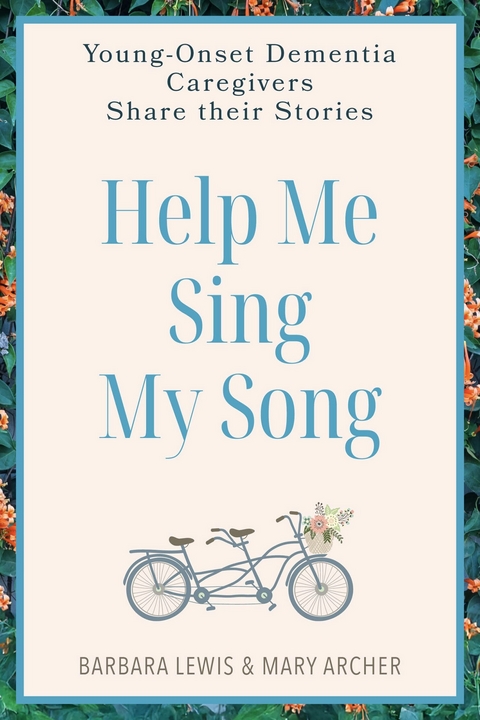
Help Me Sing My Song (eBook)
136 Seiten
Bookbaby (Verlag)
979-8-3178-0662-0 (ISBN)
Mary Archer worked as a volunteer and employee in various dementia care settings over the course of twenty years, including nursing homes and adult day programs. She often noticed those who had mild forms of dementia, or who fit the description of young-onset, and wondered if they were being well served. Their needs seemed different than those who were older or had more advanced dementia. Did they need more physical activity? More tasks to keep them feeling productive? More opportunities to share their stories? More social connections? How could they make the best of their few remaining years? Mary created her non-profit caregiving business with these questions in mind.
Barbara Lewis and Mary Archer know first-hand and close-up what it means to care for someone who develops dementia at a relatively young age. Barbara's husband started having cognitive challengeswhen he was 55 years old, while they were still working and parenting their eight year old daughter. Mary Archer had created a dementia care business which was specifically designed for younger people like Steve. He became one of her first clients, where he received the support and socialization they'd been seeking. Over the years Barbara and Mary have found too few resources focused on younger people with dementia, and realized that their experiences, and those of others they'd met, were stories that needed to be told. Young-onset dementia generally refers to someone who has received a diagnosis when younger then age 65. A person with young-onset dementia will tend to lose their job and driver's license well before they turn seventy. They'll lose earning potential, while they sometimes still have dependent children to care for, a mortgage to pay, and even elderly parents to look after. The younger person with dementia may be in the prime of their career, beginning to plan for retirement, and be physically active and in excellent health otherwise. It can be very difficult to balance all of this while experiencing gradual and steady cognitive decline. Recognizing there is no one clear path for dementia caregiving, this isn't a how-to book. Rather, it is a collection of stories that offer encouragement, help trigger creative caregiving ideas, and remind young-onset families they are not alone.
1
Introduction
Barbara Lewis’s husband, Steve, first showed signs of cognitive decline when Barbara was forty-eight and Steve was in his fifties. He was forced to retire, while she was working full time, taking care of all the household duties, raising their daughter, and doing her very best to care for Steve. Mary Archer had created a dementia care business that was specifically designed for people like Steve, and he became one of the very first people to join Mary’s program.
We know first-hand and up close what it means to care for somebody who develops dementia at a relatively young age. We intimately understand the tragedy and the slow-motion loss and grief. Yet, we’ve found that there is also humor, tenderness, and a deep sense of humanity in this journey.
While we supported Steve in our different roles, as his wife and his professional caregiver, we became friends and discovered a shared passion: creating ways for people like Steve who are living with dementia to experience dignity, connection, and meaning. Our shared passion inspired this book. We marvel at the many resourceful and creative caregivers we’ve met along the way, and want to share their stories. We conducted interviews to learn from these caregivers—spouses, adult children, siblings, and friends—and uncovered what they were doing, what they believed worked best, and what they might imagine could help improve their lives.
In this book, we’ve focused on nine families who best represent the special circumstances of young-onset dementia. We’ve written snippets of their stories, hoping they will inspire other caregivers and help them understand that they are not alone.
What Is Young-Onset Dementia?
Today there are millions of Americans who have some form of dementia. Hundreds of thousands of them are considered young-onset or early-onset. Though the terms are used interchangeably, the term young-onset is the only one used in this book. Generally, young-onset refers to those who are diagnosed with dementia before the age of sixty-five.
A basic definition of dementia is progressive cognitive impairment. There are countless causes of dementia, possibly fifty to one hundred or more. Most people are familiar with Alzheimer’s disease, which is one cause; details on causes and stages of dementia are detailed on our website, www.youngonsetdementiabook.com
While dementia at any age is tragic, the younger families carry an extra burden. A person with young-onset dementia will tend to lose their job and driver’s license well before they turn seventy. They’ll lose earning potential, while they sometimes still have dependent children to care for, a mortgage to pay, and even elderly parents to look after. The younger person with dementia may be in the prime of their career, beginning to plan for retirement, and be physically active and in excellent health otherwise. It can be very difficult to balance all of this while experiencing gradual and steady cognitive decline.
While people with dementia have similar experiences, each journey is unique because there are so many types and causes. In addition, how dementia progresses will vary from person to person. One person might still be working but rapidly losing the ability to use technology, while another person might be skilled at bike riding and skiing but be struggling to speak. Another might be enjoying family dinners, and then suddenly become overwhelmed and agitated at those same dinners. Social behaviors and self-confidence might remain normal or gradually diminish. This variability is reflected in the common saying, “If you know one person with dementia, you know one person with dementia.”
Our hope is that the stories in Help Me Sing My Song will resonate with readers, no matter what stage or type of dementia their loved one has. Our website, www.youngonsetdementiabook.com, provides greater detail on the specifics of young-onset and our recommendations for helpful books, videos, and websites.
Why This Book?
This isn’t a standard how-to book. There is no one clear path for dementia caregiving, but we hope that the variety of stories we’ve shared will be relevant for caregivers in different circumstances and with varying experiences. We want to offer encouragement, trigger creative caregiving ideas, and give voice to the particular struggles of young-onset dementia.
The stories are in no particular order. You may choose to scan the descriptions of each chapter and jump to the one that speaks to you now, perhaps coming back to others as you are called to explore it. Each of the chapters is described below.
Chapter 2: Mary’s Journey to Young-Onset Care
This chapter introduces a professional caregiver’s perspective on why she was drawn to serve people with young-onset dementia. It will give you a feel for our approach to caregiving and insights into what co-author Mary has learned along the way.
Chapter 3: Steve, Part 1
Steve was a gentle person with a quick wit, zany sense of humor, and kind eyes. His superpower was making people laugh, which continued to be a blessing in his connection to his daughter and others throughout his journey with dementia. Nicknamed the Music Man, Steve could name any song and artist while whistling almost any tune on key. Co-author Barbara cared for her husband Steve at home for several years, beginning with many rounds of misdiagnosis and dramatic changes in his abilities. Barbara juggled raising their daughter, working full time, and creating new social connections as some friends faded away when Steve started changing. This chapter shares the first part of Steve’s story of resilience, of being driven to find a better way to make life work well for their small family.
Chapter 4: Joe
Robin said she fell in love “the minute I saw Joe riding into town on his motorcycle, with that thick head of hair. He looked like he was one of the Beatles!” Soon afterward, Joe was drafted and served in the Vietnam War, which decades later played a role in his dementia and challenges with his diagnosis. During their journey, Robin remarked, “I felt like I was always running to catch up.” Still, she was determined to find resources to guide her in understanding what Joe was experiencing and to keep him connected to the things he loved most (besides her!): music and visiting family.
Chapter 5: Tom
Tom was diagnosed with Alzheimer’s in his late forties while mid-career and parenting two four-year-old children, one boy and one girl. His wife, Ann, became amazingly adept at juggling the demands of caregiving and parenting, while still finding the odd five minutes for a restorative cup of tea. She knew, for example, how much Tom craved exercise and competition, even as his dementia progressed, and found ways to keep him running, hiking, or skiing as much as possible. On one particularly problematic day, Tom asked a fateful question, “Isn’t there some other way we can make this work?”
Chapter 6: Jon
A successful businessman who was once a Yo-Yo champion, Jon was the oldest of eleven children. One of Jon’s younger brothers, Jim, noticed changes in Jon after he’d suffered several personal losses. Jim noticed his brother’s confusion and isolating behaviors and eventually took on the role of Jon’s caregiver. Jim describes his brother as “the most competitive person I ever knew.” Jim gives himself permission to do the best he can for Jon, without worrying about being perfect. “I learned to think like Jon. If I was Jon, what would I want right now? How would I want to spend my time?”
The experience of helping his brother inspired Jim to become a professional caregiver, so he now assists many others as well.
Chapter 7: Jemal
Jemal, an engineer from Ethiopia, has found that the local senior center is his happy place. There, they know him as the man who runs, dances, and smiles. Jemal’s wife, Elizabeth, shares a peak experience traveling home to Ethiopia to visit his family and other members of his tribe. She says, “It’s very important to take advantage of the time you have now. We don’t know what’s ahead. I’m thankful we have done all that we could so far. Right now, we’re okay.”
Chapter 8: Susan
A single mother and teacher with a sense of style, Susan became increasingly confused and relied heavily on the support of her adult daughter, Kate Elizabeth. Kate Elizabeth found activities Susan enjoyed, and above all learned how to integrate her mom into her life. She would introduce Susan to her friends saying, “Here she is. This is my mom. Take her just as she is. I love her.” Eventually, Kate Elizabeth made the difficult decision to move her mom into a care facility and, to her surprise, her mom thrived in her new home.
Chapter 9: Scott
Scott and his wife, Melodie, worked in partnership to manage his challenges. They spoke of the changes Scott was experiencing, even before he was diagnosed. As she put it, “Talking openly, making a list, and being open helped us feel like we were in control.” However, when Scott lost his job in a mass layoff at IBM, he ended up moving out of town for another work opportunity which became increasingly difficult with his cognitive decline. Still, they laughed often and found ways to enjoy the activities on Scott’s bucket list. Melodie...
| Erscheint lt. Verlag | 24.12.2025 |
|---|---|
| Sprache | englisch |
| Themenwelt | Sachbuch/Ratgeber ► Gesundheit / Leben / Psychologie ► Lebenshilfe / Lebensführung |
| ISBN-13 | 979-8-3178-0662-0 / 9798317806620 |
| Informationen gemäß Produktsicherheitsverordnung (GPSR) | |
| Haben Sie eine Frage zum Produkt? |
 EPUB (Ohne DRM)
Größe: 1,5 MB
Digital Rights Management: ohne DRM
Dieses eBook enthält kein DRM oder Kopierschutz. Eine Weitergabe an Dritte ist jedoch rechtlich nicht zulässig, weil Sie beim Kauf nur die Rechte an der persönlichen Nutzung erwerben.
Dateiformat: EPUB (Electronic Publication)
EPUB ist ein offener Standard für eBooks und eignet sich besonders zur Darstellung von Belletristik und Sachbüchern. Der Fließtext wird dynamisch an die Display- und Schriftgröße angepasst. Auch für mobile Lesegeräte ist EPUB daher gut geeignet.
Systemvoraussetzungen:
PC/Mac: Mit einem PC oder Mac können Sie dieses eBook lesen. Sie benötigen dafür die kostenlose Software Adobe Digital Editions.
eReader: Dieses eBook kann mit (fast) allen eBook-Readern gelesen werden. Mit dem amazon-Kindle ist es aber nicht kompatibel.
Smartphone/Tablet: Egal ob Apple oder Android, dieses eBook können Sie lesen. Sie benötigen dafür eine kostenlose App.
Geräteliste und zusätzliche Hinweise
Buying eBooks from abroad
For tax law reasons we can sell eBooks just within Germany and Switzerland. Regrettably we cannot fulfill eBook-orders from other countries.
aus dem Bereich