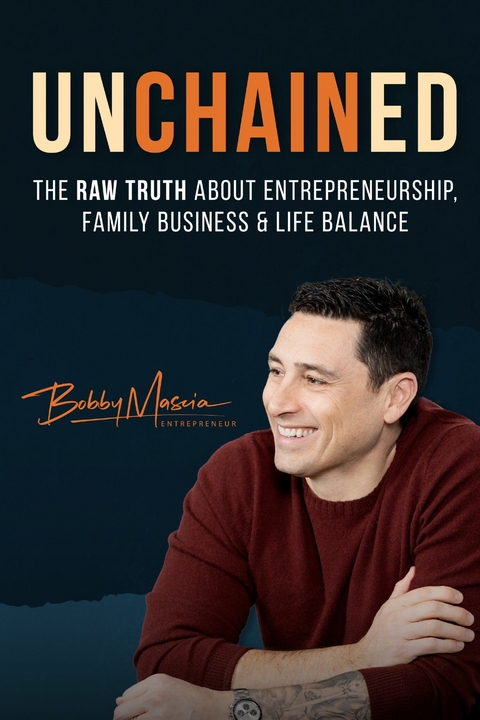
Unchained (eBook)
204 Seiten
Bookbaby (Verlag)
979-8-3178-1879-1 (ISBN)
Robert 'Bobby' Mascia is a straight-shooting entrepreneur, advisor, and founder of Green Ridge Wealth Planning, where he helps business owners get their financial house in order so they can grow with clarity. He built his first company from scratch, fixed a broken family business when no one else could, and lived to tell the tale. His experience spans starting up, scaling fast, burning out, and breaking the cycle - including everything no one wants to talk about: family drama, failed partnerships, and what happens when your success becomes unsustainable. With hard-won lessons and unapologetic honesty, he now helps other business owners stop playing small, ditch the BS, and build something that actually lasts. This book is for anyone stuck in the grind who knows it's time to take control - and finally lead like they own it.
Chapter 1
You Never Know Where the Road Will Lead
“The journey of a thousand miles begins with a single step.”
— Lao Tzu
It was a chilly spring evening, one that I’ll never forget. That night, a somber mood had settled over the nine of us gathered around the table: my sisters, my parents, my brother-in-law, my aunt, and my dad’s business partners. The food we ordered mostly sat untouched. We were trying to act normally, making small talk, filling the uneasy air, but we were just waiting for the bomb to drop.
Usually, my parents’ New Jersey house was a place of warmth. Convivial and homey. Relatives would drop in, eating and drinking and bullshitting, laughing, swapping stories. Moments that remind you that family is more important than anything. But this night was different.
We were there because my father, Thomas Mascia, the family patriarch and head of Mascia Enterprises, a thriving operation that boasted eighteen Dunkin’ Donuts stores from the Jersey side of the Hudson River all the way down into Pennsylvania, plus a Sonic franchise, a pizzeria, and a smattering of commercial real estate, was dying.
Now the guy who had built a million-dollar family business, basically from scratch, was at a loss for words. His health was fading. He was in the throes of a losing battle with cancer. Recently, the doctors informed him, and us, that it was terminal. The very word was a punch to the gut.
No one wanted to come to terms with dad’s mortality, least of all my dad himself. But no one could deny it. He was losing weight, his memory was suffering, he was deteriorating before our very eyes. And there was nothing I, nor he, nor anyone else could do. In the face of this, business was not priority number one. But when you run a family enterprise—one which so many people depend upon for their livelihood, you can’t just brush the work aside, especially during moments of crisis. Someone needs to steer the ship.
That night, everyone just kind of sat around looking at each other, looking at Tommy, not sure how to begin.
So I took over. “Hey, I know everyone wants to know what’s going on. Not just health-wise, but in terms of the business. We need to be on the same page,” I said. “We can’t muddle through this. Dad’s cancer came back, and the prognosis isn’t good. We don’t know how much time he has left, but we know that it is time to start planning. We know the murmuring is starting and if we aren’t controlling the narrative, then people will start to take control of it. We need a plan—one where Dad can focus on himself and his health.”
Dad finally spoke up, with a slow, and paused delivery. “I don’t know who’s going to take care of this (run the business), now and when I’m gone.”
My aunt, her voice tinged with concern at the idea of losing the brother she loved and the leader of the business, repeated that sentiment—what are we going to do here? Questions were many; answers were few.
In family business, in any business really, indecision can be fatal. You can’t just flounder. Someone had to step up.
I felt a wave of responsibility come over me. I was now in a position that I never wanted to be in. A place where my father, the authority of the family, needed direction. This was a conversation he had been dreading. Dad turned to look at me, he was scared, tired, and in pain and I saw in his eyes that he needed my help. With that, I addressed everyone announcing, “It’s going to have to be me.”
“You can’t. You have your own business to run,” said my father. “How are you going to be able to do both?”
He was right. It was a big task, but, as usual, I never wanted to let him down. “Dad, you know I’ve always put family first. I have my team set up. We’ll figure this out, one way or another.”
“Are you sure?” he said.
“I am. But we are going to have to be on the same page on how this happens, so if you’re ready to talk that through with me, we can make it happen.”
Dad said, “OK. So, then let’s figure it out together.”
It’s funny to think back and put my journey in perspective. What if I had never left the business in the first place, as I had done one night, years before, at my parents’ house? What if I hadn’t ended up in the profession that ultimately teed me up for success when I came back to take his business over?
It was, in truth, the one thing I never wanted to do, and not just because I had my own company to run. In my twenties, I had worked alongside my dad in the family business for many years. I learned a lot, but it was a rocky endeavor—stressful, problematic, sometimes outright maddening—and he and I butted heads frequently. When I finally left to open my own business, we didn’t exactly part on good terms. It wasn’t as if he and I were estranged, although after the first time I left, we didn’t talk to each other, even when we were in the same room, for about a year. I just never wanted to have anything to do with Dunkin’ Donuts again.
Now, I was returning, under the worst of circumstances, charged with undertaking a task—getting the house in order after decades of DIY housekeeping and handshake deals—that was gargantuan in scope. Little did I know at the time, I also had to become executor of the estate, CEO to Mascia Enterprises, and all this while also working as CEO to Green Ridge, my wealth management firm. I felt like I just took on this monumental task, one that made me feel responsible for every member of my family all at once, in the blink of an eye. My lack of hesitation was because of my background in working with my high-net-worth clients, but what I didn’t know yet was how the nuances that I took for granted as the advisor would really impact me as the executor.
What did that task entail? Like many successful entrepreneurs, my father had built something incredible, but as the business grew, its operational structure hadn’t fully evolved to match its scale. The company was thriving, but much of its success still relied on his personal oversight and decision-making, rather than a fully developed infrastructure that could run efficiently without him.
His long-standing team of internal admin and small firm professionals had been loyal and hardworking, but the increasing complexity of the business required new levels of expertise, specialization, and standardization. His attorney and accountant, who had been invaluable in the early days, were operating as a two-man shop, and while they had served him well, the business had simply outgrown what a small firm could manage on its own.
Processes were largely informal, relying on trust and long-standing relationships rather than structured, scalable systems. Agreements between partners were often made on a handshake—a testament to the strong personal relationships my father built—but as the company expanded, the need for clear, documented agreements became more pressing.
Record keeping had been done the old-school way, spread across multiple locations, in physical files—making it challenging to track key financials and business performance with precision. The company’s success had been built on my father’s deep industry knowledge, his ability to make quick, intuitive decisions, and his hands-on leadership. But as the business scaled, so too did the need for a sustainable structure that could support long-term growth and operate smoothly, even in his absence.
This wasn’t unique to him—many entrepreneurs find themselves in similar positions. They work relentlessly to grow their business, wearing multiple hats and making sacrifices along the way, only to find that the very methods that brought them to success needed to evolve in order to keep them there. Transitioning from an owner-driven model to a systems-driven organization is one of the hardest—but most important—shifts a business must make to ensure its legacy thrives for generations to come.
The first day of my new mission, I drove to his office. It had been years since I stepped through that door, and it was a weird feeling. His office was a visual analogue of the held-together-by-duct-tape disorder of the company. Immediately I was like, “Holy shit, I can’t believe I’m back here.”
A typical baby boomer, my dad saved everything: not just ancient paperwork that should have been shredded years ago, but all kinds of doodads and knickknacks, models of cars that he loved, office detritus, fast-food paper cups filled with paper clips, Lionel Train catalogs (he loved trains), everything. It was like walking into a time capsule of his past. In every office hung the neon paper printouts that read: “Tommy needs to know EVERYTHING.”
I took a moment to take stock of the massive project that I was about to embark upon, and reflect on what had led to this moment. The blood, sweat, and tears that he invested to build this—often at the expense of spending time with his family. I thought about what it meant, really meant, to be an “entrepreneur.” I thought about my father’s version of what he felt an entrepreneur was, and how that differed from mine. I reflected on our relationship, one that had many peaks and valleys, which was loving, but fraught.
I took a seat in his chair, the one he had spent so many countless hours in across decades, and got to work.
If you’re an entrepreneur—and especially if you work in or operate a family...
| Erscheint lt. Verlag | 23.12.2025 |
|---|---|
| Sprache | englisch |
| Themenwelt | Sachbuch/Ratgeber ► Beruf / Finanzen / Recht / Wirtschaft ► Bewerbung / Karriere |
| ISBN-13 | 979-8-3178-1879-1 / 9798317818791 |
| Informationen gemäß Produktsicherheitsverordnung (GPSR) | |
| Haben Sie eine Frage zum Produkt? |
 EPUB (Ohne DRM)
Größe: 2,8 MB
Digital Rights Management: ohne DRM
Dieses eBook enthält kein DRM oder Kopierschutz. Eine Weitergabe an Dritte ist jedoch rechtlich nicht zulässig, weil Sie beim Kauf nur die Rechte an der persönlichen Nutzung erwerben.
Dateiformat: EPUB (Electronic Publication)
EPUB ist ein offener Standard für eBooks und eignet sich besonders zur Darstellung von Belletristik und Sachbüchern. Der Fließtext wird dynamisch an die Display- und Schriftgröße angepasst. Auch für mobile Lesegeräte ist EPUB daher gut geeignet.
Systemvoraussetzungen:
PC/Mac: Mit einem PC oder Mac können Sie dieses eBook lesen. Sie benötigen dafür die kostenlose Software Adobe Digital Editions.
eReader: Dieses eBook kann mit (fast) allen eBook-Readern gelesen werden. Mit dem amazon-Kindle ist es aber nicht kompatibel.
Smartphone/Tablet: Egal ob Apple oder Android, dieses eBook können Sie lesen. Sie benötigen dafür eine kostenlose App.
Geräteliste und zusätzliche Hinweise
Buying eBooks from abroad
For tax law reasons we can sell eBooks just within Germany and Switzerland. Regrettably we cannot fulfill eBook-orders from other countries.
aus dem Bereich