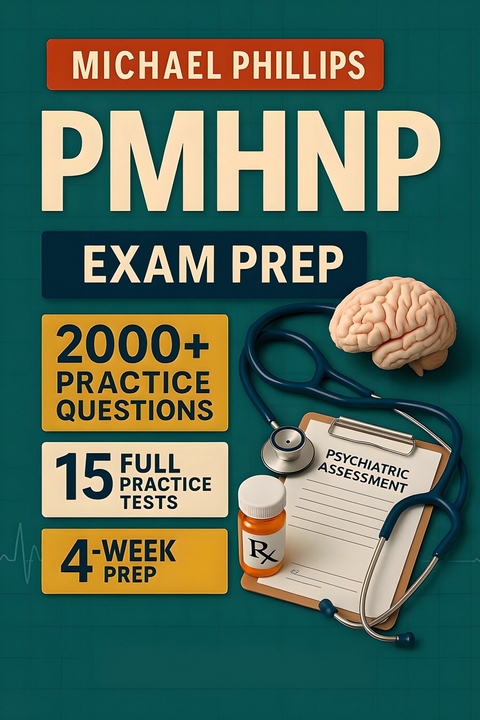
PMHNP Exam Prep (eBook)
148 Seiten
Publishdrive (Verlag)
978-0-00-112551-3 (ISBN)
What if I told you that preparing for the PMHNP exam with confidence-without overwhelm, without confusion, and without doubting your clinical skills-can become your reality?
If you're worried you won't pass on the first attempt or certain psychiatric concepts still feel unclear, then following a clinically aligned study plan can be your answer.
It can significantly strengthen your psychiatric assessment skills, diagnostic reasoning, and understanding of the disorders most frequently tested on the PMHNP exam.
It's so effective because every chapter mirrors ANCC exam logic-using clean explanations, real-world mental-health scenarios, and step-by-step reasoning written the way psychiatric providers think.
All lessons follow the current ANCC test outline, making this guide ideal for new graduates, experienced nurses, and retakers looking for a clear, organized route to passing. So whether you're confident in some areas or shaky in others, this guide supports every starting level.
You don't need years of psychiatric experience to benefit-but it becomes even more powerful if becoming a certified PMHNP is your next step. So you get one study guide... designed for busy nurses, students, and professionals who want efficient, focused, high-yield prep.
And if you feel unsure whether this can truly help, don't worry. Inside this book you'll find simple explanations, practical examples, and exam-specific strategies that make complex psychiatric topics easier to understand.
You don't need long study hours. Even with 30 minutes a day, this system helps you stay organized, build mastery, and avoid burnout.
This works best if you want a cost-effective preparation method without overwhelming textbooks or pricey review courses.
Whether you struggle with mood disorders, psychopharmacology, therapeutic communication, ethics, or lifespan considerations, each chapter teaches you how to think exactly the way the PMHNP exam expects.
Here is just a fraction of what you'll discover inside this book:
A complete 4-week PMHNP study plan with daily goals
• Full coverage of the ANCC domains: Assessment, Diagnosis, Psychotherapy, Pharmacology, Ethics
• DSM-based reviews of common psychiatric disorders
• Psychopharmacology made simple-mechanisms, side effects, safety
• Therapeutic communication strategies and psychotherapy frameworks
• Suicide risk, safety planning, and crisis intervention
• Cultural and lifespan considerations from pediatrics to geriatrics
• 90+ PMHNP-style practice questions with detailed reasoning
• Short, focused lessons ideal for busy nurses
• Up-to-date content aligned with the modern PMHNP exam
• Quick-reference charts, diagnostic clues, and clinical summaries included
CHAPTER 1 — PART 1
Overview
Psychiatric–Mental Health Nurse Practitioners (PMHNPs) serve at the intersection of advanced nursing, neuroscience, psychopharmacology, psychotherapy, and diagnostic reasoning. On the exam, questions test not only knowledge, but role clarity, legal constraints, and clinical judgment. This chapter establishes the foundation for the rest of the book: how you think, what you’re allowed to do, and how the exam expects you to respond in complex scenarios.
Learning Objectives
By the end of this chapter, you should be able to:
- Describe the PMHNP role, standards, and competencies.
- Differentiate full scope of practice, reduced practice, and restricted practice states.
- Identify the foundations of evidence-based psychiatric practice.
- Apply PMHNP role boundaries to clinical and exam scenarios.
- Recognize high-yield exam traps involving scope and delegation.
Core Concepts
1. PMHNP Core Competencies (NONPF Framework)
PMHNP exam questions frequently map to the NONPF competency framework, even when not stated directly.
1.1 Scientific Foundation Competency
You must demonstrate the ability to:
- Use evidence-based practice (EBP).
- Integrate neurobiology, psychopharm, and psychopathology.
- Apply research findings to real clinical scenarios.
Exam pattern:
Questions often frame two interventions as reasonable choices — the correct response is the one supported by guidelines or research evidence, not personal preference.
1.2 Leadership Competency
Leadership does not mean managing staff.
It means being able to:
- Advocate for patients.
- Influence system-level improvements.
- Promote quality and safety initiatives.
Exam Tip: When two answers look appropriate, choose the one that protects patient safety, promotes quality, or strengthens interdisciplinary collaboration.
1.3 Quality Competency
Includes the ability to:
- Evaluate practice outcomes.
- Apply quality improvement (QI) methods.
- Use data to improve care processes.
High-yield QI terms:
- PDSA cycle (Plan–Do–Study–Act)
- Root cause analysis
- Outcome measures vs. process measures
1.4 Practice Inquiry Competency
You must be able to translate research into practice and identify gaps in care.
This competency ties directly to exam questions such as:
“The PMHNP identifies a pattern of medication nonadherence in adult patients with schizophrenia. What should the PMHNP do first?”
Correct: Investigate causes → collect data → generate practice inquiry.
1.5 Technology and Informatics
Expect exam questions involving:
- EMR documentation
- Patient portals
- E-prescribing
- Telepsychiatry rules
Remember:
What is documented is what is considered done.
Documentation is a clinical safety tool — errors usually default in favor of patient protection, not provider convenience.
1.6 Health Delivery System Competency
This includes systems-level awareness, care coordination, and transitions of care.
Exam questions often contrast:
- Level of care
- Resources
- Safety needs
Your answer must align with:
Safest, least restrictive, most appropriate level of care.
1.7 Ethics Competency
Ethical decision-making appears in nearly every exam domain.
Core values:
- Autonomy
- Beneficence
- Nonmaleficence
- Justice
- Fidelity
- Veracity
Full ethical scenarios are covered later in Part 2.
1.8 Independent Practice Competency
This area controls how you diagnose, prescribe, and manage treatment.
You’re expected to:
- Provide full psychiatric evaluations
- Prescribe independently (in most states)
- Manage ongoing treatment
- Evaluate outcomes
- Collaborate appropriately with other disciplines
2. Scope of Practice
2.1 Levels of Practice (State Dependent)
- Full Practice: Diagnose, treat, and prescribe independently.
- Reduced Practice: Requires collaboration with a physician for some functions.
- Restricted Practice: Requires supervision or team management for all advanced functions.
Exam logic:
The exam does not require you to know each state’s laws — but you must know how scope limits decision-making.
2.2 High-Yield Exam Example
Scenario:
A PMHNP in a reduced practice state is unsure whether they can initiate clozapine.
Exam answer pattern:
- If the question states “reduced practice,” look for:
→ Consult physician per collaborative agreement.
Not because you lack competence — but because legal scope dictates the safest, compliant option.
3. Foundations of Psychiatric Practice
3.1 Evidence-Based Practice (EBP)
EBP integrates:
- Best research evidence
- Clinical expertise
- Patient values and preferences
When two interventions are valid, the exam favors:
The one supported by guidelines or empirical evidence.
3.2 High-Yield EBP Example
Question:
A patient with severe GAD requests benzodiazepines. The PMHNP wants to follow EBP guidelines.
Correct approach:
- Begin with CBT + SSRI/SNRI, because guidelines support these as first-line.
- Benzodiazepines → second-line after failure of first-line therapies.
4. The PMHNP in Interdisciplinary Teams
4.1 Collaboration, Not Supervision
PMHNPs collaborate horizontally, not hierarchically.
Meaning:
- You do not “supervise nurses.”
- You are not subordinate to psychiatrists in full-practice authority states.
- You function as an independent advanced practice clinician.
4.2 When Exam Questions Include Team Tension
Exam questions often show disagreements among nurses, social workers, or physicians.
Correct PMHNP action patterns:
- Ensure patient safety
- Promote interdisciplinary communication
- Use evidence-grounded reasoning
- Avoid blame
- Seek collaborative solutions
5. Boundary Management
Boundary questions appear frequently and often trick test-takers.
Key principle:
The PMHNP must maintain professional, therapeutic, non-dual, and non-exploitative boundaries.
Examples of boundary violations:
- Meeting patients outside clinical settings
- Accepting personal gifts
- Sharing personal details
- Treating friends or relatives
- Engaging on social media
Correct exam pattern:
→ Redirect, restate boundaries, maintain professionalism, and avoid dual relationships.
GUIDED PRACTICE (Part 1)
Practice Scenario
A patient asks the PMHNP for advice on how to handle a personal conflict with their sister outside of treatment goals.
Correct approach:
- Redirect to treatment goals
- Avoid engaging in personal role
- Maintain therapeutic boundary
6. Legal and Ethical Frameworks
Legal and ethical reasoning is woven throughout the PMHNP exam. Many questions are not about “knowledge,” but about what you are allowed—or required—to do.
The safest exam answer always aligns with:
Patient safety → Ethical principle → Legal requirement → Practice standard.
6.1 Consent and Capacity
Capacity refers to a patient’s ability to:
- Understand information
- Appreciate consequences
- Reason about treatment options
- Communicate a choice
Capacity is task-specific, not global. A person may consent to one treatment but not another.
High-yield exam rule:
- If capacity is questionable, the correct first step is:
→ Assess capacity formally
Not “call family,” “seek guardian,” or “proceed.”
6.2 Informed Consent Requirements
Consent requires:
- Diagnosis
- Nature & purpose of proposed treatment
- Risks & benefits
- Alternatives
- Right to refuse
The exam loves to ask which element is missing.
6.3 Confidentiality & Exceptions
Core rule: Protect confidentiality — unless a legal exception applies.
Legal exceptions include:
- Imminent danger to self
- Imminent danger to others
- Abuse of minor, elder, or vulnerable adult
- Court order
- Communicable disease reporting
Exam Tip:
When a patient threatens harm to a specific person → duty to warn & protect applies.
6.4 Mandatory Reporting
Mandatory reporting is non-negotiable.
You must report:
- Child abuse
- Elder abuse
- Abuse of dependent/vulnerable adults
- Active threats toward...
| Erscheint lt. Verlag | 5.11.2025 |
|---|---|
| Sprache | englisch |
| Themenwelt | Sachbuch/Ratgeber ► Beruf / Finanzen / Recht / Wirtschaft ► Bewerbung / Karriere |
| ISBN-10 | 0-00-112551-6 / 0001125516 |
| ISBN-13 | 978-0-00-112551-3 / 9780001125513 |
| Informationen gemäß Produktsicherheitsverordnung (GPSR) | |
| Haben Sie eine Frage zum Produkt? |
 EPUB (Adobe DRM)
Größe: 1,1 MB
Kopierschutz: Adobe-DRM
Adobe-DRM ist ein Kopierschutz, der das eBook vor Mißbrauch schützen soll. Dabei wird das eBook bereits beim Download auf Ihre persönliche Adobe-ID autorisiert. Lesen können Sie das eBook dann nur auf den Geräten, welche ebenfalls auf Ihre Adobe-ID registriert sind.
Details zum Adobe-DRM
Dateiformat: EPUB (Electronic Publication)
EPUB ist ein offener Standard für eBooks und eignet sich besonders zur Darstellung von Belletristik und Sachbüchern. Der Fließtext wird dynamisch an die Display- und Schriftgröße angepasst. Auch für mobile Lesegeräte ist EPUB daher gut geeignet.
Systemvoraussetzungen:
PC/Mac: Mit einem PC oder Mac können Sie dieses eBook lesen. Sie benötigen eine
eReader: Dieses eBook kann mit (fast) allen eBook-Readern gelesen werden. Mit dem amazon-Kindle ist es aber nicht kompatibel.
Smartphone/Tablet: Egal ob Apple oder Android, dieses eBook können Sie lesen. Sie benötigen eine
Geräteliste und zusätzliche Hinweise
Buying eBooks from abroad
For tax law reasons we can sell eBooks just within Germany and Switzerland. Regrettably we cannot fulfill eBook-orders from other countries.
aus dem Bereich