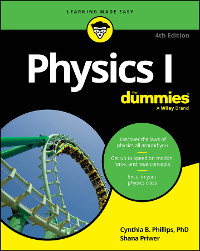
Physics I For Dummies (eBook)
459 Seiten
For Dummies (Verlag)
978-1-394-36715-3 (ISBN)
Discover the power of physics!
Physics I For Dummies, 4th Edition explains the basic principles of physics simply and clearly. This useful guide includes easy-to-follow explanations of motion, energy, the states of matter, thermodynamics, electromagnetism, relativity, and beyond. It breaks down complex concepts into manageable chunks and uses relatable examples to you readers understand how physics applies to everyday situations. You'll get a handle on physics in no time!
Inside:
- Work through everything in an intro physics class, explained in plain English
- Understand physics formulas and how to use them
- Learn the basics of motion, force, work, heat, and more-and pass your test!
- Make learning easier with examples that connect physics to the world
Perfect for anyone looking for a course supplement or for those simply curious about physics and the way it intersects with our everyday life, Physics I For Dummies takes the work out of learning physics.
Cynthia B. Phillips, PhD, is a NASA scientist. She offers astronomy and planetary science lectures to audiences of all ages and backgrounds. Dr. Phillips also worked at the SETI Institute for 15 years.
Shana Priwer is an experienced technical writer. Shana and Cynthia are the authors of Astrophysics For Dummies and Space Exploration For Dummies.
Chapter 1
Using Physics to Understand Your World
IN THIS CHAPTER
Recognizing the physics in your world
Understanding motion
Handling the force and energy around you
Warming up to thermodynamics
Physics is the study of the world and universe around you. Luckily, the behavior of matter and energy — the stuff of this universe — is not completely unruly. Instead, it strictly obeys laws that we can understand through the careful application of the scientific method, which relies on experimental evidence and rigorous reasoning. In this way, physicists have been uncovering more and more of the beauty that lies at the heart of the workings of the universe, from the infinitely small to the mind-bogglingly large.
Physics is an all-encompassing science. You can study various aspects of the natural world (in fact, the word physics is derived from the Greek word physika, which means “natural things”), and accordingly, you can study different fields in physics: The physics of objects in motion, of energy, of forces, of gases, of heat and temperature, and so on. This book exposes you to the study of all these topics and many more. In this chapter, we give you an overview of physics — what it is, what it deals with, and why mathematical calculations are important to it.
What Physics Is All About
Thinking about physics makes most of us a little nervous. The sheer number of equations, symbols, and other terms makes physics seem like a language in and of itself. Guess what? It is! And by reading this book, you can pick up the key to understanding this language. Physics exists to help you make sense of the world, and it’s a human adventure — undertaken on behalf of everyone — into the way the universe works.
At its root, physics is all about becoming aware of your world and using mental and mathematical models to explain it. The gist of physics is this: You start by making an observation, you create a model to simulate that situation, and then you add some math to fill it out — and voilà! You have the power to predict what will happen in the real world. All this math exists to help you see what happens and why.
In this section, we explain how real-world observations fit in with the math. The later sections take you on a brief tour of the key topics that comprise basic physics.
Observing the world
The complexity of today’s world is an excellent starting point for observations of motion. Leaves are waving, the sun is shining, light bulbs are glowing, driverless cars are moving, 3-D printers are making objects, people are walking and riding bikes, streams are flowing, and so on. When you stop to examine these actions, your natural curiosity gives rise to endless questions such as these:
- Why do I slip when I try to climb that snowbank?
- How distant are other stars, and how long would it take to get there?
- How can a thermos flask keep hot things warm and keep cold things cool?
- Why does an enormous cruise ship float when a paper clip sinks?
- Why does water roll around when it boils?
Any law of physics comes from very close observation of the world, and any theory that a physicist comes up with has to stand up to experimental measurements. Physics goes beyond qualitative statements about physical actions — “If I push the child on the swing harder, then she swings higher,” for example. With the laws of physics, you can predict precisely how much higher the child will swing.
Making predictions
Physics is simply about modeling the world (although an alternative viewpoint claims that physics actually uncovers the truth about the workings of the world; it doesn’t just model it). You can use these mental models (abstract representations of physical phenomena) to describe how the world works: How blocks slide down ramps, how stars form and shine, how black holes trap light so it can’t escape, what happens when cars collide, and so on.
Initially, physics models are relatively number-free; they focus on explaining and understanding scenarios at a high level. Here’s an example: How are stars created? You could start by saying that stars are made up of this layer and then that layer, and as a result, this reaction takes place, followed by that one. And pow! — you have a star.
As time goes on, those models become more numerically inclined. Physics class would be a cinch if you could simply say, “That cart is going to roll down that hill, and as it gets toward the bottom, it’s going to roll faster and faster.” But the story is more involved than that: Not only can you say that the cart is going to go faster, but by exerting your grasp of the physical world, you can also say how much faster it’ll go.
Think about the power of physics this way: You can start with a qualitative, intuitive explanation of some physical phenomenon that just makes sense to you — such as the harder you throw a ball, the further it will go. Applying physics takes that intuitive understanding into a quantitative result: If you know the force with which you throw the ball, you can predict how far it will travel!
There’s a delicate interplay between theory — formulated with math — and experimental measurements. Often experimental measurements not only verify theories but also suggest ideas for new theories, which in turn suggest new experiments. Theories and measurements feed off each other and lead to further discovery.
Many people approaching the technical side of physics may think of math as something tedious and overly abstract. However, in the context of physics, math comes to life. While quadratic equations may seem like something you’d rather skip over, don’t rush to judgement — they’re key to understanding concepts such as the correct angle to fire a rocket for the perfect trajectory. Chapter 2 explains all the math you need to know to perform basic physics calculations.
Reaping the rewards
So what do you get out of studying physics? If you want to pursue a career in physics or in a related field such as engineering, the answer is clear: You’ll need this knowledge on an everyday basis. But even if you’re not planning to embark on a physics-related career, you can get a lot out of studying the subject. You can apply much of what you discover in an introductory physics course to real life for these reasons:
- In a sense, all other sciences are based upon physics. For example, the structure and electrical properties of atoms determine chemical reactions; therefore, all of chemistry is governed by the laws of physics. In fact, you could argue that everything ultimately boils down to the laws of physics!
- Physics does deal with some pretty cool phenomena. Many videos of physical phenomena have gone viral on TikTok (or other social media); take a look for yourself. Do a search for “non-Newtonian fluid,” and you can watch the creeping, oozing dance of a cornstarch/water mixture on a speaker cone.
- The applications of physics arm you with problem-solving skills for approaching any kind of problem. Physics problems train you to stand back, consider your options for attacking the issue, select your method, and then solve the problem in the easiest way possible.
Observing Objects in Motion
Some of the most fundamental questions you may have about the world deal with objects in motion. Will that boulder rolling toward you slow down? How fast do you have to move to get out of its way? (Grab your calculator …) Evaluating motion was one of the earliest explorations of physics.
When you take a look around, you see that the motion of objects changes all the time. You see a motorcycle coming to a halt at a stop sign. You see a leaf falling and then stopping when it hits the ground, only to be picked up again by the wind. You see a pool ball hitting other balls in just the wrong way so that they all move without going where they should. Part 1 of this book handles objects in motion — from balls to railroad cars and most objects in between. In this section, we introduce motion in a straight line, rotational motion, and the cyclical motion of springs and pendulums.
Measuring speed, direction, velocity, and acceleration
Speeds are big with physicists — how fast is an object going? Is 35 miles per hour not fast enough? How about 3,500? No problem when you’re dealing with physics. Besides speed, the direction an object is going is important if you want to describe its motion. If the home team is carrying a football down the field, you want to make sure that they’re going in the right direction.
When you put speed and direction together, you get a vector — the velocity vector. Vectors are a very useful kind of quantity. Anything that has both magnitude (an amount) and direction is best described with a vector. Vectors are often represented as arrows, where the length of the arrow tells you the magnitude (size), and the direction of the arrow tells you, well, the direction. For a velocity vector, the length corresponds to the speed of the object, and the arrow points in the direction the object is moving. (To find out how to use vectors, head to Chapter 4.)
Everything has a velocity, so velocity is great...
| Erscheint lt. Verlag | 17.12.2025 |
|---|---|
| Sprache | englisch |
| Themenwelt | Sachbuch/Ratgeber ► Natur / Technik ► Naturwissenschaft |
| Naturwissenschaften ► Physik / Astronomie | |
| Schlagworte | basic physics • beginning physics • beginning physics book • college physics book • easy physics • high school physics book • intro physics book • intro to physics book • physics book • physics examples • Physics for Beginners • Physics Lessons • simple physics |
| ISBN-10 | 1-394-36715-5 / 1394367155 |
| ISBN-13 | 978-1-394-36715-3 / 9781394367153 |
| Informationen gemäß Produktsicherheitsverordnung (GPSR) | |
| Haben Sie eine Frage zum Produkt? |
 EPUB (Adobe DRM)
Kopierschutz: Adobe-DRM
Adobe-DRM ist ein Kopierschutz, der das eBook vor Mißbrauch schützen soll. Dabei wird das eBook bereits beim Download auf Ihre persönliche Adobe-ID autorisiert. Lesen können Sie das eBook dann nur auf den Geräten, welche ebenfalls auf Ihre Adobe-ID registriert sind.
Details zum Adobe-DRM
Dateiformat: EPUB (Electronic Publication)
EPUB ist ein offener Standard für eBooks und eignet sich besonders zur Darstellung von Belletristik und Sachbüchern. Der Fließtext wird dynamisch an die Display- und Schriftgröße angepasst. Auch für mobile Lesegeräte ist EPUB daher gut geeignet.
Systemvoraussetzungen:
PC/Mac: Mit einem PC oder Mac können Sie dieses eBook lesen. Sie benötigen eine
eReader: Dieses eBook kann mit (fast) allen eBook-Readern gelesen werden. Mit dem amazon-Kindle ist es aber nicht kompatibel.
Smartphone/Tablet: Egal ob Apple oder Android, dieses eBook können Sie lesen. Sie benötigen eine
Geräteliste und zusätzliche Hinweise
Buying eBooks from abroad
For tax law reasons we can sell eBooks just within Germany and Switzerland. Regrettably we cannot fulfill eBook-orders from other countries.
aus dem Bereich