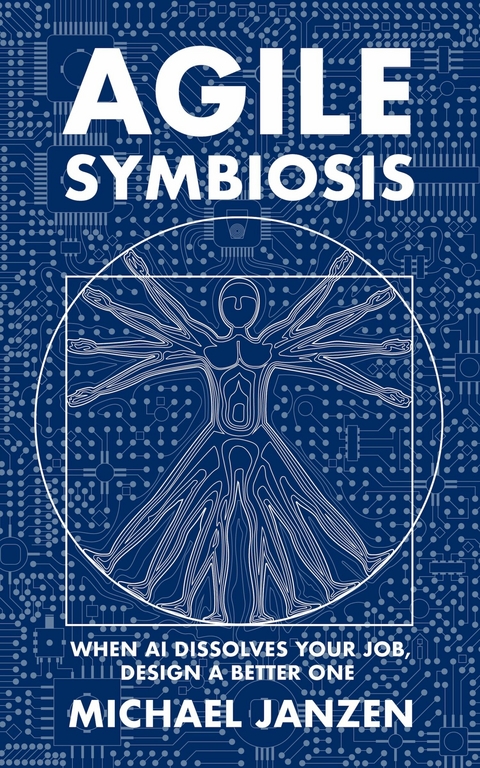
Agile Symbiosis (eBook)
200 Seiten
Publishdrive (Verlag)
978-0-00-112335-9 (ISBN)
The 'job' as we know it is dissolving. The choice is no longer whether to adapt, but what you will become.
The debate over AI's impact on work is impossible to follow: apocalyptic warnings of mass unemployment collide with bland assurances that AI is just another productivity tool. Both sides miss what is actually happening. They are arguing about the future while the fundamental nature of work dissolves beneath them.
Artificial intelligence is acting as a universal solvent. It is breaking down the rigid container of tasks, skills, and responsibilities that has defined a 'job' for a century. As access to information becomes instant, the economic value of simply holding knowledge is collapsing.
Agile Symbiosis is the manual for professionals who refuse to be automated. It is not a book of theory; it is a practical playbook for taking control of your professional evolution in the Age of AI Synthesis.
Inside, digital product innovator Michael Janzen provides the blueprint to shift your value from static skills that depreciate to the durable capacity for rapid synthesis and continuous reinvention.
You will learn how to:
Become the Navigator: Move beyond the passive role of the 'Passenger' and actively design your own value proposition.
Master the D.I.S.T. Framework: Apply a repeatable, four-step method to Dissolve your current role, Isolate high-value human judgment from mechanical execution, Synthesize new symbiotic workflows, and Titrate changes through rigorous experimentation.
Forge the Polymorphic Professional: Develop a new model of career resilience defined by the ability to adapt, learn at high velocity, and create.
Deploy the Symbiotic Scorecard: Use a new way to measure value that accounts for innovation, resilience, and institutional knowledge-metrics that traditional spreadsheets usually miss.
For Leaders and Organizations: This book provides the financial case for the 'Augmentation Wager'-betting on human capability rather than short-sighted replacement. Learn how to build an organizational 'chassis' capable of surviving the transition, moving from rigid functional silos to outcome-centric mission teams.
About the Author: Michael Janzen is a digital product innovator and former VP with thirty years of experience building tools that amplify human capability. Grounded by a decade as a potter before entering technology, Michael views AI not as a replacement for human creativity, but as a new kind of clay waiting for a skilled hand.
You do not need to wait for your organization to change to begin. You start with your own craft. The raw materials are waiting for your hand to reform them.
Don't wait for the system to change your work. Be the designer of your own evolution.
Chapter 2: The D.I.S.T. Framework
While the mindset provides the direction, this framework provides the mechanics, fusing the iterative speed of agile execution with the specific capabilities of artificial intelligence.
The goal is proactive work redesign. Psychologists Amy Wrzesniewski and Jane Dutton identified the human drive for this behavior decades ago, defining it as job crafting.16 Think of their original concept as the manual mode of work redesign—renegotiating tasks and relationships through purely human effort.
The D.I.S.T. Framework represents the symbiotic mode. It uses AI to accelerate this process, allowing you to break down and reconfigure work at a speed and granularity that was previously impossible.
The theoretical foundation extends to the Job Demands-Resources model, which posits that well-being and performance depend on the balance between job demands (workload, time pressure, emotional labor) and job resources (autonomy, tools, support, and capability).17
Pre-AI job crafting operated within relatively fixed constraints. You could negotiate your tasks and relationships, but your cognitive and informational resources were largely static. AI fundamentally disrupts this equilibrium. It simultaneously reduces certain demands (mechanical tasks, information gathering) while expanding resources (analytical capability, creative ideation, domain knowledge previously requiring years to develop).
D.I.S.T. is the methodology for actively managing this rebalancing act. The Dissolve step breaks the rigid role into liquid elements. The Isolate step maps the new demands. The Synthesize step architects how to deploy the expanded resources. The Titrate step ensures the new balance is sustainable. Where traditional job crafting was about renegotiating within constraints, the D.I.S.T. Framework is about redesigning the constraints themselves.
Professionals are already using these tools for task crafting to actively reform their work. But doing this randomly creates chaos; doing it systematically creates leverage. Static methods resemble blueprints for buildings on solid ground. D.I.S.T. is a navigational system for piloting through shifting states.
Before you start, one critical guardrail: the opportunity is to steer your work toward genuine augmentation, not just automation. As you redesign your workflow, ask yourself if you are automating a mechanical task or outsourcing your core judgment. Am I reinvesting my reclaimed time into higher-value human responsibilities, or just filling it with more low-value work?
Redesigning your work is not neutral. Every choice has consequences—for you, for the people around you, for the quality of what you create. As you move through this, carry this question with you: Am I building something of quality—effective, elegant, and ethical?
Proven Tools, New Direction
While the metaphor is chemistry, the mechanics are management science. The D.I.S.T. Framework draws on proven techniques from organizational development and process reengineering—the same analytical tools management consultants use when they audit organizations.
But there is a critical difference in the direction they are pointed. Consultants audit to identify redundancy and eliminate inefficiency. They make work legible to the system, making workers replaceable. You audit to identify leverage. You find the high-value work only you can do, the judgment that cannot be automated, and the relationships that create trust.
You are using the analysis to understand your own value proposition before anyone else defines it for you. This is not about gaming the system; it is about an honest assessment of where you create genuine value, allowing you to deliberately organize your work to amplify it.
D is for DISSOLVE
Right now, your work presents itself as a solid block. When someone asks what you do, you give them a title: I am a project manager. Clean and complete.
But that title is actually a compressed bundle of dozens—maybe hundreds—of distinct tasks, activities, and micro-responsibilities. AI’s arrival acts like a solvent on this bundle, breaking down the bonds that held it together. Tasks that seemed inseparable start separating, and skills that seemed like one block reveal themselves as several distinct elements.
The first step is to apply that solvent consciously. You can stop treating your job as a solid block and start seeing it as a collection of elements.
You might spend one full week tracking every single professional activity. The key is granularity. "Wrote emails" doesn’t tell you much, but "Wrote an email to the engineering lead asking for a status update on the server migration" is a discrete task. "Attended meeting" isn't very useful. But identifying that you "presented progress," "answered budget questions," and "mediated a disagreement" within that single meeting reveals three distinct activities requiring three different skills.
This exercise will feel uncomfortable. You may be shocked by how much of your day gets consumed by low-value administrative work that uses none of your talents. That discomfort is the catalyst. Without this honest accounting of where your time actually goes, you cannot design something better.
Consider capturing the invisible work, too. The ten minutes spent staring at a wall working through a problem, the decision made during a commute—this can be your highest-value work, so label it clearly as reflection or decision-making.
By the end of the week, you have a list of hundreds of items. You have dissolved the role. Now you can see the components.
I is for ISOLATE
The next step is elemental separation: separating the silicon (mechanical) from the carbon (human). We prize our mastery of pattern-based execution. But once a task becomes a predictable script, it can be handed off to the silicon.
Returning to your list of dissolved tasks, the next move is sorting every item into one of two lists: AI-ready tasks (silicon) or human responsibilities (carbon).
AI-ready tasks follow known patterns with structured data. Like computer code, they are rigid and executable. Data entry, report generation, scheduling, and basic code debugging go here. These are tasks where accuracy matters more than interpretation.
Human responsibilities are organic. They require judgment, ambiguity navigation, and relational trust. Like lifeforms, they adapt. They involve reading between the lines, understanding unstated context, or making calls with incomplete information. Persuading a skeptic, mentoring a team member, or deciding which problem to solve goes here.
Sorting often reveals a counter-intuitive reality. Some tasks look simple but trip up AI models; some look complex but are trivial for a machine. If a task requires understanding social nuance or moral weight, it goes in the carbon list. If it requires processing vast amounts of information to find a pattern, it goes in the silicon list.
When you find a compound task like "Client Report," break it down. The data compilation is silicon; the strategic narrative is carbon. Isolate the human element so it can thrive. By the end, you have two lists.
The silicon list represents the work you want to automate or delegate to an AI agent, and the carbon list represents the work you want to expand.
But remember, isolating your expertise increases your value, but may also shrink the total market for your role. You are trading the security of having many job options for the power of being harder to replace.
S is for SYNTHESIZE
You have dissolved your work into elements, and you have sorted what is mechanical from what is human. Now you design.
Many people use AI to make their current job slightly faster. That is progress, but it misses the bigger opportunity: fundamentally redesigning how value gets created. You are not just identifying what to automate; you are designing new workflows where human insight and AI capability combine to produce better outcomes.
You can pick one high-friction workflow—something that eats up your time with mechanical prep work. Map the current state. Where does the time go? Likely, you spend hours gathering and cleaning information and only minutes making decisions based on it. We often rely on that manual friction to help form our judgments.
In the new workflow, that cognitive processing doesn't disappear; it shifts to the validation step. Once the AI handles the data gathering, the cleaning, and the initial drafting, you reinvest that reclaimed time into the human elements: the validation, the strategy, and the communication.
Some organizations punish efficiency with volume, filling your plate with more low-value work the moment you clear it. To protect the quality of your new workflow, resist the urge to advertise your speed immediately. Reinvest that reclaimed time into the Titrate phase—specifically the rigorous verification of your output—to ensure your results are unassailable before you reveal the method.
This requires designing collaboration patterns. It is rarely as simple as "AI does...
| Erscheint lt. Verlag | 12.12.2025 |
|---|---|
| Sprache | englisch |
| Themenwelt | Sachbuch/Ratgeber ► Beruf / Finanzen / Recht / Wirtschaft ► Bewerbung / Karriere |
| ISBN-10 | 0-00-112335-1 / 0001123351 |
| ISBN-13 | 978-0-00-112335-9 / 9780001123359 |
| Informationen gemäß Produktsicherheitsverordnung (GPSR) | |
| Haben Sie eine Frage zum Produkt? |
 EPUB (Adobe DRM)
Größe: 1,5 MB
Kopierschutz: Adobe-DRM
Adobe-DRM ist ein Kopierschutz, der das eBook vor Mißbrauch schützen soll. Dabei wird das eBook bereits beim Download auf Ihre persönliche Adobe-ID autorisiert. Lesen können Sie das eBook dann nur auf den Geräten, welche ebenfalls auf Ihre Adobe-ID registriert sind.
Details zum Adobe-DRM
Dateiformat: EPUB (Electronic Publication)
EPUB ist ein offener Standard für eBooks und eignet sich besonders zur Darstellung von Belletristik und Sachbüchern. Der Fließtext wird dynamisch an die Display- und Schriftgröße angepasst. Auch für mobile Lesegeräte ist EPUB daher gut geeignet.
Systemvoraussetzungen:
PC/Mac: Mit einem PC oder Mac können Sie dieses eBook lesen. Sie benötigen eine
eReader: Dieses eBook kann mit (fast) allen eBook-Readern gelesen werden. Mit dem amazon-Kindle ist es aber nicht kompatibel.
Smartphone/Tablet: Egal ob Apple oder Android, dieses eBook können Sie lesen. Sie benötigen eine
Geräteliste und zusätzliche Hinweise
Buying eBooks from abroad
For tax law reasons we can sell eBooks just within Germany and Switzerland. Regrettably we cannot fulfill eBook-orders from other countries.
aus dem Bereich