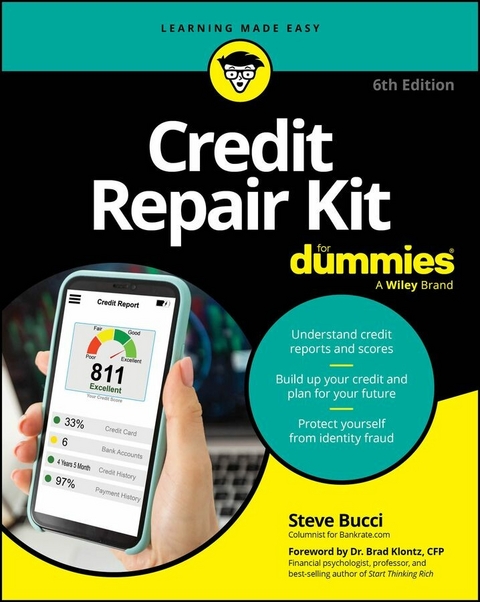
Credit Repair Kit For Dummies (eBook)
660 Seiten
For Dummies (Verlag)
9781394375325 (ISBN)
Improve your credit score and rebuild your financial future
Interested in getting a credit makeover? You're not alone. The overall amount of Americans' outstanding credit card and revolving debt continues to rise, powered by the increasing availability of lending options and an increasingly challenging financial environment. Millions of people are struggling to repay - or even keep up with - one or more loans, on a credit card or some other debt instrument.
Credit Repair Kit For Dummies delivers easy-to-follow, usable advice on how to get your debt under control, repair your credit score, and restore your financial health. You'll find reliable info on getting out of debt quicksand and implementing the steps you need to take to improve your finances and credit once and for all. You'll also explore practical proven strategies for tackling student debt, medical debt, and even credit score disasters caused by a divorce, identity theft or bankruptcy.
- Updates on student loan repayment rules in the United States and medical debt repayment regulations
- Explanations of AI's role in contemporary credit decisions
- Discussions of a new kind of identity theft
- The latest changes to credit reporting in the United States
- A ton of helpful credit repair tools, including sample credit reports, forms, templates, and links to online resources
We all deserve a fighting chance to enjoy the benefits of good credit. This book demonstrates how to climb your way back from even the worst credit situations and build a new, prosperous, and financially rewarding future.
Steve Bucci has been helping people decode and master personal credit and debt issues for the last 20+ years. His personal finance advice column can be seen on the financial mega-site Bankrate (www.bankrate.com). Steve was formerly president of the Money Management International Financial Education Foundation and president of the Consumer Credit Counseling Service of Southern New England. He is the author of Getting Out of Debt For Dummies and Back to Basics: Debt Management.
Chapter 1
Introducing Credit Repair, Credit Scores, and Your Life on Credit
IN THIS CHAPTER
Handling credit problems
Dealing with the issues surrounding fairness in credit
Rebuilding your credit after a crisis such as a foreclosure or bankruptcy
Safeguarding your credit and your identity
Discovering how to manage your credit
Keeping your credit solid in every stage of life
Credit plays a larger role in life than ever, and its influence will only expand in the years to come. The good life, happiness, and credit are inextricably linked. It’s not that more material things make you happier, but bad credit exacts a price from your life, your hopes, and your dreams, as well as your relationships with others. Think of it as your credit/life connection. Whether it is hard or easy, fair or not, you must learn to successfully manage your credit and, by extension, your personal finances if you are to lead a successful and satisfying life in the United States.
Financial products, credit foremost among them, have become much more complex and powerful, while the price for having a bad credit report or no credit at all has never been steeper. Your credit report is a financial snapshot of your life in financial terms. For example, a divorce can wreak havoc in your life, and that instability can show up as missed payments or even a bankruptcy on your credit report as well. When you use credit, the information usually gets reported to a data center known as a credit bureau. This information ends up on your credit report for at least the next seven years. The good, the bad, and the ugly are all there for anyone you do business with to see and for FICO, VantageScore, and other lesser-known scoring elves to summarize in a three-digit number known as your credit score.
A bad credit report can keep you from finding a job, getting the promotions you deserve at work, being approved for an affordable loan, getting insurance (or paying the lowest price for it), securing an apartment or house, and more.
This chapter is all about getting you started in repairing, rebuilding, or even just starting your credit so you can get that job, promotion, loan, home, and insurance to protect it. I cover the basics and the fine points. It’s really simple. But if you don’t understand credit, you can’t fix it, so I discuss how credit works, how to apply that knowledge to get what you want, how to deal with the effects of life’s inevitable setbacks on your credit, and how to recover from those setbacks as quickly as possible. Other chapters build on this information, helping to make your credit the best it can be and keep it that way. Why? Because life isn’t always fair, but you still need to repair the damage and carry on without being taken advantage of by unscrupulous financial companies or wasting precious years recovering from credit problems that you can avoid or minimize by using the advice in this book.
Repairing Bad Credit
After you’ve had a rough patch and fallen behind on your payments, you may think that you can never recover. Between the cost of interest and maybe even collection actions, the situation can be overwhelming. But I assure you that you can reverse the cycle. You can not only reestablish good credit but also keep good credit and enjoy its benefits for the rest of your life. Forever is a long time, but if you follow my advice, you can banish the credit blues permanently! It’s not magic, and it won’t cost you another dime. By realistically assessing your situation, seeing yourself as others see you, knowing where you stand, using free help if you need it, setting goals, planning your spending and savings, and using credit as part of your overall plan, you can quickly rebuild your credit.
Settling debts
You hear the ads all the time: “Settle your debt for pennies on the dollar!” “You have a right to pay less than you owe!” Debt settlement is an often misunderstood option that may work for you, but only if you handle it properly. Many companies that offer debt settlement services help themselves a lot more than they help you. You can avoid huge fees and potential credit damage if you reach a settlement agreement with your lender on your own for free using the information in this book or if you use your own attorney.
You are personally responsible for the actions of the debt settlement company you hire, and your credit will be ruined in what is a protracted and adversarial settlement process. Chapter 6 gives you the information you need to decide whether debt settlement is for you and outlines your best options.
Resetting your goals
Just as you did when you first started establishing credit, I want you to revisit your goals from time to time. When your life changes, your goals should reflect your new reality. Goals that once seemed within easy reach may move from short term to long term. Others may change as you mature. Buying that red sports car may not be as important to you now as it was in your 20s. Take the time to reset your sights, as I explain in Chapter 2.
Begin by envisioning your life as you’d like it to be over the short, medium, and long term. Next, create a spending plan (or update your plan if you already have one) so that you know your current financial strengths and weaknesses. Then begin to see how long it will take to fund your goals and determine when using credit may be appropriate. Chapter 18 goes into detail about how to create and maintain a spending plan and how to use credit wisely as a part of that plan.
To ensure that your credit is up to the task of supporting your goals for the future, check your credit reports and dispute any inaccuracies or out-of-date information. To rebuild your credit reports, you need to start with an accurate credit history, not one riddled with errors that may hold you back. After you check your reports, look for opportunities to review them for free as often as you can. Part 4 tells you everything you need to know about credit reporting.
Rebuilding your credit by using it
The best way to rebuild your credit is to exercise it! Using your goals and spending plan as a guide, start making those payments as agreed, on time and for the correct amounts. Every month you do so, you build better credit while your older, bad credit either counts for less or drops off your credit reports altogether.
Consider opening a secured credit card (backed by a bank account deposit) or a passbook/savings account loan to add a revolving and installment account to fatten your credit history and boost your score. You can find the details in Chapter 10.
Using a cosigner or becoming an authorized user
I normally don’t recommend that you, personally, ever cosign for a loan, but in this case, someone else is doing the cosigning for you! Enlisting a cosigner is a way to get access to credit so that you can begin to rebuild your credit history with the credit bureaus. But you need to keep in mind a few important rules:
- You have to make all the payments on time.
- If you can’t make a payment when it’s due, you have to tell the cosigner in advance so that the cosigner can make the payment and protect his or her credit. You can pay your pal back later.
- You can’t get mad at the cosigner for not being understanding or more helpful while you owe him or her money. Your cosigner is doing you a huge favor at great personal credit risk!
Another way to rebuild your credit is to become an authorized user on someone else’s credit card. After you’re added to the other person’s account, his or her good credit history flows onto your credit record as a positive account and payment stream, beefing up your record and credit score. The person needs to have good credit, though, or his or her bad credit may negatively affect yours. I suggest that you decline getting your own card for the account so that only the other person’s charges appear on the account. That way, if he or she has a bad memory (as I do), you’re spared monthly calls asking whether this or that charge is yours. Although you won’t have access to new credit, your credit score gets a boost.
Finding sources of free help
You can do a lot of things on your own, but sometimes having a pro on your side to give you tips helps. You can find that help in three main places, and it ranges from inexpensive to free. Nonprofit credit counselors, pro bono lawyers, and HUD-approved counseling agencies offer priceless free insight, assistance, and advice. The trick is to know to ask for it.
Nonprofit credit counselors work with you to set goals, develop a spending plan, and assess your ability to repay your debts. They can set up a repayment plan in concert with your lenders to lower your payments and interest rates and get positive information back on your credit reports faster than you could on your own. They’re funded by creditors but work for you, and I recommend the good ones highly. Discover where to find the good ones in Chapter 4.
Lawyers sometime offer free or pro bono help if you can’t afford to pay. Chapter 4 includes a list of resources to help you find one in your area.
A mortgage is a different and sometimes dangerous type of loan. The rules for handling a delinquent mortgage are different from those...
| Erscheint lt. Verlag | 2.12.2025 |
|---|---|
| Sprache | englisch |
| Themenwelt | Sachbuch/Ratgeber ► Beruf / Finanzen / Recht / Wirtschaft ► Geld / Bank / Börse |
| Schlagworte | Brad Klontz • credit score repair • debt repayment guide • debt repayment tips • do I have bad credit? • do I have good credit? • how do I fix my credit score? • how do I improve my credit? • is my credit bad? • what's a good credit rating? • what's a good credit score? |
| ISBN-13 | 9781394375325 / 9781394375325 |
| Informationen gemäß Produktsicherheitsverordnung (GPSR) | |
| Haben Sie eine Frage zum Produkt? |
 EPUB (Adobe DRM)
Kopierschutz: Adobe-DRM
Adobe-DRM ist ein Kopierschutz, der das eBook vor Mißbrauch schützen soll. Dabei wird das eBook bereits beim Download auf Ihre persönliche Adobe-ID autorisiert. Lesen können Sie das eBook dann nur auf den Geräten, welche ebenfalls auf Ihre Adobe-ID registriert sind.
Details zum Adobe-DRM
Dateiformat: EPUB (Electronic Publication)
EPUB ist ein offener Standard für eBooks und eignet sich besonders zur Darstellung von Belletristik und Sachbüchern. Der Fließtext wird dynamisch an die Display- und Schriftgröße angepasst. Auch für mobile Lesegeräte ist EPUB daher gut geeignet.
Systemvoraussetzungen:
PC/Mac: Mit einem PC oder Mac können Sie dieses eBook lesen. Sie benötigen eine
eReader: Dieses eBook kann mit (fast) allen eBook-Readern gelesen werden. Mit dem amazon-Kindle ist es aber nicht kompatibel.
Smartphone/Tablet: Egal ob Apple oder Android, dieses eBook können Sie lesen. Sie benötigen eine
Geräteliste und zusätzliche Hinweise
Buying eBooks from abroad
For tax law reasons we can sell eBooks just within Germany and Switzerland. Regrettably we cannot fulfill eBook-orders from other countries.
aus dem Bereich