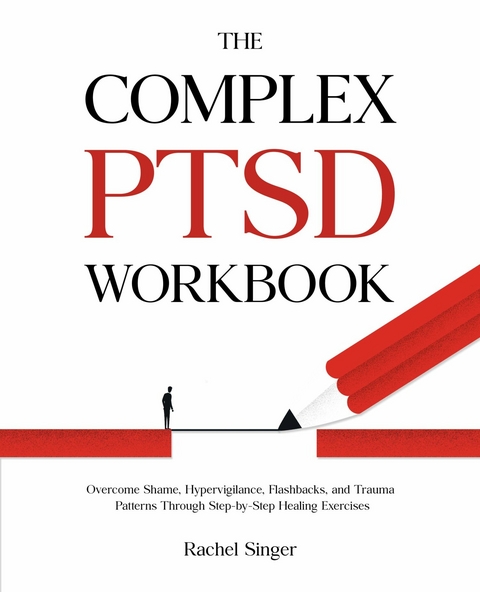
The Complex PTSD Workbook (eBook)
160 Seiten
Publishdrive (Verlag)
978-1-80647-235-2 (ISBN)
Do you ever react with panic, shutdown, or self-criticism and have no idea why?
Do you feel like your body is still bracing for something that happened years ago?
Do you keep 'functioning' on the outside while feeling overwhelmed on the inside?
If these patterns feel familiar, you're not imagining them, your nervous system is still working in survival mode.
According to the CDC-Kaiser Permanente ACE Study, nearly two-thirds of adults report at least one adverse childhood experience.
Hypervigilance, emotional flashbacks, freeze responses, and self-criticism are not personality flaws, they're survival patterns your body never had a chance to update.
But First, a Warning:
This is not a quick-fix guide .
If you're looking for instant hacks to erase anxiety or override lifelong patterns, this won't deliver that.
The tools inside require consistency, honesty, and the willingness to slow down and notice what your body is signaling. Some exercises may feel unfamiliar at first, that's part of the process.
If you're committed to understanding your reactions and working with your nervous system over time, you'll find what you need here.
Inside:
Understand the 4 mechanisms through which childhood trauma reshapes your brain
- Decode your body's signals using a simple, judgment-free mapping method
- Identify your top 3 emotional flashback patterns before they take over
- Apply a 13-step protocol that short-circuits a flashback in real time
- Build a compact first-aid kit for panic, dissociation, and overwhelm
- Dismantle the inner critic using targeted counter-scripts
- Spot the exact moment where self-reflection turns into shame
- Release stored shame with practical somatic cues
- Reduce hypervigilance by training your social tolerance window
- Interrupt constant scanning with micro-interventions you can use anywhere
- Shift out of freeze using 3 movement-based reset techniques
- Recognize dissociation early with fast, reliable indicators
- Ground yourself in seconds with no-nonsense sensory anchors
- Access healthy anger and convert it into clean, firm boundaries
- Practice trauma-safe self-compassion through 3 daily pillars
- Understand your attachment style to reduce relationship reactivity
- Communicate needs with low-conflict scripts that prevent escalation
- Set boundaries without guilt using simple, enforceable steps
- Design daily routines based on your nervous system's real capacity
What Could Start To Feel Easier
- Stay calmer in situations that used to trigger panic
- Catch emotional spirals earlier and redirect them
- Feel more present during conversations and difficult moments
- Reduce the constant tension your body carries for 'no reason'
If you're exhausted from panic that appears out of nowhere, from shutting down when you need yourself the most, or from feeling broken for reactions you never chose, this book gives you the structure and tools you've never been taught.
If you want your daily life to stop feeling like a constant fight with your own body, this is where the shift begins.
Chapter 1:
Your Nervous System Holds the Story Your Mind Cannot Tell
"The body keeps the score." — Bessel van der Kolk
You're sitting in your living room on a Sunday morning. Sunlight streams through the window. Your coffee is hot. No one is yelling. No doors are slamming. Nothing bad is happening.
Your heart is pounding anyway. Your chest feels tight. Your mind is scanning the room, the sounds from outside, the expression on your partner's face, searching for threats that don't exist. You can't name what you're afraid of, but the fear is there, thick and real and exhausting.
You've probably spent years trying to figure out what's wrong with you. Why can't you relax when you're safe? Why does your body react like you're in danger when you're just sitting in your own home? You've tried deep breathing, positive thinking, telling yourself to calm down. None of it touches this feeling.
Here's what you need to know: your nervous system isn't broken. It's doing exactly what it learned to do when you were young. During childhood, your brain figured out that staying alert, scanning for danger, and never fully relaxing kept you safer. Maybe it helped you read your parent's mood before they exploded. Maybe it helped you become invisible when you needed to be. Maybe it helped you survive emotional abandonment by learning to need nothing from anyone.
That alarm system saved you then. The problem is, it never learned to turn off.
This isn't about being too sensitive or weak. This isn't about lacking willpower or positive thinking. Your symptoms have a biological basis. Your body is telling a story your conscious mind might not even remember. Understanding how your nervous system works and what it's trying to protect you from is the first step toward changing your relationship with it.
Why You Feel Broken When You're Actually Protecting Yourself
Your brain has one primary job: keep you alive. Not happy, not comfortable, not thriving. Alive.
When you were growing up in an environment where the people supposed to protect you were also the source of threat, your brain adapted. If your caregiver's mood could shift from loving to rageful in minutes, your nervous system learned to track every micro-expression, every tone shift, every footstep. If showing emotion led to punishment or mockery, you learned to shut feelings down before they surfaced. If no one responded when you cried, you stopped expecting comfort and handled pain alone.
These weren't conscious choices. Your developing brain was solving a survival problem with the tools it had. The hypervigilance, the emotional numbing, the people-pleasing, the isolation—all of it made sense in that context.
You scan every room you enter because surprise used to mean danger. You struggle to trust people because the adults who were supposed to be safe weren't. You have trouble identifying your own feelings because tuning them out was how you survived. You push people away before they can leave you because abandonment was inevitable and at least this way you control the timing.
Every symptom you judge yourself for has roots in protection. Your nervous system is still doing its job. It just hasn't received the memo that the danger has passed.
You've probably spent years asking yourself the wrong questions. "Why can't I just get over it?" implies there's something wrong with your character. "Other people had it worse and they're fine" ignores the reality that trauma isn't a competition and nervous systems respond to what they experience, not to objective rankings of suffering. "I should be stronger than this" assumes strength means overriding your body's distress signals rather than learning to work with them.
The right question is: What is my nervous system trying to protect me from, and how can I help it recognize that I'm safe now?
Your hypervigilance isn't paranoia. Your emotional reactivity isn't drama. Your difficulty in relationships isn't a personality flaw. Your physical symptoms aren't imaginary. These are all evidence of a nervous system working overtime to keep you safe from threats that no longer exist.
The survival strategies that helped you make it through childhood are now interfering with your adult life. Your body hasn't figured out yet that it can stop fighting a war that ended years ago.
EXERCISE: Mapping Your Protection Strategies
Reflect on behaviors you tend to judge in yourself and explore how each one may have served as protection in childhood. Consider both everyday habits and emotional reactions.
- What is a behavior you judge yourself for, and how might it have protected you when you were young?
- What is a second behavior you judge yourself for, and how might it have protected you?
- What is a third behavior you judge yourself for, and in what way could it have served as protection?
- What is a fourth behavior you judge yourself for, and what protective function might it have had?
- What is a fifth behavior you judge yourself for, and how might it have kept you safe in your childhood environment?
Example to guide reflection:
Avoiding all conflict may have helped you avoid triggering someone’s anger.
The Difference Between PTSD and Complex PTSD That Changes Everything
If you've been in therapy before, you might have heard the term PTSD. Maybe you've even been diagnosed with it. But if the treatments designed for PTSD haven't worked, if exposure therapy made you worse instead of better, if processing your trauma memories didn't bring the relief everyone promised, there's a reason.
You might not have PTSD. You might have Complex PTSD.
PTSD typically develops after a single traumatic event or a series of discrete incidents. A car accident. A natural disaster. Combat. An assault. The trauma has a clear beginning and end. You can point to what happened. Treatment focuses on processing that specific memory, reducing its emotional charge, and helping your brain file it away as something that happened in the past.
Complex PTSD develops differently. It comes from chronic, repeated trauma that usually happened during childhood, when your brain was still forming its understanding of how the world works. The trauma was relational. The people who hurt you or neglected you were the same people you depended on for survival. There was no single event to process because the trauma was the environment you lived in.
A soldier with PTSD might have flashbacks to a specific firefight, complete with visual details and sensory memories. You might have emotional flashbacks where terror or shame crashes over you without any visual memory attached. You feel five years old again, but you don't know why. There's no scene to process because what damaged you wasn't a scene. It was years of emotional abandonment, unpredictability, or abuse.
The symptoms overlap, but Complex PTSD includes dimensions that standard PTSD doesn't capture. A pervasive sense that you're fundamentally damaged or worthless. Difficulty controlling your emotions, with intense reactions that seem disproportionate. Relationship patterns that repeat the same painful dynamics. Feeling disconnected from yourself, like you're watching your life from outside. Loss of meaning or direction, like you don't know who you are beneath the survival strategies.
Trauma during childhood doesn't just create painful memories. It shapes your sense of self, your ability to regulate emotions, and your template for relationships.
You might have been diagnosed with depression, anxiety, bipolar disorder, borderline personality disorder, or ADHD at different points. Those diagnoses capture pieces of what you experience, but they miss the underlying cause. If you've tried multiple treatments without lasting relief, the treatment wasn't designed for your specific type of trauma.
Standard PTSD protocols focus on memory processing. Complex PTSD requires rebuilding your sense of safety, learning emotional regulation from scratch, and addressing the relational wounds that single-event trauma doesn't create.
EXERCISE: Recognizing Your C-PTSD Pattern
Reflect on the symptoms you experience from both PTSD and C-PTSD.
PTSD symptoms you relate to:
- Flashbacks with clear visual or sensory details
- Nightmares that replay specific traumatic events
- Avoiding places or people that remind you of trauma
- Feeling on edge or easily startled
- Intrusive thoughts about specific events
C-PTSD symptoms you relate to:
- Emotional flashbacks with intense feelings and no clear memories
- Deep shame or a sense of being fundamentally flawed
- Difficulty controlling emotional reactions
- Relationship patterns that repeat painful dynamics
- Feeling disconnected from yourself or unreal
- Not knowing who you are or what you want
Consider your responses.
- What does it feel like to see your experiences reflected in these symptoms?
- What emotions or sensations come up as you recognize these patterns?
- How do these symptoms show up in your daily life?
- In what ways have they shaped how you see yourself or relate to others?
How Childhood Trauma Rewires Your Brain and Body
Your brain built itself around the environment you grew up in. That's what brains do. They adapt.
A child raised in a safe, predictable home develops a nervous system that generally trusts the...
| Erscheint lt. Verlag | 2.12.2025 |
|---|---|
| Sprache | englisch |
| Themenwelt | Sachbuch/Ratgeber ► Beruf / Finanzen / Recht / Wirtschaft |
| Sachbuch/Ratgeber ► Gesundheit / Leben / Psychologie ► Lebenshilfe / Lebensführung | |
| Schlagworte | Childhood Neglect Self-Compassion Fear Anger • Dialectical Beahavior Therapy DBT CBT ACT EMDR • Gaslighting Codependency Becoming Whole • Inner Child Healing Resilience shame survivors • Internal Family System IFS Mental Health • Mind-body Approach Emotional Control Dissociation • Rebuild Identity Domestic Abuse Chronic Stress |
| ISBN-10 | 1-80647-235-X / 180647235X |
| ISBN-13 | 978-1-80647-235-2 / 9781806472352 |
| Informationen gemäß Produktsicherheitsverordnung (GPSR) | |
| Haben Sie eine Frage zum Produkt? |
 EPUB (Ohne DRM)
Digital Rights Management: ohne DRM
Dieses eBook enthält kein DRM oder Kopierschutz. Eine Weitergabe an Dritte ist jedoch rechtlich nicht zulässig, weil Sie beim Kauf nur die Rechte an der persönlichen Nutzung erwerben.
Dateiformat: EPUB (Electronic Publication)
EPUB ist ein offener Standard für eBooks und eignet sich besonders zur Darstellung von Belletristik und Sachbüchern. Der Fließtext wird dynamisch an die Display- und Schriftgröße angepasst. Auch für mobile Lesegeräte ist EPUB daher gut geeignet.
Systemvoraussetzungen:
PC/Mac: Mit einem PC oder Mac können Sie dieses eBook lesen. Sie benötigen dafür die kostenlose Software Adobe Digital Editions.
eReader: Dieses eBook kann mit (fast) allen eBook-Readern gelesen werden. Mit dem amazon-Kindle ist es aber nicht kompatibel.
Smartphone/Tablet: Egal ob Apple oder Android, dieses eBook können Sie lesen. Sie benötigen dafür eine kostenlose App.
Geräteliste und zusätzliche Hinweise
Buying eBooks from abroad
For tax law reasons we can sell eBooks just within Germany and Switzerland. Regrettably we cannot fulfill eBook-orders from other countries.
aus dem Bereich