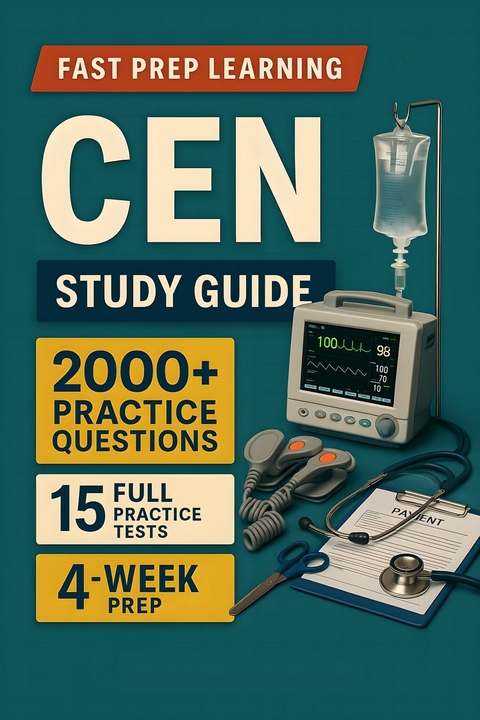
Cen Study Guide (eBook)
147 Seiten
Publishdrive (Verlag)
9780001113268 (ISBN)
What if I told you that preparing for the CEN exam with confidence-without stress, without overwhelm, and without doubting your emergency care skills-can become your reality?
If you're worried you won't pass on the first attempt or certain emergency scenarios still feel unclear, then following a clinically aligned study plan can be your answer.
It's so effective because every chapter mirrors real CEN testing patterns, trauma logic, and clinical pathways used in emergency departments across the country.
All lessons follow the BCEN exam blueprint, making this guide ideal for emergency nurses, travel nurses, and first-time CEN candidates. So whether you're new to the ED or have years of experience, this book supports every level of emergency practice.
So you get one study guide... that works for busy nurses, retakers, and anyone who wants a clear, structured path to passing.
And if you feel unsure whether this can truly help you succeed, don't worry.
Inside this guide you'll find straightforward explanations, real-world examples, and focused strategies that help transform clinical experience into exam success.
You don't need long study sessions. Even 30 minutes a day is enough to build confidence, reinforce key concepts, and keep you on track.
Whether you struggle with trauma protocols, cardiac emergencies, pediatrics, shock, respiratory conditions, or OB/GYN scenarios, each chapter teaches you exactly how to think like the CEN exam expects.
Here is just a fraction of what you'll discover inside this book:
• A complete 4-week study plan with simple daily tasks
• Emergency fundamentals aligned with the official BCEN blueprint
• Trauma care essentials: burns, fractures, bleeding control, shock, head injuries
• Medical emergency coverage: GI, GU, endocrine, infectious disease, neuro
• Cardiac and respiratory emergencies explained with clinical clarity
• Pediatric and geriatric emergency considerations
• OB/GYN emergencies, labor complications, and postpartum risks
• Environmental and toxicology emergencies simplified
• Disaster management, triage systems, and MCI principles
• 90+ exam-style practice questions with step-by-step reasoning
• Short, focused lessons ideal for busy nurses
• Up-to-date content reflecting modern emergency care standards
• Quick-reference charts, assessment guides, and terminology summaries
To get your copy right now, just scroll up and click 'Add to Cart.'
Chapter 2: Emergency Assessment Frameworks
Overview
Emergency assessment requires structured, repeatable approaches that rapidly identify life-threatening conditions. This chapter reinforces the primary and secondary survey frameworks used in modern emergency nursing, including ABCDE, focused assessments, and triage systems like ESI. You’ll learn how to differentiate findings requiring immediate intervention from those that can wait until later in the exam or clinical workflow. Because assessment forms the backbone of many CEN questions, mastery of these frameworks is essential for interpreting clinical scenarios quickly and accurately. This chapter emphasizes early recognition of deterioration, selection of appropriate interventions, and prioritization based on severity and resource needs. You will also examine disaster triage and high-acuity principles that guide mass-casualty decisions.
Learning Objectives
- Apply ABCDE priorities consistently
- Differentiate primary vs. secondary assessment findings
- Identify red flags needing rapid intervention
- Use triage tools such as ESI and disaster frameworks
- Recognize trends indicating early deterioration
### Core Concepts
#### Concept 1: Primary Assessment (ABCDE)
Explanation
ABCDE is the gold standard for identifying immediate life threats. Each step must be completed in sequence: airway, breathing, circulation, disability (neuro), and exposure. Interventions should occur the moment a threat is detected.
Worked Example
A trauma patient presents with snoring respirations and retractions. Even if hypotension is noted, airway positioning and adjunct insertion take priority over fluid resuscitation.
Common Pitfalls
- Jumping to circulation before airway
- Treating low blood pressure without securing ventilation
- Missing subtle signs like muffled voice or accessory muscle use
#### Concept 2: Secondary Assessment & Focused Exam
Explanation
After stabilization, perform a head-to-toe survey, obtain vitals, and review focused history. Secondary assessment identifies hidden injuries and clarifies the clinical picture.
Worked Example
A stable MVC patient with chest tenderness undergoes full secondary assessment before diagnostic imaging is ordered.
Common Pitfalls
- Completing secondary assessment before addressing airway
- Over-reliance on initial vitals without trending
- Missing nonverbal cues (grimacing, guarding)
#### Concept 3: Triage Systems (ESI & Disaster Triage)
Explanation
ESI levels prioritize resources and acuity. ESI 1 = immediate life threat. Disaster triage shifts from individual optimization to population survival, using START or SALT frameworks.
Worked Example
A patient with respiratory distress requiring immediate airway support is ESI 1 even if vitals are borderline.
Common Pitfalls
- Confusing resource-based ESI with diagnosis-based systems
- Misclassifying stable patients with abnormal vitals
- Using hospital-level triage (ESI) during mass casualty events instead of START/SALT
### Guided Practice (5 items)
Q1. The first priority in ABCDE is always:
A) Assess circulation B) Insert IV C) Airway D) Disability E) Exposure
Correct: C
Q2. Secondary assessment occurs:
A) Before airway management
B) After all life threats addressed
C) Only in trauma
D) Before vital signs
E) Immediately on arrival
Correct: B
Q3. ESI 1 classification reflects:
A) High resource needs only
B) Life-threatening instability
C) Mild distress
D) Need for labs
E) Non-urgent care
Correct: B
Q4. START triage prioritizes:
A) Detailed assessment
B) Speed and population survival
C) Diagnosis-based categories
D) Resource-heavy interventions
E) Secondary survey
Correct: B
Q5. A subtle early sign of airway compromise is:
A) Bradypnea
B) Cardiac arrest
C) Hoarse voice
D) Cyanosis
E) Apnea
Correct: C
### Quick Checks (Answer Key Only)
- C 2) B 3) B 4) B 5) C
Part II — Shock, Resuscitation & Trauma
## Chapter 3: Shock Recognition & Management
(Target ~6,000 words; long, detailed, high-value clinical content)
### Overview (≈170–180 words)
Shock is a state of impaired tissue perfusion in which oxygen delivery fails to meet metabolic demands. In emergency nursing, early shock recognition is one of the highest-value skills you can master—both clinically and for the CEN exam. Shock questions frequently test subtle physiologic patterns, compensatory changes, and the correct sequence of interventions. This chapter provides a systematic approach to identifying the four major shock types—hypovolemic, cardiogenic, distributive, and obstructive—and teaches how to interpret key hemodynamic markers, vital sign trends, and compensatory mechanisms. You’ll learn how to differentiate early from late shock, select appropriate therapies, and prioritize interventions that stabilize circulation while addressing underlying causes.
Because shock appears throughout the CEN blueprint, this chapter is intentionally comprehensive. We explore both classic and exam-favorite presentations such as tension pneumothorax, tamponade, sepsis, and massive hemorrhage. You will also work through clinical decision pathways, scenario-based examples, common pitfalls, and targeted practice questions designed to reinforce pattern recognition and exam-ready reasoning.
### Learning Objectives
- Distinguish the four major types of shock by pathophysiology and presentation
- Identify early vs. late hemodynamic and clinical markers
- Select evidence-based interventions for each shock type
- Prioritize ABC and circulation-stabilizing steps
- Recognize exam-favorite shock patterns and subtle clues
### Core Concepts
#### Concept 1: Types of Shock — Foundations & Pathophysiology
Hypovolemic Shock
Explanation
Hypovolemic shock results from decreased circulating volume, most commonly from hemorrhage, burns, dehydration, or third spacing. The core issue is inadequate preload. Early compensatory mechanisms include tachycardia, narrowed pulse pressure, cool skin, and delayed cap refill. Late signs include hypotension and altered mental status.
Worked Example
A trauma patient presents with tachycardia, pale cool skin, and borderline blood pressure. Even if there is no obvious external bleeding, the exam expects you to suspect internal hemorrhage until proven otherwise.
Common Pitfalls
- Waiting for hypotension before diagnosing shock
- Over-focusing on external bleeding and missing internal hemorrhage
- Forgetting that elderly patients may not mount tachycardia
Cardiogenic Shock
Explanation
Cardiogenic shock is pump failure—often caused by STEMI, arrhythmias, severe CHF, or cardiomyopathy. Patients typically show cool, clammy skin, pulmonary edema, JVD, and hypotension unresponsive to fluids.
Worked Example
A patient with chest pain and crackles has hypotension after receiving a 250 mL bolus. The correct response is stop fluids and start pressors—the exam rewards understanding that fluids worsen cardiogenic shock.
Common Pitfalls
- Giving aggressive fluids
- Misinterpreting crackles as pneumonia instead of pump failure
- Missing arrhythmia-induced cardiogenic shock
Distributive Shock
Explanation
Distributive shock involves massive vasodilation and maldistribution of blood flow. Types include:
- Septic shock (most common)
- Neurogenic shock
- Anaphylactic shock
Early septic shock may present with warm, flushed skin (unlike other shock types). Neurogenic shock uniquely presents with hypotension + bradycardia.
Worked Example
A patient with fever, warm skin, bounding pulses, and confusion likely has early septic shock. The best initial step is aggressive fluids + broad-spectrum antibiotics.
Common Pitfalls
- Missing “warm shock” early presentation
- Confusing neurogenic shock (bradycardia) with hypovolemic shock (tachycardia)
- Delaying antibiotics
Obstructive Shock
Explanation
Obstructive shock is caused by physical obstruction to blood flow, most commonly:
- Tension pneumothorax
- Cardiac tamponade
- Massive PE
Worked Example
A patient with sudden dyspnea, unilateral breath sounds, and JVD after trauma = tension pneumothorax. Correct step: needle decompression, not imaging.
Common Pitfalls
- Ordering diagnostics before treating life threats
- Missing Beck’s triad in tamponade
- Treating PE’s hypotension with fluids instead of focusing on oxygenation and anticoagulation
#### Concept 2: Assessment Markers & Hemodynamic Patterns
Vital Signs & Compensation
Shock progresses as compensation fails:
Early: tachycardia → narrowed pulse pressure → tachypnea
Late: hypotension → altered mental status → metabolic acidosis
CEN Pattern Tip:
If the question describes “normal” blood pressure with multiple...
| Erscheint lt. Verlag | 1.12.2025 |
|---|---|
| Sprache | englisch |
| Themenwelt | Sachbuch/Ratgeber ► Beruf / Finanzen / Recht / Wirtschaft ► Bewerbung / Karriere |
| ISBN-13 | 9780001113268 / 9780001113268 |
| Informationen gemäß Produktsicherheitsverordnung (GPSR) | |
| Haben Sie eine Frage zum Produkt? |
 EPUB (Adobe DRM)
Größe: 1,1 MB
Kopierschutz: Adobe-DRM
Adobe-DRM ist ein Kopierschutz, der das eBook vor Mißbrauch schützen soll. Dabei wird das eBook bereits beim Download auf Ihre persönliche Adobe-ID autorisiert. Lesen können Sie das eBook dann nur auf den Geräten, welche ebenfalls auf Ihre Adobe-ID registriert sind.
Details zum Adobe-DRM
Dateiformat: EPUB (Electronic Publication)
EPUB ist ein offener Standard für eBooks und eignet sich besonders zur Darstellung von Belletristik und Sachbüchern. Der Fließtext wird dynamisch an die Display- und Schriftgröße angepasst. Auch für mobile Lesegeräte ist EPUB daher gut geeignet.
Systemvoraussetzungen:
PC/Mac: Mit einem PC oder Mac können Sie dieses eBook lesen. Sie benötigen eine
eReader: Dieses eBook kann mit (fast) allen eBook-Readern gelesen werden. Mit dem amazon-Kindle ist es aber nicht kompatibel.
Smartphone/Tablet: Egal ob Apple oder Android, dieses eBook können Sie lesen. Sie benötigen eine
Geräteliste und zusätzliche Hinweise
Buying eBooks from abroad
For tax law reasons we can sell eBooks just within Germany and Switzerland. Regrettably we cannot fulfill eBook-orders from other countries.
aus dem Bereich