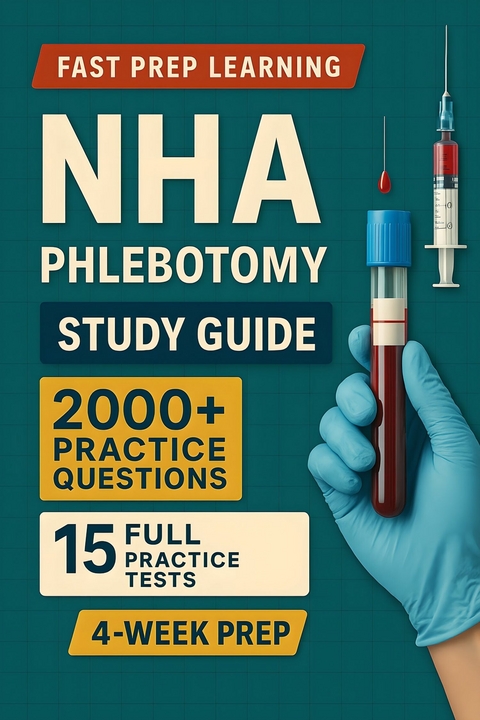
NHA Phlebotomy Study Guide (eBook)
149 Seiten
Publishdrive (Verlag)
9780001112797 (ISBN)
What if I told you that preparing for the NHA Phlebotomy exam with confidence-without stress, without confusion, and without second-guessing every answer-can become your reality?
If you're worried you won't pass on the first attempt or that you don't know where to start, then following a clinically aligned study plan can be your answer.
It can drastically improve your understanding of phlebotomy procedures, safety rules, and certification-level skills.
It's so effective because every chapter follows NHA exam standards, real testing logic, and step-by-step explanations that help you learn quickly and clearly.
All content is structured to match the exact knowledge areas the NHA evaluates-patient preparation, venipuncture, specimen handling, infection control, and professionalism.
So whether you're completely new to healthcare, already working in a clinical setting, or returning to study after years, this guide supports every learning level.
The truth is, you don't need medical experience to benefit-but it becomes even more powerful if certification is your next career step.
Inside this book you'll find simplified explanations, clinical examples, and exam-focused strategies designed to make learning easier, not harder.
You don't need long study sessions.If you only have 30 minutes per day, this system helps you build confidence quickly and efficiently.
Here is just a fraction of what you'll discover inside this book:
• A fully guided 4-week study plan with daily tasks
• All NHA Phlebotomy domains covered clearly and simply
• Step-by-step venipuncture and capillary collection procedures
• Order of draw charts, tube color explanations, and additive functions
• Safety rules, infection control, PPE basics, and exposure procedures
• Patient preparation techniques and special-population considerations
• Specimen processing, transport, and error-prevention strategies
• 90+ exam-style practice questions with detailed explanations
• Short, easy-to-read lessons ideal for busy students
• No outdated or irrelevant content-everything matches modern NHA expectations
• Checklists, terminology summaries, and workflow guides included
To get your copy right now, just scroll up and click 'Add to Cart.'
Chapter 1: Healthcare Systems, Roles, and Professional Conduct
1. The Healthcare System and Where Phlebotomists Fit In
Phlebotomists function at a critical intersection of patient care and laboratory science. Although most patients never step inside the laboratory, they usually meet the person who collects their blood. That contact is often their primary impression of the entire lab department. Because lab results drive the majority of medical decisions, the phlebotomist’s work directly influences diagnosis, monitoring, and treatment.
1.1 Healthcare Settings that Use Phlebotomists
Phlebotomists may work in many different environments:
- Hospitals (inpatient) – drawing samples from acutely ill, post-operative, or critically ill patients.
- Outpatient clinics and physician offices – performing routine draws for chronic disease management and screening.
- Reference laboratories – high-volume sample processing from multiple clinics or hospitals.
- Long-term care and nursing homes – serving older adults and medically complex residents.
- Emergency departments – responding quickly to STAT orders.
- Mobile phlebotomy services – visiting homes, workplaces, or community events.
Each setting has different workflow expectations. For example, in hospitals you may work from printed or electronic requisitions and follow a strict collection schedule; in outpatient clinics you may interact more with walk-in patients and insurance-related questions.
1.2 Example
A phlebotomist working in a large hospital starts the morning on the “AM round.” They receive a printed list of fasting labs, prioritize STAT orders, and move from room to room. Later that day, they might draw blood in the emergency department for a patient with chest pain, then head to outpatient oncology for central line collections.
Although the locations and patient populations change, the core responsibilities remain: correct patient identification, safe collection, accurate labeling, and timely delivery to the lab.
1.3 Common Pitfalls
- Failing to understand how your timing affects other departments (e.g., delay in draws delays medication decisions).
- Viewing phlebotomy as “just drawing blood” rather than a critical safety and quality role.
- Ignoring the unique needs of each setting, such as infection control in long-term care or fast turnaround in emergency departments.
2. The Role and Scope of the Phlebotomist
The phlebotomist’s role combines technical skills, communication, and professional judgment within a defined scope of practice.
2.1 Core Responsibilities
Typical phlebotomy duties include:
- Verifying test orders and requisitions.
- Correctly identifying the patient using at least two identifiers (for example, name and date of birth).
- Preparing equipment and selecting appropriate tubes based on ordered tests.
- Performing venipuncture or capillary puncture safely and efficiently.
- Labeling specimens at the bedside, in the presence of the patient.
- Ensuring proper handling, mixing, and transport of specimens.
- Documenting the collection in the appropriate system or log.
- Reporting issues such as unsuccessful attempts, patient refusal, or adverse reactions.
2.2 Scope of Practice
Phlebotomists are not providers. They do not diagnose conditions, interpret lab results, or independently change the test orders. Their scope generally includes:
- Collecting blood and, in many settings, some non-blood specimens.
- Following facility policies and national standards (CLSI, OSHA, etc.).
- Recognizing when something is outside their authority and escalating appropriately.
If a patient asks, “What do my lab results mean?” the appropriate response is to explain that the provider will interpret results and that your role is to obtain the sample accurately and safely.
2.3 Example
A patient asks the phlebotomist, “Is my white blood cell count high? Does that mean I have cancer?”
A professional phlebotomist might respond:
“I understand you’re worried. My role is to collect your blood so the provider can get accurate results. Your nurse or doctor will review your labs with you and explain what they mean.”
This maintains scope boundaries while still showing empathy.
2.4 Common Pitfalls
- Giving opinions about diagnoses (“It probably isn’t anything serious.”).
- Suggesting treatment (“You should ask for antibiotics.”).
- Changing or canceling orders without provider authorization.
Staying within scope protects the patient, the phlebotomist, and the organization.
3. Professionalism, Ethics, and Legal Principles
Professionalism goes beyond wearing scrubs. It includes your behavior, appearance, reliability, and respect for patients and coworkers.
3.1 Key Professional Behaviors
- Punctuality and reliability – arriving on time, completing rounds as scheduled.
- Appearance – clean uniform, closed-toe shoes, ID badge visible, good hygiene.
- Respectful communication – using appropriate titles, avoiding slang, listening actively.
- Confidentiality – not sharing patient information in public or with unauthorized persons.
- Accountability – admitting mistakes and following incident-reporting policies.
3.2 Ethics and Patient Rights
Important ethical principles include:
- Autonomy – patients have the right to make informed decisions, including refusing a blood draw.
- Beneficence – acting in the patient’s best interest (e.g., using the least painful, safest option).
- Nonmaleficence – “do no harm,” including avoiding unnecessary needle sticks.
- Justice – treating all patients fairly, regardless of background.
Patients have the right to:
- Be treated with respect and dignity.
- Know why blood is being collected.
- Refuse or withdraw consent.
- Have their information kept confidential.
3.3 Informed Consent
Before collecting blood, the patient should understand:
- Who you are and your role.
- What you plan to do.
- Why the specimen is needed.
Consent can be verbal in most routine cases, but some procedures use written consent according to facility policy.
If a patient declines, you must respect the refusal and inform the nurse or provider—never argue or coerce.
3.4 Legal Considerations
- Battery – touching a patient without consent, including performing a blood draw after refusal.
- Negligence – failing to follow the standard of care, which leads to harm.
- Abandonment – leaving a patient mid-procedure without ensuring safety.
- Documentation – incomplete or inaccurate records can have legal consequences.
3.5 Example
A confused patient repeatedly pulls away, saying “No needles.” Their spouse insists, “Just hold him down and do it.”
The ethical and legal response is to stop the attempt, ensure safety, and notify the nurse. You do not proceed against the patient’s expressed refusal.
4. Confidentiality, PHI, and HIPAA Basics
Phlebotomists regularly handle protected health information (PHI), such as names, medical record numbers, and test orders. Keeping PHI secure is both an ethical and legal requirement.
4.1 PHI in Everyday Practice
Examples of PHI you may encounter:
- Patient names on wristbands and requisitions.
- Medical record numbers and dates of birth.
- Test orders that may reveal diagnoses (e.g., HIV testing, pregnancy tests).
You must only access and share PHI when it is necessary for your job.
4.2 Confidentiality in Real Life
- Do not discuss patients in elevators, hallways, or cafeterias.
- Do not post any patient-related content on social media.
- Do not leave papers with names visible where others can see them.
- Log out of electronic systems when stepping away.
4.3 Example
A phlebotomist finishes a difficult draw on a well-known local athlete. At lunch, a coworker asks, “What are they in for?” The correct professional response is:
“I can’t discuss any patient information. Everything we do here is confidential.”
4.4 Common Pitfalls
- Reading charts out of curiosity.
- Looking up friends’ or family members’ results without a work-related reason.
- Sharing patient stories with identifying details.
Any of these can be violations and may result in disciplinary action.
5. Communication and Patient Interaction
Communication is just as important as technical skill. A well-performed venipuncture may still be experienced as negative if the patient feels ignored, rushed, or disrespected.
5.1 Building Rapport
Key steps include:
- Knock, enter, and introduce yourself: name and role.
- Verify the patient’s identity using two identifiers.
- Explain what you are going to do in clear, simple language.
- Ask if the patient has had problems with blood draws before.
- Encourage questions and respond calmly.
For anxious patients, a few extra...
| Erscheint lt. Verlag | 30.11.2025 |
|---|---|
| Sprache | englisch |
| Themenwelt | Sachbuch/Ratgeber ► Beruf / Finanzen / Recht / Wirtschaft ► Bewerbung / Karriere |
| ISBN-13 | 9780001112797 / 9780001112797 |
| Informationen gemäß Produktsicherheitsverordnung (GPSR) | |
| Haben Sie eine Frage zum Produkt? |
 EPUB (Adobe DRM)
Größe: 1,2 MB
Kopierschutz: Adobe-DRM
Adobe-DRM ist ein Kopierschutz, der das eBook vor Mißbrauch schützen soll. Dabei wird das eBook bereits beim Download auf Ihre persönliche Adobe-ID autorisiert. Lesen können Sie das eBook dann nur auf den Geräten, welche ebenfalls auf Ihre Adobe-ID registriert sind.
Details zum Adobe-DRM
Dateiformat: EPUB (Electronic Publication)
EPUB ist ein offener Standard für eBooks und eignet sich besonders zur Darstellung von Belletristik und Sachbüchern. Der Fließtext wird dynamisch an die Display- und Schriftgröße angepasst. Auch für mobile Lesegeräte ist EPUB daher gut geeignet.
Systemvoraussetzungen:
PC/Mac: Mit einem PC oder Mac können Sie dieses eBook lesen. Sie benötigen eine
eReader: Dieses eBook kann mit (fast) allen eBook-Readern gelesen werden. Mit dem amazon-Kindle ist es aber nicht kompatibel.
Smartphone/Tablet: Egal ob Apple oder Android, dieses eBook können Sie lesen. Sie benötigen eine
Geräteliste und zusätzliche Hinweise
Buying eBooks from abroad
For tax law reasons we can sell eBooks just within Germany and Switzerland. Regrettably we cannot fulfill eBook-orders from other countries.
aus dem Bereich