


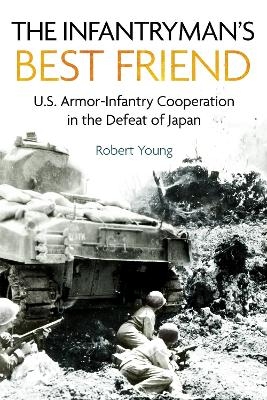
The Infantryman's Best Friend
U.S. Armor–Infantry Cooperation in the Defeat of Japan
Seiten
2027
Casemate Publishers (Verlag)
978-1-63624-665-9 (ISBN)
Casemate Publishers (Verlag)
978-1-63624-665-9 (ISBN)
- Noch nicht erschienen (ca. Februar 2027)
- Versandkostenfrei
- Auch auf Rechnung
- Artikel merken
In the Pacific War, American tanks were essential partners to the infantry. From Tarawa to Okinawa, tanks helped break fortified Japanese defenses of bunkers, caves, and pillboxes. This book explores how armor supported infantry across island campaigns and how coordination between the two often determined success or failure.
In the European theater of World War II, the tank was the master of the battlefield. From the initial German blitzkrieg to the Allied advance across western Europe, its armor, firepower, and mobility revolutionized warfare. In the Pacific the tank was not the master of the battlefield but American infantry’s big brother. That did not make them any less vital. The Pacific was a maze of islands, most of them very small though as the war progressed campaigns were fought across larger islands including Luzon and Okinawa, a the Japanese turned those islands into fortresses. Due to the terrain and conditions in the Pacific, the infantry of the U.S. Army and Marine Corps were the main weapon, but they often needed help to blast through Japanese defenses. In Europe the tank’s main opposition was other tanks; in the Pacific the opposition was pillboxes, bunkers, and caves. On battlefields from New Guinea to the Philippines, Tarawa to Iwo Jima, American tanks supported their infantry brethren as they advanced towards Japan.
To operate effectively together tanks and infantry had to train together. The effectiveness of this joint training was displayed on the numerous battlefields. Problems arose when units did not spend enough time together or in some cases, were completely unfamiliar with each other. Both infantry and armor had to understand the other’s capabilities and vulnerabilities to work effectively.
This study examines the role tanks played in many of the individual battles in the Pacific War. Their value is demonstrated not in just the battles they participated in but in those they were unable to join. When tanks could not lend their support, due to the difficult jungle terrain of Pacific islands, battles took more time and were more costly.
In the European theater of World War II, the tank was the master of the battlefield. From the initial German blitzkrieg to the Allied advance across western Europe, its armor, firepower, and mobility revolutionized warfare. In the Pacific the tank was not the master of the battlefield but American infantry’s big brother. That did not make them any less vital. The Pacific was a maze of islands, most of them very small though as the war progressed campaigns were fought across larger islands including Luzon and Okinawa, a the Japanese turned those islands into fortresses. Due to the terrain and conditions in the Pacific, the infantry of the U.S. Army and Marine Corps were the main weapon, but they often needed help to blast through Japanese defenses. In Europe the tank’s main opposition was other tanks; in the Pacific the opposition was pillboxes, bunkers, and caves. On battlefields from New Guinea to the Philippines, Tarawa to Iwo Jima, American tanks supported their infantry brethren as they advanced towards Japan.
To operate effectively together tanks and infantry had to train together. The effectiveness of this joint training was displayed on the numerous battlefields. Problems arose when units did not spend enough time together or in some cases, were completely unfamiliar with each other. Both infantry and armor had to understand the other’s capabilities and vulnerabilities to work effectively.
This study examines the role tanks played in many of the individual battles in the Pacific War. Their value is demonstrated not in just the battles they participated in but in those they were unable to join. When tanks could not lend their support, due to the difficult jungle terrain of Pacific islands, battles took more time and were more costly.
Robert Young has a PhD in military history and is a professor at American Military University. He is associate editor of Military History Chronicles. He is the author of Pacific Hurtgen, They Too Fought the Japanese, and The Forgotten Army, a number of articles and a chapter on combined arms in the New Guinea campaign to Bringing Order to Chaos (2018).
1. Background
2. The First Battles—Army Tanks at Buna, Marine tanks at Guadalcanal
3. Japanese Anti-tank Tactics and Weapons
4. 1943—A Year of Training and Preparation
5. Near Disaster—Tanks on Tarawa
6. They Turned the Tide—Tanks on New Guinea
7. The Mariana Campaign
8. We Used Them Where We Could—Tanks in the Philippines
9. Iwo Jima and Okinawa
Conclusions
Appendices
| Erscheint lt. Verlag | 1.2.2027 |
|---|---|
| Zusatzinfo | 50 |
| Sprache | englisch |
| Maße | 152 x 229 mm |
| Themenwelt | Natur / Technik ► Fahrzeuge / Flugzeuge / Schiffe ► Militärfahrzeuge / -flugzeuge / -schiffe |
| Geschichte ► Allgemeine Geschichte ► 1918 bis 1945 | |
| Geisteswissenschaften ► Geschichte ► Regional- / Ländergeschichte | |
| Geschichte ► Teilgebiete der Geschichte ► Militärgeschichte | |
| Sozialwissenschaften ► Politik / Verwaltung | |
| ISBN-10 | 1-63624-665-6 / 1636246656 |
| ISBN-13 | 978-1-63624-665-9 / 9781636246659 |
| Zustand | Neuware |
| Informationen gemäß Produktsicherheitsverordnung (GPSR) | |
| Haben Sie eine Frage zum Produkt? |
Mehr entdecken
aus dem Bereich
aus dem Bereich
von der frühen Neuzeit bis ins Computerzeitalter
Buch | Hardcover (2025)
De Gruyter (Verlag)
CHF 83,90


