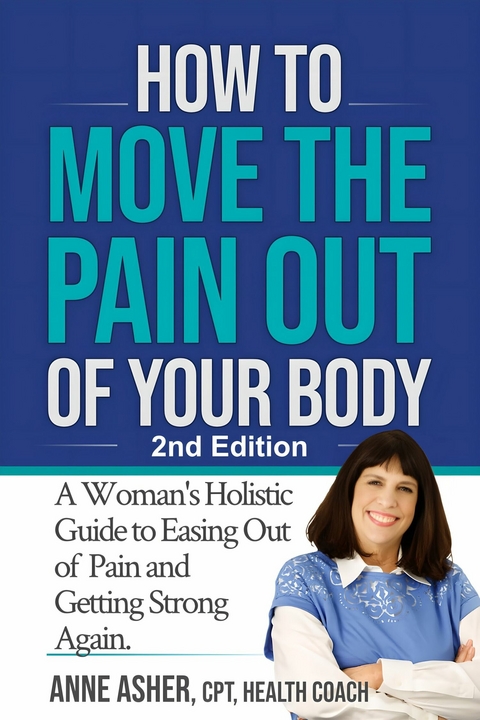
How to Move the Pain Out of Your Body (eBook)
228 Seiten
Publishdrive (Verlag)
978-0-00-111067-0 (ISBN)
Tired of living with pain? Getting relief can be a satisfying experience...
When you know how the body moves and heals itself.
As it is with most people who live with low back pain, if posture or muscle imbalances are what underlie your condition you may be able to resolve it yourself.
Try an approach to corrective exercise that includes simple, refreshing techniques to align joints, relax muscle stiffness and strengthen your core.
A RECIPIE FOR STAYING IN CHRONIC PAIN MUCH LONGER THAN YOU HAVE TO
(Don't try this if your pain is caused by poor posture or muscle imbalance.)
Doctors typically treat chronic pain with pills, injections and surgeries. But research shows these approaches often do not meet patients' expectations for long term relief and increased physical functioning.
And many complain that conventional medicine is a mill.
No matter how much it hurts, how long you've been enduring the pain nor how disruptive it's been to your life, relationships and finances, provider appointments are generally limited to 15 minutes. Patients also complain that during their allotted 15 minute window, the doctor doesn't seem to be listening.
Going that route alone, without a skillful, holistic approach to movement, is a recipe for staying in chronic body pain for the long term.
If you've tried every treatment you can think of and are still in pain, perhaps it's time to:
1. Take charge of things yourself.
2. Take a step back and learn about how the body moves and heals itself.
3. And use a gentle but powerful approach that honors your strengths as a human being right from the outset.
Learn short and long term pain relief techniques used by certified personal trainer and health coach, and award-winning spine health journalist, Anne Asher, to heal her own pain and help her clients do the same.
YOU'LL COME AWAY WITH...
1. Gentle, effective techniques to ignite your motivation
2. Pre-exercises for getting into proper alignment
3. Alignment experiences that help you start moving again - without stress or judgment
4. A Holistic Foundation for all types of movement, including corrective exercise
5. The ability to turn a generic back strengthening program (provided in the book) into a healing experience.
You'll adore this program, because fully engaging in your activities without paying for it later is a great way to live.
Introducing the Movement Instrument
As I alluded to when I told you my story, the key to feeling and functioning the way you did 5, 10 or even 20 years ago likely lies in your body’s alignment, how strong your core is, plus your overall muscle balance. (These are all related.)
And, as you've probably guessed, addressing these conditions requires moving your body, using your muscles, and well, exercising.
But for those of us who deal with injuries, posture problems, dysfunction, and/or pain, receiving exercise instructions barked out by cute 20-something gym bunnies, or turning to a medical system that by necessity must answer to the insurance industry before it can answer to its patients, can be frustrating to say the least.
If you are intrigued by the idea of “owning” your body and taking charge of your pain yourself, you may find these more conventional avenues limiting as well.
These are a few of the reasons why I like to talk to people about using an inside out approach to exercise and movement.
GET IN SYNCH
Very much a mind-body activity, the inside-out approach is about getting in synch with your physical self before, during and after doing prescribed movements for pain relief and/or improved physical functioning. It's about arriving at a whole new vista for understanding flexibility; in other words, going beyond mere stretching exercises and working strategically with your alignment.
Not only will the inside-out approach help you establish a therapeutic focus for the work you’ll do, but it’s also an enjoyable and relaxing experience. It may help ease you out of pain, which is a good idea prior to engaging with strengthening exercise.
Don’t get me wrong. As I said, you do need to work your muscles, or most likely your body will always hurt. But to target the right muscles for strengthening, the ones that are designed to keep you up against the downward pull of gravity without pain, you’ll need to find them first. The same is true for the joints and bones. I’ll walk you through that.
The beauty of the inside-out approach used in this book is that the techniques can serve multiple purposes at the same time including, but not limited to, energy rejuvenation, flexibility improvement, strengthening and, an idea with which we'll work a lot in this book, as a way of learning about how your body is designed to move.
DON'T LET THE WORD “ANATOMY” SCARE YOU I PROMISE!
I’m an anatomy geek, but I know not everyone is.
The good news is that I’m also an artist-type. The combination allows me to present this aspect of the work in an easy-to-digest - and even fun - way.
Knowing and consciously experiencing your instrument – the muscles, bones and joints that produce your movements - is important for this work. Without being aware of the areas to target, it will be difficult, if not impossible, to effectively use movement and exercise for releasing chronic pain.
Bear with me on this. Your back and joints will thank you for it.
ANATOMY: EASY TO LEARN POWERFUL TO EMPLOY
In this chapter – “Introduction to the Instrument” - you’ll learn about, and experience, aspects of muscle, bone and joint anatomy rarely revealed to clients or patients in typical fitness and clinical settings.
A big reason why I dedicate an entire section to this topic is that I truly believe with guidance, most exercisers are quite capable of understanding enough anatomy to manage their chronic pain themselves - without straining the brain. This type of body knowledge is key for transforming routine - and often ineffective – exercise programs into healing experiences.
While getting clear on your anatomy is instrumental for your success with my program, this won’t be an academic experience.
No quizzes. No memorization. I promise.
For example, in the “Build a Holistic Foundation” section, you’ll learn unique breathing and imagery techniques for finding the muscles, bones and joints to employ for releasing longstanding pain.
If you’re anything like my clients and I, you’ll love them. But there's more to the Holistic Foundation than its feel-good aspect. The Holistic Foundation can get you started with the subtle but powerful approach to movement-based healing and chronic pain management I mentioned earlier.
In the “Exercise” section you’ll learn how to weave the Holistic Foundation, along with your newly acquired anatomy knowledge, into basic back exercises – the same exercises you’d likely get as a patient in a spine care program. The difference is, the exercises are “Posturally-atized,” meaning they combine research-based, recommended starter core support exercises with inside-out, holistic techniques that take the whole person into consideration.
In this way, you’ll begin to grow a skill set you can apply to nearly all your physical activities, be they your daily tasks or chores, your chosen workout routine, a home exercise program given to you by your doctor or P.T., or any standalone healing/relaxation session you may gift to yourself.
With that in mind, let’s start learning about this instrument – your body – that supports you when you stand or sit, takes you where you intend to go, and does its very best to carry out your every objective, goal, and dream.
And since much of this book is about strengthening your core, we’ll begin with the abs.
ABS, YOUR BACK'S BFF (BEST FRIEND FOREVER)
Also known as the "washboard abs," the rectus ab muscle extends straight down from ribs to pelvis. Its main job is to bend the spine over. Think “crunches.”
Most people associate the term “abdominal muscle” with the much-coveted washboard abs they see in men’s magazines.
The highly sculpted muscle they drool over is called the rectus abdominus.
Well, I am sorry to be the one to pop a hole in your balloon, but as far as low back pain and great posture are concerned, the rectus, as it is sometimes called for short, is not the most important ab muscle to focus on.
We humans have six abdominals. The location of each greatly affects the amount and type of influence it has over your posture and back health. From superficial, meaning you can touch them through the skin, to deep, the six abs are:
- Rectus Abdominus
- External Obliques
- Internal Obliques
- Transverse Abdominus.
We’ll next go through all of them in detail. You’ll learn where they are, what they do and what each means to good posture and a heathy, happy back.
Also known as the "washboard abs," the rectus abdominus muscle extends straight down from ribs to pelvis. The rectus abdominal muscle, sometimes called the RA muscle, is the most superficially located ab.
You can touch the RA from the outside – that’s what makes it “superficial”. The rectus abdominus bends your body forward. This action is called trunk “flexion.”
Any and all ab muscles connect from ribs to pelvis, allowing them to provide core stability to the entire trunk. All 6 abs work together to make this happen. It's just that some have greater influence over posture and body alignment than others.
THE OBLIQUE AB MUSCLES
Underneath the rectus (often phrased as “deep to the rectus”), are two pairs of ab muscles, on each site for a total of four, that orient in opposite diagonal directions to one another. This diagonal crisscrossing makes for scaffolding that can be very supportive for the trunk and core. These are the oblique muscles, namely the external obliques and the internal obliques.
Like the rectus, both the internal and external obliques run from ribs to pelvis. Both sets of oblique muscles mainly work to tilt and turn your spine (called lateral flexion and spinal rotation, respectively).
And key to our work in Section 3, Exercise, they also play an important role in stabilizing your trunk during movement.
External Obliques
The external obliques are more superficial than the internal obliques. The external obliques are oriented the same direction your fingers point when you put your hands in your pocket.
Internal Oblique Abs
The internal oblique abs are located underneath the externals. In other words, they are “deep" to the external obliques.
Due to their deep location, the internals will likely influence your posture and low back health more than...
| Erscheint lt. Verlag | 18.11.2025 |
|---|---|
| Sprache | englisch |
| Themenwelt | Sachbuch/Ratgeber ► Gesundheit / Leben / Psychologie |
| ISBN-10 | 0-00-111067-5 / 0001110675 |
| ISBN-13 | 978-0-00-111067-0 / 9780001110670 |
| Informationen gemäß Produktsicherheitsverordnung (GPSR) | |
| Haben Sie eine Frage zum Produkt? |
 EPUB (Adobe DRM)
Größe: 8,4 MB
Kopierschutz: Adobe-DRM
Adobe-DRM ist ein Kopierschutz, der das eBook vor Mißbrauch schützen soll. Dabei wird das eBook bereits beim Download auf Ihre persönliche Adobe-ID autorisiert. Lesen können Sie das eBook dann nur auf den Geräten, welche ebenfalls auf Ihre Adobe-ID registriert sind.
Details zum Adobe-DRM
Dateiformat: EPUB (Electronic Publication)
EPUB ist ein offener Standard für eBooks und eignet sich besonders zur Darstellung von Belletristik und Sachbüchern. Der Fließtext wird dynamisch an die Display- und Schriftgröße angepasst. Auch für mobile Lesegeräte ist EPUB daher gut geeignet.
Systemvoraussetzungen:
PC/Mac: Mit einem PC oder Mac können Sie dieses eBook lesen. Sie benötigen eine
eReader: Dieses eBook kann mit (fast) allen eBook-Readern gelesen werden. Mit dem amazon-Kindle ist es aber nicht kompatibel.
Smartphone/Tablet: Egal ob Apple oder Android, dieses eBook können Sie lesen. Sie benötigen eine
Geräteliste und zusätzliche Hinweise
Buying eBooks from abroad
For tax law reasons we can sell eBooks just within Germany and Switzerland. Regrettably we cannot fulfill eBook-orders from other countries.
aus dem Bereich