
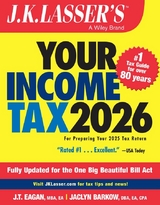
The most up-to-date entry in America's #1 all-time best-selling personal tax guide
J.K. Lasser's Your Income Tax 2026: For Preparing Your 2025 Tax Return delivers practical and hands-on guidance for everyday people preparing to file their taxes for the 2025 calendar year. You'll find timely and up-to-date info about the latest changes to the US tax code, as well as worksheets and forms you can use to make filing your taxes easier. You'll get the most current insight on how to maximize your credits and deductions, keeping more money in your pocket.
In the latest edition of this celebrated and best-selling series, you'll find:
- Special features that walk you through the most recent Tax Court decisions and IRS rulings that determine how your deductions and credits will work
- Simple tips and tricks on how to properly file your taxes, as well as tax planning strategies that save you and your family money
- Full updates on the One Big Beautiful Bill Act and how it could impact your tax
- A revised and expanded section on cryptocurrency.
Trusted by hundreds of thousands of Americans for over 80 years, J.K. Lasser's Your Income Tax 2026 is the perfect resource for everyone looking for the latest and most up-to-date personal tax information to make filing their next tax return a breeze.
What’s New for 2025
Significant Tax News for 2025
| Item— | Highlight— |
|---|
| Tax rate brackets and preferential rates for capital gains/qualified dividends | The rate brackets for 2025 ordinary income remain at 10%, 12%, 22%, 24%, 32%, 35% and 37%, but the taxable income amounts in each bracket have changed. The top bracket of 37% for 2025 applies if taxable income exceeds $626,350 for single taxpayers and heads of households, $751,600 for married persons filing jointly and qualifying surviving spouse, and $375,800 for married taxpayers filing separate returns {1.2}. Qualified dividends {5.2} and long-term capital gains {6.3} may escape tax entirely under the 0% rate, or be subject to capital gain rates of 15% or 20% depending on filing status, taxable income, and how much of the taxable income consists of qualified dividends and eligible long-term gains {6.3}. The 20% capital gain rate applies in 2025 when taxable income exceeds $533,400 for single taxpayers, $566,700 for heads of households, $600,050 for married persons filing jointly and qualifying surviving spouse, and $300,000 for married persons filing separately. The 0%, 15%, and 20% rates do not apply to long-term gains subject to the 28% rate (collectibles and taxed portion of small business stock) or the 25% rate for unrecaptured real estate depreciation {6.3}. |
| Retirement plan distributions | The SECURE Act raised the age to 72 for IRA owners who reached age 70½ after 2019, meaning those born on or after July 1, 1949. SECURE 2.0 raised the age again; anyone attaining age 72 after 2022 does not have to begin receiving RMDs until the year they reach age 73 {9.13}. |
| Education-related tax breaks | Educator expenses of up to $300 are deductible for 2025 {13.2}. |
| Standard deductions | The basic standard deduction for 2025 {14.1} is $31,500 for married persons filing jointly and qualifying surviving spouse, $23,625 for heads of households, or $15,750 for single taxpayers or married persons filing separately. The additional standard deduction {14.4} for being 65 or older or blind increases to $2,000 if single or head of household ($4,000 if 65 and blind). If married filing jointly, the additional standard deduction increases to $1,600 if one spouse is 65 or older or blind, $3,200 if both spouses are at least 65 (or one is 65 and blind, or both are blind and under age 65). |
| Self-employment tax and deduction for portion of self-employment tax; Social Security wage base | For 2025, the tax rate on the employee portion of Social Security is 6.2% on wages up to $176,100, so Social Security tax withholdings should not exceed $10,918. Medicare tax of 1.45% is withheld from all wages regardless of amount. On Schedule SE for 2025, self-employment tax applies to earnings of up to $176,100; only 92.35% of earnings are taken into account. The 15.3% rate equals 12.4% for Social Security (6.2% employee share and 6.2% employer share) plus 2.9% for Medicare. If net earnings exceed $176,100 (after the reduction), the 2.9% Medicare rate applies to the entire amount {45.3–45.4}. One-half of the self-employment tax may be claimed as an above-the-line deduction on Schedule 1 of Form 1040 or 1040-SR {45.3–45.4}. |
| IRA and Roth IRA contributions | Contributions to a traditional IRA for 2025 can be made as long as you have earned income (or other eligible income). You may make contributions to a traditional IRA for 2025 of up to $7,000, or $8,000 if you are age 50 or older at the end of 2025, provided that you have at least $7,00/$8,000 of earned income {9.2}. |
| Qualified business income deduction | If you are a sole proprietor or have an interest in a partnership, limited liability company, or S corporation, you may be eligible for a deduction of up to 20% of qualified business income {40.24}. This deduction is a personal deduction, not a business deduction, and can be claimed whether you itemize or take the standard deduction. The taxable income amounts used to figure the deduction for 2025 have been increased for inflation. |
| First-year expensing | For qualifying property placed in service in 2025, first-year expensing {42.3} is allowed up to a limit of $2,500,000, and the limit begins to phase out if the total cost of qualifying property exceeds $4,000,000 {42.3}. |
| IRS mileage allowance | The IRS standard business mileage rate for 2025 is 70 cents per mile {43.1}. The rate for medical expense {15.9} and moving expense for certain military personnel {13.3} deductions remains 21 cents per mile for 2025, unchanged from 2024. For charitable volunteers {18.4}, the mileage rate is unchanged at 14 cents a mile for 2025. |
| Vehicle depreciation limit | For a vehicle placed in service in 2025 and used over 50% for business, the first-year depreciation limit using bonus depreciation is $20,200. However, if you elect not to have bonus depreciation apply, or you are not eligible for the bonus, the first-year depreciation limit is $12,200 {43.5}. |
| Clean vehicle credit | Credit of up to $7,500 for eligible new clean vehicles and up to $4,000 for eligible previously owned clean vehicles. Specific criteria must be met and must purchase must have occurred by September 30, 2025 {25.16}. |
| Health savings accounts (HSAs) | The definition of a high-deductible health plan, which is a prerequisite to funding an HSA, means a policy with a minimum deductible for 2025 of $1,650 for self-only coverage and a maximum out-of-pocket cap on co-payments and other amounts of $8,300. These limits are doubled for family coverage ($3,300/$16,600) {41.10}. The contribution limit for 2025 is $4,300 for self-only coverage and $8,550 for family coverage {41.11}. Those age 55 or older and not yet on Medicare can add an additional $1,000. |
| Adoption expenses | For 2025, the limit on the adoption credit as well as the exclusion for employer-paid adoption assistance is $17,280 {4.6}. The benefit phaseout range is modified adjusted gross income between $259,190 to $299,190 {25.9}. Beginning in 2025 with the passage of the One Big Beautiful Bill Act, up to $5,000 of this credit may now be refundable. |
| Child tax credit | For 2025, the maximum child tax credit for a child under age 17 is $2,200 {25.2}. The credit begins to phase out when modified adjusted gross income exceeds $400,000 on a joint return or $200,000 for all other filers. There is an additional child tax credit that can be claimed if the child tax credit otherwise allowed is limited by tax liability; the refundable amount may not exceed $1,700 per qualifying child {25.3}. The credit for other dependents is unchanged (i.e., not refundable and limited to $500 per dependent) {25.4}. The maximum child tax credit is now indexed for inflation. |
| Dependent care credit and exclusion | For 2025, the child and dependent care credit is nonrefundable {25.5}. Qualifying expenses taken into account in figuring the credit are $3,000 for one qualifying individual and $6,000 for two or more qualifying individuals. The credit ranges from 35% down to 20%, depending on adjusted gross income. The exclusion for dependent care under an employer’s dependent care assistance plan is $5,000 ($2,500 if married filing separately). |
| Earned income tax credit | For 2025, the maximum credit amount is $4,328 for one qualifying child, $7,152 for two qualifying children, $8,046 for three or more qualifying children, and $649 for taxpayers who have no qualifying child {25.7}. The phaseout ranges for the credit have been adjusted for inflation {25.8}. The excessive investment income limit is $11,950. |
| Premium tax credit | For 2025, the premium tax credit is allowed even if household income exceeds 400% of the federal poverty line. The required contribution percentages are reduced {25.13}. |
| Alternative minimum tax (AMT) exemption and tax brackets | The AMT exemptions, exemption phaseout thresholds, and the dividing line between the 26% and 28% AMT brackets are adjusted for inflation. The 2025 AMT exemptions (prior to any phaseout) are $137,000 for married couples filing jointly and qualifying surviving spouse, $88,100 for single persons and heads of households, and $68,500 for married persons filing separately. See 23.1 for exemption phaseout rules and AMT calculation details. All nonrefundable personal credits may be claimed against the AMT as well as the regular tax {23.3}. |
| Erscheint lt. Verlag | 25.11.2025 |
|---|---|
| Reihe/Serie | J.K. Lasser |
| Sprache | englisch |
| Themenwelt | Sachbuch/Ratgeber ► Beruf / Finanzen / Recht / Wirtschaft ► Geld / Bank / Börse |
| Schlagworte | 2025 credits • 2025 deductions • filing 2025 taxes • filing my taxes • how do I file my taxes? • Income tax 2025 • Jaclyn Barkow • JT Egan • OBBBA • tax credits • tax deductions • tax filing guide • tax filing tips • tax year 2025 • us income tax • us income tax 2025 • us income tax guide |
| ISBN-13 | 9781394359837 / 9781394359837 |
| Informationen gemäß Produktsicherheitsverordnung (GPSR) | |
| Haben Sie eine Frage zum Produkt? |
 EPUB (Adobe DRM)
Kopierschutz: Adobe-DRM
Adobe-DRM ist ein Kopierschutz, der das eBook vor Mißbrauch schützen soll. Dabei wird das eBook bereits beim Download auf Ihre persönliche Adobe-ID autorisiert. Lesen können Sie das eBook dann nur auf den Geräten, welche ebenfalls auf Ihre Adobe-ID registriert sind.
Details zum Adobe-DRM
Dateiformat: EPUB (Electronic Publication)
EPUB ist ein offener Standard für eBooks und eignet sich besonders zur Darstellung von Belletristik und Sachbüchern. Der Fließtext wird dynamisch an die Display- und Schriftgröße angepasst. Auch für mobile Lesegeräte ist EPUB daher gut geeignet.
Systemvoraussetzungen:
PC/Mac: Mit einem PC oder Mac können Sie dieses eBook lesen. Sie benötigen eine
eReader: Dieses eBook kann mit (fast) allen eBook-Readern gelesen werden. Mit dem amazon-Kindle ist es aber nicht kompatibel.
Smartphone/Tablet: Egal ob Apple oder Android, dieses eBook können Sie lesen. Sie benötigen eine
Geräteliste und zusätzliche Hinweise
Buying eBooks from abroad
For tax law reasons we can sell eBooks just within Germany and Switzerland. Regrettably we cannot fulfill eBook-orders from other countries.
aus dem Bereich