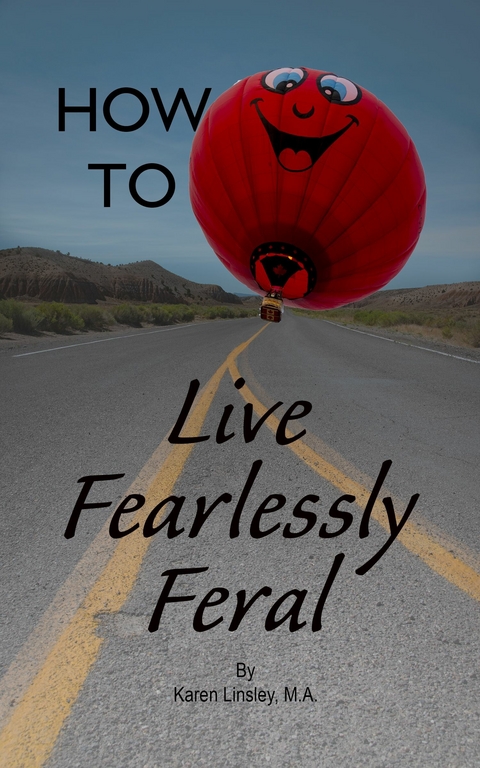
How to Live Fearlessly Feral (eBook)
264 Seiten
Bookbaby (Verlag)
979-8-9934051-1-7 (ISBN)
Rev. Karen Linsley has been described as a diminutive dynamo and a firecracker. She lives in rural Northern Nevada with two horses, two dogs and two cats. When she is not serving a Center for Spiritual Living community as their Interim Minister, she serves a greater audience through her Focus Ministry, Fearlessly Feral Living. She does this through her writings and podcast, as well as with numerous guest speaking engagements. In addition, she has the pleasure of officiating many elopements in nearby Lake Tahoe. She enjoys gardening, photography and cooking, especially when she can cook for others. Her web site is https://www.fearlesslyferal.org How to Live Fearlessly Feral is her third book. Her other two books are 'A New Thought Journey through the 12 Steps' and 'The Girl Who Cried Woogie.'
This book is your go to place for everything you need, all in one place, on your journey to a happier, more successful live than you ever dreamed possible. in this book, you will learn in depth about practices such as meditation, gratitude and forgiveness. In addition, you will also become well versed in affirmative prayer (also known as treatment), and the practice of unconditional love. Most importantly, there are several ways to practice introspection, leading to the invaluable self awareness that allows you to say yes when you mean yes, no when you mean no as well as set and keep healthy boundaries. In addition the list of principles is invaluable. Principles are like values, we must know what they are and what we believe in, so we are not swayed by opinions that are not our own. In this book, you will explore values or principles such as Love, Oneness, Freedom and the Creative Process. Last but not least are the monthly guides. Rather than daily guides, which tend to be superficial and thus short lived, this book takes you on a deep dive into a principle and a practice each month, so it is cemented and will last you for the rest of your life, ensuring that you live happily and successfully no matter what.
The We Believe Statements
I give credit to Centers for Spiritual Living and Science of Mind for these Principles. The We Believe statements came from Ernest Holmes, the founder of Centers for Spiritual Living, who, in the 1920s, originally penned these statements in the form of I Believe. He called our teaching Science of Mind because he believed that these core concepts were provable by scientific methods. And today, quantum physics has indeed proved many of these statements.
I won’t be going into much detail about these, like I will be the principles I mention in the principles section. I wanted to mention these because they are the precursors, and sometimes the foundation, to the principles and practices I mention, and to the teaching called Science of Mind that I love so much. And because I believe it is important for you, dear reader, to be aware of them.
The essential key here is to know which ones you believe in, and why, and then to further begin to know how to apply these beliefs in your life. How to live them. How to base your decisions on them. For example, you may be familiar with how businesses and even spiritual communities use mission statements. They get together, they use a process to create a mission statement, and then all subsequent decisions are based on that mission statement. In other words, if the decision or action being contemplated fits within the parameters of the mission statement, then the decision or action is approved. If not, it isn’t.
These statements, as are the following set of principles, can guide you in creating your own personal mission statement.
The We Believe statements are published every month in the Science of Mind magazine. By the way, if you don’t have a subscription to the magazine, I recommend you get one. These statements are also in Ernest Holmes’ book called Living the Science of Mind, along with his explanation of them. I’ve included my own brief interpretation here but I do recommend you read Living the Science of Mind, particularly the We Believe section, which is called What We Believe: The Declaration of Principles. The key to these principles is that they are a starting point for you to begin to do some inner inquiry about what it is that you believe in. A principle is like a value or a belief. It is something we base all our thoughts, words and deeds on. We get to create and/or choose our own principles. So as you read through these, feel free to rename, tweak, discard or add. Although I will highly and strongly suggest as we go along that some of them need to stay because they are key elements on the pathway to living Fearlessly Feral.
Some of these statements illustrate principles which I will be repeating, such as Oneness. I’ve included the We Believe statements because they are important in this teaching, and because they provide a good introduction to how I will present the principles later on in the book.
Here are the We Believe statements:
“WE BELIEVE in God, the Living Spirit Almighty; one, indestructible, absolute and self-existent Cause. This One manifests Itself in and through all creation, but is not absorbed by Its creation. The manifest universe is the body of God; it is the logical and necessary outcome of the infinite self-knowingness of God.”
I asked ChapGPT to give me a modernized version of this statement, and here is what it said: “We believe in a universal, powerful Spirit — the one true Source that’s unshakable, eternal, and completely self-sustaining. This Spirit shows up in everything around us and within us, but it’s bigger than just the world we see. The universe is like the body of this Spirit — a natural result of its infinite awareness and creative energy.”
God, or spirit, is. It just is. This, by the way, is also the first step of affirmative prayer, also called treatment, which we will cover in the practices section.
How could this principle be applied in your life? You may be familiar with aspects of Spirit, or qualities of God. Lots of different folks have posited their version of aspects of spirit. Here’s mine: love, freedom, energy, power. If you do a google search on aspects of God or aspects of spirit, you will get lots of hits. Choose some that resonate with you. Then ask yourself how you could apply these in your life. Or better yet, how you could allow such a principle as love or power to apply you. In other words, how could you allow a principle to work you and change you from the inside out.
For example, if I choose love as my primary aspect of spirit, I would then begin to contemplate all the different ways love shows up in the world. Contemplation is a spiritual practice, by the way. Once I get some concrete and clear examples of how love shows up in the world, my job would then be to exemplify that. To embody that. To practice what I’ve said love is. To be love. In all my affairs. To say to myself, in all situations, “love what is.” Just that. Love what is. Love it all. Just that. Love it all. You can use this principle as a guide. Because if you aren’t feeling right, guess what? Chances are there are some areas in your life where you are not being what you said you wanted to be.
This is how we use principle as our foundation.
“WE BELIEVE in the individualization of the Spirit in us, and that all people are individualizations of the One Spirit.”
This one is my favorite! My absolute favorite. My guiding light, my reason for being the way that I am, and my foundation for how I show up in the world. This is Oneness. Oneness is what gives me my faith. Oneness is what gives me my confidence and sense of self worth. Oneness is what gives me my power, my ability to do things that people say can’t be done. And I’ll be really honest here, the part in the statement about “all people are individualizations of the One Spirit” is what I use to speak to my own Oneness. It is from Ernest Holmes, saying that we are individualized centers of God consciousness, that I get that we are each individualized manifestations of God. Little Godlings running around on this earth, in our human versions, spirits having a human experience. One of my favorite Ernest Holmes quotes is from the Science of Mind textbook and it says this, “It has been said that we can know God only in so far as we can become God.” Take this far enough and consider the place where you can extrapolate that if we are each individualized centers of God consciousness, what does that mean for how we conduct our lives? Does this mean that we can say that we are God? OOOOH! Stop for a moment and check out what feelings popped up in you when you read that. Just notice. This is your line in the sand. The cool thing about lines in the sand is that they can be changed. Just saying.
Now, if you say you believe in this, then you may want to look at your languaging around God. Do you refer to It in the third person, as in “God does this and God does that?” Do you speak of God’s will as something outside of you? Is God a he? I’m not saying any of these things is wrong. I’m asking you to explore what you really believe about the statement that we are all manifestations of spirit.
“WE BELIEVE in the eternality, the immortality and the continuity of the individual soul, forever and ever expanding.”
How can this principle apply to us? Well, if we believe that our bodies are simply physical manifestations of spirit, then some part of us must be more than physical. A part of us that just might live on no matter what our physical bodies do. If we believed this, then wouldn’t this take away much of the fear of death? Something to consider.
And if we believed in this statement, then would we not want to explore how we could expand our soul, right here and now, while we are still on this plane of existence?
“WE BELIEVE that heaven is within us, and that we experience it to the degree that we become conscious of it.”
This one is pretty simple. We believe that heaven is simply a state of consciousness. As is hell.
Contemplate that for a while and see how this could apply in your life. Consider what most of us have been taught, that heaven and hell are a place we go to as our final reward or punishment, depending on how we have lived our life. Now consider a time in your life when you’ve felt like you’ve been in hell. Get down to the nitty gritty with this one. By the way, in the practices you will find ways to do this. You will find that the reason you are in hell is because you have made decisions and taken actions that are in direct conflict with the things you really believe in. You have ignored your intuition. You have gone against your true nature. That’s hell. Heaven, on the other hand, is when we are in touch with our intuition, when we know our true nature, when we act in accordance with that. When that happens, we experience peace, calm, joy, and we know what heaven feels like. Heaven and hell are simply states of consciousness.
“WE BELIEVE the ultimate goal of life to be a complete freedom from all discord of every nature, and that this goal is sure to be attained by all.”
Well! That’s quite a statement isn’t it? How on earth could it possibly say that? And mean it? Here’s the deal, we are as we believe. Here is a list of all traditions that say, in way or the other, that we are as we believe: Christianity, Hinduism, Taoism, Buddhism, Islam, Judaism, Indigenous wisdom, and of course, our very own New Thought/Science Of Mind.
What it boils down to is this: you either believe this statement or you don’t. The question is, why? And perhaps a bigger question: what...
| Erscheint lt. Verlag | 28.11.2025 |
|---|---|
| Sprache | englisch |
| Themenwelt | Sachbuch/Ratgeber ► Gesundheit / Leben / Psychologie ► Lebenshilfe / Lebensführung |
| ISBN-13 | 979-8-9934051-1-7 / 9798993405117 |
| Informationen gemäß Produktsicherheitsverordnung (GPSR) | |
| Haben Sie eine Frage zum Produkt? |
 EPUB (Ohne DRM)
Größe: 2,6 MB
Digital Rights Management: ohne DRM
Dieses eBook enthält kein DRM oder Kopierschutz. Eine Weitergabe an Dritte ist jedoch rechtlich nicht zulässig, weil Sie beim Kauf nur die Rechte an der persönlichen Nutzung erwerben.
Dateiformat: EPUB (Electronic Publication)
EPUB ist ein offener Standard für eBooks und eignet sich besonders zur Darstellung von Belletristik und Sachbüchern. Der Fließtext wird dynamisch an die Display- und Schriftgröße angepasst. Auch für mobile Lesegeräte ist EPUB daher gut geeignet.
Systemvoraussetzungen:
PC/Mac: Mit einem PC oder Mac können Sie dieses eBook lesen. Sie benötigen dafür die kostenlose Software Adobe Digital Editions.
eReader: Dieses eBook kann mit (fast) allen eBook-Readern gelesen werden. Mit dem amazon-Kindle ist es aber nicht kompatibel.
Smartphone/Tablet: Egal ob Apple oder Android, dieses eBook können Sie lesen. Sie benötigen dafür eine kostenlose App.
Geräteliste und zusätzliche Hinweise
Buying eBooks from abroad
For tax law reasons we can sell eBooks just within Germany and Switzerland. Regrettably we cannot fulfill eBook-orders from other countries.
aus dem Bereich