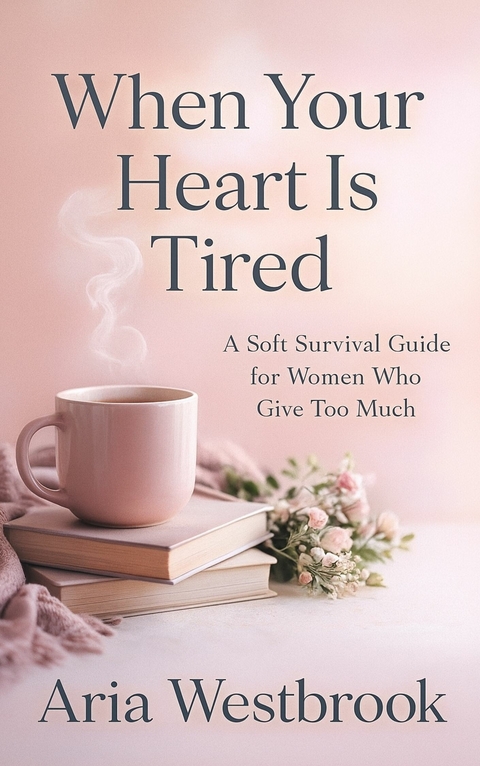
When Your Heart Is Tired (eBook)
113 Seiten
Publishdrive (Verlag)
978-0-00-110890-5 (ISBN)
Some women carry the world quietly.
They hold families together, soothe everyone else's storms, and keep showing up even when their hearts feel stretched thin.
If you've spent years being the steady one, the understanding one, the giver - this book is for you.
When Your Heart Is Tired is a gentle guide for women who feel worn down by emotional responsibility, silent expectations, and the pressure to always be 'fine.'
Through calm, grounded reflection, it helps you understand why you feel exhausted, where your patterns of overgiving began, and how to return to yourself with tenderness instead of guilt.
Inside, you'll explore:
the subtle signs of emotional fatigue that strong women often ignore
why you learned to overextend yourself
how to create boundaries that feel natural, not harsh
how to rest without defending your need for space
how to love others without losing your voice
how to rebuild your identity after years of putting yourself second
how to create a softer, safer future for your heart
This is not a book about becoming tougher.
It's an invitation to live gently, to choose peace, and to honor the parts of you that have long been overlooked - even by you.
If you are tired in a way sleep doesn't fix, if your heart feels heavy from carrying too much for too long, these pages will give you room to breathe again.
They offer comfort, clarity, and a steady reminder:
You deserve care, too - not as a reward, but because you're human too.
CHAPTER 1: The Weight You’ve Been Carrying
There are women who break loudly — suddenly, dramatically, in full view of the world.
And then there are women like you.
Women who begin to feel tired long before anything on the outside looks wrong.
Women whose exhaustion shows up quietly, gently, like a warning whispered under their breath.
Women who carry so much, so consistently, that breaking isn’t one moment — it’s a slow unraveling no one else seems to notice.
You know this tiredness.
The one that sits in your chest like a knot.
The one that makes your mornings feel heavier than your nights.
The one that doesn’t go away with sleep or coffee or a weekend “off,” because it isn’t your body that’s collapsing — it’s your heart.
People often assume strong women are fine because they look fine.
You hold your posture, you manage your responsibilities, you keep your voice steady, your face calm.
But deep inside, something feels stretched, thinned, worn down by years of being the one who carries what others cannot.
Strong women feel tired long before they break because they have been the emotional backbone of too many situations.
You’ve been dependable in moments where you needed someone to depend on.
You’ve been calm in situations that should have shaken you.
You’ve been resilient in relationships that gave you little to hold onto.
You’ve been understanding even when no one tried to understand you.
Strength is beautiful — but carrying too much for too long turns strength into strain.
And women like you rarely collapse suddenly.
You fade quietly.
You start feeling tired in ways you can’t explain.
You start needing silence more than usual.
You start withdrawing not because you don’t care, but because you have nothing left to give.
You start noticing that small things drain you, not because they’re big, but because you are already running on empty.
That is the weight you’ve been carrying — the weight no one sees, because you’ve learned to hold it so gracefully.
Emotional Exhaustion vs. Physical Exhaustion — Understanding the Difference
Most people understand physical tiredness.
You work, you move, you push your body, and it asks for rest.
Physical exhaustion shows itself clearly — sore muscles, heavy eyelids, slowed movements.
Emotional exhaustion is different.
It is quieter.
More subtle.
More deceptive.
It shows up in the way your mind feels foggy even when your body is still.
In the way you wake up tired, not because you slept poorly, but because your heart didn’t get a chance to rest.
In the way you feel drained after conversations, responsibilities, or expectations — even when nothing “big” happened.
Emotional exhaustion is the tiredness that comes from:
It is the exhaustion of constantly supporting, understanding, forgiving, comforting, reassuring, or fixing.
The exhaustion of being the one people turn to, even when you have no one to turn to yourself.
And the hardest part?
Emotional exhaustion hides inside physical tiredness.
It disguises itself as laziness, low energy, lack of motivation — things society often shames women for.
But emotional exhaustion is not laziness.
It is not weakness.
It is not a failure of discipline.
It is the natural result of carrying emotional weight without relief.
Physical exhaustion says: “I need sleep.”
Emotional exhaustion says: “I need peace.”
Physical exhaustion recovers with rest.
Emotional exhaustion recovers with boundaries, understanding, gentleness, and permission to stop holding everything alone.
If you’ve been feeling this tiredness — the deep, quiet kind — it isn’t in your head.
It isn’t dramatic.
It isn’t unreasonable.
It’s simply the truth your heart has been trying to tell you:
“I have carried enough.”
The Hidden Signs You’ve Been Giving Too Much
There are signs your heart has been giving more than it can replenish — quiet signals that something inside you is stretched thinner than it should be.
Most of these signs are subtle, so subtle that even you may not recognize them at first.
Because when you’re used to carrying the emotional weight of others, you learn to call the strain “normal.”
But it isn’t normal.
And your body, your mind, your spirit — they all try to tell you.
You’ve just learned to ignore the whispers.
You’ll notice that you’ve been giving too much when…
You apologize even when you’re the one hurting.
You soften your tone, your truth, and your needs, because you don’t want to “cause trouble.” You apologize for taking space, for asking for clarity, for being human.
You feel guilty for resting.
Even sitting down for a moment feels like you’re doing something wrong, as if rest is a luxury you haven’t earned — despite giving more than anyone around you.
You absorb other people’s moods.
Someone’s anger becomes your tension.
Someone’s sadness becomes your responsibility.
You feel everything too deeply because you’ve taught yourself to carry emotional atmospheres like they are yours to fix.
You are tired in the morning, not the night.
This isn’t physical fatigue — it’s emotional depletion.
It’s waking up already drained because your heart hasn’t had a moment of true peace.
You say “yes” out of fear, not desire.
Fear of disappointing.
Fear of being misunderstood.
Fear of being seen as selfish.
Fear of being abandoned.
Your yes is not always a choice — sometimes, it’s a survival tactic.
You feel unappreciated, yet you keep giving anyway.
You tell yourself, “They don’t mean to forget,” or “It’s fine, really.”
But something inside you quietly hopes that someone will notice how deeply you care.
You feel responsible for everyone’s wellbeing.
You don’t just help — you fix, manage, soothe, absorb, anticipate.
You take on emotional responsibilities no one asked you to take, because you don’t know how to exist without being needed.
You don’t know what you want — only what others need.
You can list everyone’s preferences, desires, and comfort zones…
but when someone asks, “What about you?”
you freeze, because you’re not used to being asked.
These signs may seem small on their own.
But together, they reveal a heart that has been pouring far more than it receives.
These are not flaws.
These are symptoms.
They are the echoes of a woman who has been loving hard, supporting deeply, and surviving quietly.
And they are proof that you deserve rest.
You deserve boundaries.
You deserve gentleness — especially from yourself.
Why No One Notices Your Breaking Point
It’s not that your pain is invisible.
It’s that you’ve spent so long being strong, steady, and dependable that people forget you have limits.
They see your calmness and assume you’re not overwhelmed.
They see your competence and assume you can handle more.
They see your patience and assume you’re unshakable.
They see your kindness and assume you don’t need support.
People don’t notice your breaking point because:
You’ve made pain look manageable.
You’ve mastered the quiet art of functioning even when your heart is tired.
You get things done while carrying feelings no one knows about.
You don’t ask for help.
Not because you don’t need it —
but because you don’t want to be a burden.
Or because whenever you finally did ask in the past, someone disappointed you.
You keep showing up.
Even when you’re tired, you remain present.
You push through.
You smile through.
You survive through.
To others, it looks like strength.
To you, it feels like suffocation.
You downplay your pain.
You say things like, “It’s no big deal,” or “I’m just tired,” or “I’ll be okay.”
You minimize what hurts because you’re used to prioritizing everyone else.
You fix problems before they become visible.
You anticipate needs, calm storms before they strike, and repair situations before others realize something was broken.
You shoulder emotional labor silently.
No one sees the mental load you carry:
the remembering, the checking in, the caring, the worrying.
It’s invisible on the outside but exhausting on the inside.
You seem too strong to break.
People forget that even strong women have limits.
They forget that the woman who holds everyone up also needs a place to fall apart.
But here is the truth that no one tells you:
Even the strongest women need support.
Even the most resilient hearts have breaking points.
And even the most dependable women deserve to be held,...
| Erscheint lt. Verlag | 19.11.2025 |
|---|---|
| Sprache | englisch |
| Themenwelt | Sachbuch/Ratgeber ► Gesundheit / Leben / Psychologie ► Lebenshilfe / Lebensführung |
| ISBN-10 | 0-00-110890-5 / 0001108905 |
| ISBN-13 | 978-0-00-110890-5 / 9780001108905 |
| Informationen gemäß Produktsicherheitsverordnung (GPSR) | |
| Haben Sie eine Frage zum Produkt? |
 EPUB (Adobe DRM)
Kopierschutz: Adobe-DRM
Adobe-DRM ist ein Kopierschutz, der das eBook vor Mißbrauch schützen soll. Dabei wird das eBook bereits beim Download auf Ihre persönliche Adobe-ID autorisiert. Lesen können Sie das eBook dann nur auf den Geräten, welche ebenfalls auf Ihre Adobe-ID registriert sind.
Details zum Adobe-DRM
Dateiformat: EPUB (Electronic Publication)
EPUB ist ein offener Standard für eBooks und eignet sich besonders zur Darstellung von Belletristik und Sachbüchern. Der Fließtext wird dynamisch an die Display- und Schriftgröße angepasst. Auch für mobile Lesegeräte ist EPUB daher gut geeignet.
Systemvoraussetzungen:
PC/Mac: Mit einem PC oder Mac können Sie dieses eBook lesen. Sie benötigen eine
eReader: Dieses eBook kann mit (fast) allen eBook-Readern gelesen werden. Mit dem amazon-Kindle ist es aber nicht kompatibel.
Smartphone/Tablet: Egal ob Apple oder Android, dieses eBook können Sie lesen. Sie benötigen eine
Geräteliste und zusätzliche Hinweise
Buying eBooks from abroad
For tax law reasons we can sell eBooks just within Germany and Switzerland. Regrettably we cannot fulfill eBook-orders from other countries.
aus dem Bereich