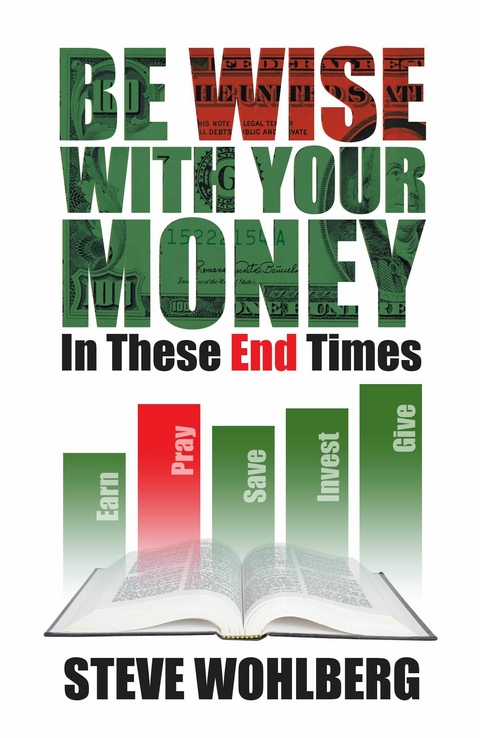
Be Wise With Your Money (eBook)
128 Seiten
Bookbaby (Verlag)
979-8-3178-2586-7 (ISBN)
A Jewish Christian from Los Angeles, Steve Wohlberg is the Speaker/Director of White Horse Media and the host of His Voice Today radio and television broadcasts (see www.hisvoicetoday.com). The author of over 50 books, he's been a guest on over 500 radio and television shows, has appeared in three History Channel documentaries (Secrets of the Seven Seals; Armageddon Battle Plan; Strange Rituals), one National Geographic International documentary (Animal Armageddon), and has spoken by special invitation inside the Pentagon and U.S. Senate. He lives in Apison, TN, with his wife, Kristin, and their two children, Seth Michael and Abigail Rose. His website is http://www.whitehorsemedia.com. To view most of Steve Wohlberg's videos, visit http://www.youtube.com/whitehorsemedia.
As we journey through "e;the time of the end"e; (Daniel 12:4) before the return of Jesus Christ, Be Wise With Your Money In These End Times is a unique book revealing solid, Bible-based principles about laziness, working, earning, saving, avoiding debt, unselfish giving, and even offers tips about how to develop a simple investment account for retirement--should that time ever come. Chapter titles include, "e;The Wisdom of Ants,"e; "e;Mount Sinai and Money,"e; "e;Steps to Financial Health,"e; "e;To Invest or Not To Invest?"e; and "e;Eternal Riches."e; Biblical, balanced, and practical, its message could change your life. --Steve Wohlberg derives new and practical biblical insights into money management that will be a blessing to you and your family. Bruce Toews, CPA, Dean and Professor of Accounting & Finance, Walla Walla University--Be Wise with Your Money In These End Times is a timely wake-up call for Christians to honor God not just with their beliefs, but with their bank accounts. Steve Wohlberg does a powerful job of weaving eternal truth with practical financial wisdom. It isn't just about money it's about mission, stewardship, and preparing for the return of Christ. I highly recommend it. Daniel Vierra, Director of Modern Manna
CHAPTER 1
Perils and Potential
Greed is not a financial issue. It’s a heart issue.
—Andy Stanley, American author and pastor
The Bible often reveals the sober truth of Paul’s words that “the love of money” can lead to terrible evils, and even the loss of one’s soul (1 Timothy 6:10, KJV).
Consider Judas. He was one of the twelve disciples of Jesus. He was an astute businessman. He carried their money bag. Yet even though he daily witnessed his Master’s merciful kindness in healing and helping others, his passionate love for gain finally got the best of him.
“What are you willing to give me if I deliver Him to you?” Judas shamelessly asked some of the chief priests of Israel, who were Christ’s enemies. “Thirty pieces of silver,” they replied. “And they counted out to him thirty pieces of silver. So from that time he sought opportunity to betray Him” Matthew 26:15, 16.
Little did Judas realize that this quick deal would become the most infamous transaction in history. Even today, countless parents name their little ones Matthew, Mark, Luke, John, James, Paul, David, Mary, Hannah, Rachel, Leah, Abigail, or Miriam based on Bible characters who did noble deeds. Yet few name their infant sons, “Judas.”
Why not? Because Judas betrayed “the Savior of the world” (1 John 4:14) for money. It was a dismal deal. Shortly thereafter, being filled with awful remorse, he hung himself, and his guts gushed out (see Matthew 27:3-5; Acts 1:18).
Another example is a rich young ruler:
“Behold, one came and said to Him, ‘Good Teacher, what
good thing shall I do that I may have eternal life?’ So He
said to him, ‘Why do you call Me good? No one is good but
One, that is, God. But if you want to enter into life, keep the
commandments.’ He said to Him, ‘Which ones?’ Jesus said,
‘You shall not murder,’ ‘You shall not commit adultery,’ ‘You
shall not steal,’ ‘You shall not bear false witness,’ ‘Honor
your father and your mother,’ and, ‘You shall love your
neighbor as yourself.’ The young man said to Him, ‘All these
things I have kept from my youth. What do I still lack?’ Jesus
said to him, ‘If you want to be perfect, go, sell what you have
and give to the poor, and you will have treasure in heaven; and come, follow Me.’ But when the young man heard that
saying, he went away sorrowful, for he had great possessions.”
Matthew 19:16-22.
After their earnest dialog, Jesus gave this young man a once-in-a-lifetime opportunity to become one of His chosen disciples and lay up “treasure in heaven.” What would he do? Sadly, “he went away sorrowful, for he had great possessions.” Jesus then told His disciples, “Assuredly, I say to you that it is hard for a rich man to enter the kingdom of heaven” (verse 23). Fortunately, it may be “hard,” but not impossible. “Who then can be saved?” Christ’s disciples asked. “With men this is impossible,” the Master quickly replied, “But with God all things are possible” (verses 25, 26).
Another example is Balaam, who accepted great wealth from King Balak in return for betraying the children of Israel. Poor Balaam. Heaven’s verdict has been pronounced: “Balaam … loved the wages of unrighteousness” (2 Peter 2:15). Then there’s those “rich men” described in the book of James, chapter five. Gazing down the ages to The Great Day of God, James wrote:
“Come now, you rich, weep and howl for your miseries that are coming upon you! Your riches are corrupted, and your
garments are moth-eaten. Your gold and silver are corroded,
and their corrosion will be a witness against you and will
eat your flesh like fire. You have heaped up treasure in the
last days. Indeed the wages of the laborers who mowed your
fields, which you kept back by fraud, cry out; and the cries
of the reapers have reached the ears of the Lord of Sabaoth.
You have lived on the earth in pleasure and luxury; you
have fattened your hearts as in a day of slaughter. You have
condemned, you have murdered the just;
he does not resist you.”
James 5:1-5.
Too late will such “rich men” discover that “Riches do not profit in the day of wrath” (Proverbs 11:4). Yet a closer look at James 5 also reveals that the apostle isn’t condemning wealth per se, but selfishly hoarding it. Those rich men had “heaped up treasure” for themselves, focusing mainly on their own “plea-sure and luxury.” They also wrongfully “kept back” just “wages” from their employees and even “condemned” and “murdered” honest, hard-working men. Their “love of money” led them to commit horrible acts of injustice and “evil,” once again verifying the words of Paul in 1 Timothy 6:10.
Examples could be multiplied endlessly, not just from biblical accounts, but from the annals of history and daily news reports. Cruel murders, bold robberies, wicked gang activities, Wall Street insider trading, greedy wars of conquest, business and political corruption, child-trafficking, prostitution rings, and packed prisons all too often result from the same selfish desires that ruined Judas, Balaam, and the rich young ruler.
The love of money.
It can ruin us too, if we’re not careful.
Yet this chapter isn’t just about the “Perils” of money, but also its “Potential” to become a channel for incalculable good. Believe it or not, there is a bright side to money and wealth. Indeed, it’s not all dark—far from it. The same Bible that soberly warns about “the love of money” and its “evil” results, also describes many faithful servants of God, who slowly, honestly, and wisely built great fortunes, not just for themselves, but to bless many others.
Consider Abraham.
Moses wrote that “Abram [Abraham] was very rich in live-stock, in silver, and in gold” (Genesis 13:2, emphasis added). There is no hint in Scripture that God ever rebuked Abraham because he was wealthy. Instead, the same New Testament book that warns gold-hoarding rich men about the approaching Day of the Lord calls Abraham “the friend of God” (James 2:23).
Consider also faithful Job.
Job’s “possessions were seven thousand sheep, three thou-sand camels, five hundred yoke of oxen, five hundred female donkeys, and a very large household, so that this man was the greatest of all the people of the East” (Job 1:2). It’s a no-brainer that Job was fabulously rich. Was his Maker upset with him for building such great wealth? Not at all. In fact, during a heavenly conversation with the prince of darkness,
“The LORD said to Satan, ‘Have you considered My servant
Job, that there is none like him on the earth, a blameless and
upright man, one who fears God and shuns evil?’”
Job 1:8.
Thus Job was both rich and blameless. In his dialog with the devil, God even called this good man, “My servant Job.” The difference between the gold-hoarding “rich men” in James 5 and rich Job is that Job earned his wealth responsibly with the goal of using it to serve God and help others.
This leads to a key truth: money itself is neither good or bad, but neutral. It’s a bit like food. We all need to eat (just like we all need to pay bills), but the food we daily pop into our mouths can strengthen our immune systems, build our health, and pro-long our days, or clog our arteries, increase our risk of contracting deadly diseases, and bring us down to an early grave.
Consider also King Solomon.
At the beginning of his reign, God spoke to him one night in a dream, and said, “Ask! What shall I give you?” (1 Kings 3:5). Pondering his options and new responsibilities, Solomon answered, “Give to Your servant an understanding heart to judge Your people, that I may discern between good and evil. For who is able to judge this great people of Yours?” (Verse 9).
God was pleased with his prayer.
Notice carefully His response:
“Then God said to him: ‘Because you have asked this thing,
and have not asked long life for yourself, nor have asked
riches for yourself, nor have asked the life of your enemies,
but have asked for yourself understanding to discern justice,
behold, I have done according to your words; see, I have
given you a wise and understanding heart, so that there has
not been anyone like you before you, nor shall any like you
arise after you. And I have also given you what you have
not asked: both riches and honor, so that there shall not be
anyone like you among the kings all your days.”
1 Kings 3:11-13 (emphasis added).
Think about it: if riches and wealth were inherently wicked, why would the Lord grant such things to Solomon? Would a good God impart “the root of all evil” to the young king of Israel? Of course not. Instead, He noted that Solomon didn’t ask for riches for himself, but for wisdom, which is far superior to anything earthly. So, God decided to give him both.
First, wisdom—then riches.
A little reflection should teach us that if the young king would daily depend on God for wisdom, then—and only then—would he be able to use his wealth wisely. And what a blessing that would be!
Is money bad?
Obviously not. We use money to purchase food, clothing, a home, a lawnmower, a...
| Erscheint lt. Verlag | 27.11.2025 |
|---|---|
| Sprache | englisch |
| Themenwelt | Sachbuch/Ratgeber ► Gesundheit / Leben / Psychologie ► Lebenshilfe / Lebensführung |
| ISBN-13 | 979-8-3178-2586-7 / 9798317825867 |
| Informationen gemäß Produktsicherheitsverordnung (GPSR) | |
| Haben Sie eine Frage zum Produkt? |
 EPUB (Ohne DRM)
Größe: 1,1 MB
Digital Rights Management: ohne DRM
Dieses eBook enthält kein DRM oder Kopierschutz. Eine Weitergabe an Dritte ist jedoch rechtlich nicht zulässig, weil Sie beim Kauf nur die Rechte an der persönlichen Nutzung erwerben.
Dateiformat: EPUB (Electronic Publication)
EPUB ist ein offener Standard für eBooks und eignet sich besonders zur Darstellung von Belletristik und Sachbüchern. Der Fließtext wird dynamisch an die Display- und Schriftgröße angepasst. Auch für mobile Lesegeräte ist EPUB daher gut geeignet.
Systemvoraussetzungen:
PC/Mac: Mit einem PC oder Mac können Sie dieses eBook lesen. Sie benötigen dafür die kostenlose Software Adobe Digital Editions.
eReader: Dieses eBook kann mit (fast) allen eBook-Readern gelesen werden. Mit dem amazon-Kindle ist es aber nicht kompatibel.
Smartphone/Tablet: Egal ob Apple oder Android, dieses eBook können Sie lesen. Sie benötigen dafür eine kostenlose App.
Geräteliste und zusätzliche Hinweise
Buying eBooks from abroad
For tax law reasons we can sell eBooks just within Germany and Switzerland. Regrettably we cannot fulfill eBook-orders from other countries.
aus dem Bereich