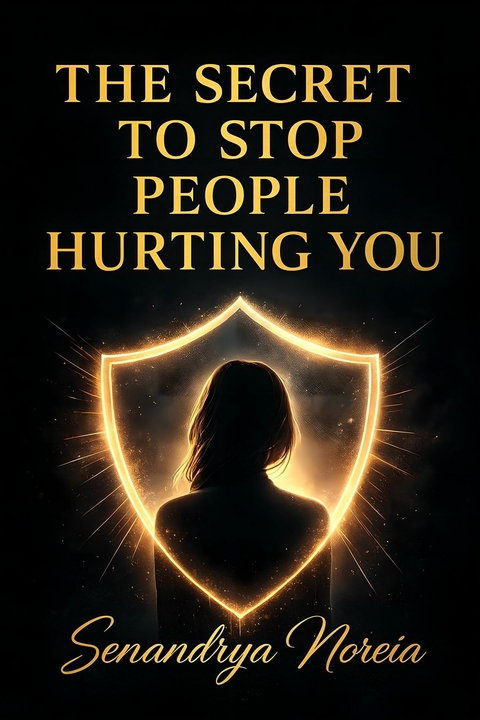
The Secret To Stop People Hurting You (eBook)
619 Seiten
Publishdrive (Verlag)
978-0-00-110681-9 (ISBN)
The Secret to Stop People Hurting You
A Life-Changing Guide to Emotional Power, Boundaries, and Becoming Impossible to Break
If you are tired of feeling used, ignored, disappointed, or emotionally drained...
If you give too much, love too deeply, or hope too strongly...
If you attract people who confuse you, exhaust you, or disappear when you need them...
This book will change your life.
The Secret to Stop People Hurting You is a groundbreaking guide to emotional clarity, self-trust, and personal power. It reveals the hidden psychology behind why you've been hurt, why patterns repeat, and why certain people find you-while others never deserved access to you in the first place.
Most importantly, it teaches you how to become the version of yourself who cannot be broken.
Inside this transformational book, you will discover:
Why emotionally unavailable, inconsistent, and manipulative people are drawn to you
Why you keep giving love to those who cannot hold it
The invisible ways you abandon yourself without realizing it
How your intuition always knew the truth-and how to finally trust it
How to spot red flags instantly without negotiating with yourself
The internal system to protect your peace without becoming cold
The Shield Method: a complete psychological framework to stop being emotionally touched, influenced, or drained
How to rebuild your identity into someone who is soft but unbreakable, loving but sovereign, open but protected
This isn't a book about other people. This is a book about YOU.
Your patterns.
Your boundaries.
Your emotional architecture.
Your new identity.
You will learn how to detach without disconnecting...
How to love without losing yourself...
How to stay open-hearted without being vulnerable to harm...
How to walk away without guilt...
And how to build a life where peace is your default, not your reward.
When you stop letting people hurt you... your entire life changes.
You attract different relationships.
You choose differently.
You rise differently.
You walk differently.
You become the woman who no longer breaks.
This book is your map back to your power.
Your clarity.
Your worth.
Your emotional freedom.
If you're ready to stop suffering, stop repeating the same painful story, and finally become the version of yourself who cannot be manipulated, diminished, or broken-
Start reading. Your new life begins here.
CHAPTER 1 — WHY PEOPLE HURT YOU EVEN WHEN THEY SAY THEY LOVE YOU
People don’t hurt you because they are evil.
They hurt you because they have never learned how to relate to another human being without making their wounds part of the relationship.
Emotional damage doesn’t come from cruelty.
It comes from limitation.
It comes from fear.
It comes from emotional illiteracy — a condition far more common than anyone wants to admit.
Most people have never learned how to communicate honestly, soothe their own discomfort, regulate their reactions, or love without recreating the chaos they grew up in.
They enter relationships unprepared, unequipped, and unaware of the impact they have on others.
But you, who siente deeply, interprets their chaos as a reflection of your worth.
That is where the real wound begins.
Emotional pain rarely comes from the event itself.
It comes from the interpretation: the story your mind creates to explain someone else’s behavior. When someone pulls away, you don’t think, “They are emotionally overwhelmed,” or “Their fear is louder than their desire.”
You think, “I wasn’t enough.”
You transform their limitation into your flaw.
You take their avoidance and call it your failure.
You take their inconsistency and turn it into self-blame.
This is the emotional distortion that shapes your relationships.
The truth is simpler and far less personal:
People treat you according to their patterns, not according to your value.
Someone who never learned emotional regulation will shut down when things get close.
Someone raised in silence will avoid difficult conversations.
Someone terrified of abandonment will sabotage connection before you can see their fear.
Someone conditioned to inconsistency will offer affection in unpredictable doses.
Someone who confuses chaos with intimacy will destabilize you without realizing it.
None of this is about you.
But you feel the impact as if it were.
You feel deeply because your emotional system is open.
You notice shifts in tone, subtle distances, micro-expressions, energy changes.
Your intuition picks up every ripple, every inconsistency, every gap between words and behavior.
This sensitivity is not a weakness — but it becomes a vulnerability when you lack boundaries to protect it.
People who feel deeply often get hurt deeply because their heart is exposed and their standards are flexible. They believe love can be healed, rescued, or earned.
They extend compassion where they should apply discernment.
They hope where they should observe.
They give where they should pause.
Pain enters through the spaces where boundaries should exist.
You were never taught how to create those boundaries.
You were taught compliance, patience, tolerance, empathy, and forgiveness — but not self-protection.
You learned to prioritize harmony over truth, connection over clarity, attachment over self-respect.
And so you became someone who absorbs pain instead of analyzing it.
You became someone who explains behavior instead of recognizing patterns.
You became someone who tries harder instead of stepping back.
This doesn’t make you weak.
It makes you untrained.
Emotional safety is a skill.
Discernment is a skill.
Boundaries are a skill.
Understanding behavior without personalizing it is a skill.
Skills you were never taught.
The result is a lifetime of confusing other people’s wounds with your worth, surrendering your emotional stability to the hands of the least stable person in the dynamic, and believing that if you could just love better, they would finally stop hurting you.
But you were never meant to carry that burden.
Once you understand that people hurt from their limitations — not from your insufficiency — something inside you shifts.
You stop internalizing their coldness.
You stop interpreting their silence as rejection.
You stop taking their inconsistency as a measurement of your value.
You stop bending to earn what should be freely offered.
And you begin to see reality clearly:
You were not broken — you were misinformed.
You were not unworthy — you were unprotected.
You were not the problem — you were the one who felt too deeply for people who could not meet you at the same depth.
You are not here to be hurt and then rebuilt.
You are here to understand the architecture of emotional pain so you can rise above it, create boundaries that defend your heart, and walk into relationships where your softness becomes a strength — not a target.
This book is not about blaming others or glorifying your suffering.
It is about giving you the psychological clarity and emotional intelligence that no one taught you growing up.
Because once you see why people hurt you,
you finally learn how to stop them.
You grow up believing that love is something you must earn, something you must demonstrate, something that requires constant proof of your worth. You learn to anticipate the needs of others before you even understand your own. You learn to silence your discomfort so you don’t disrupt the emotional climate around you. Without realizing it, you become fluent in self-abandonment long before you learn the language of self-respect.
This is why relationships hurt you more deeply than they hurt others. You enter them with an open system, receptive and attuned, hoping that reciprocity will naturally follow compassion. But most people were raised in emotional scarcity; they learned survival, not connection. They carry fear in their bodies like inherited memory. They carry shame like shadow. They carry avoidance the way others carry affection.
And because they cannot name their wounds, they behave through them.
They distance when they feel vulnerable.
They withdraw when they feel too close.
They become cold when they feel exposed.
They sabotage when things feel safe.
They lash out when they feel inadequate.
You stand there trying to interpret behavior that has nothing to do with you.
Trying to solve a problem that didn’t begin with you.
Trying to love someone who doesn’t know how to be seen without breaking.
But you’re not responsible for holding together what another person refuses to examine.
Every relationship becomes a classroom where you’re doing all the work while the other person hasn’t even realized there was homework assigned. You analyze, reflect, adjust, communicate, overextend yourself emotionally, and translate dynamics that the other person doesn’t even acknowledge. And because you’re the only one doing the emotional labor, the relationship becomes unbalanced before it even begins.
This emotional imbalance is the birthplace of pain — not because you’re weaker, but because you’re carrying more weight than one heart was ever meant to hold.
You start thinking love demands endurance, that connection requires self-sacrifice, that intimacy means forgiving more than you should have to forgive. You begin to believe that love is something you maintain alone, through emotional effort that becomes invisible to the person receiving it.
This is where the fracture happens.
Not in the relationship, but in your relationship with yourself.
You start shrinking, adjusting, suppressing, bending. You become smaller in the places where you should be expanding. You become quieter in the moments where your truth matters most. You begin to disappear little by little while the relationship becomes a theatre where you’re acting out the role of “the one who stays” while the other person remains unchallenged, unchanged, untouched by the work that keeps connection alive.
You tell yourself it’s love, but in reality, it’s fear — fear of losing something that is already costing you too much.
This fear convinces you to tolerate behaviors that you would never accept if your self-worth were fully intact.
Fear convinces you that walking away is failure.
Fear convinces you that asking for what you deserve is unreasonable.
Fear convinces you that their inconsistency is better than being alone.
Fear convinces you that crumbs are sustenance.
And yet, a quieter part of you keeps whispering:
“This is not love. This is survival.”
You silence that whisper because you’ve never been taught to trust it. You were taught to be loyal, patient, understanding, forgiving — but not discerning. Not protective. Not sovereign inside your own emotional landscape.
You keep trying to make sense of someone’s behavior through the lens of their potential instead of the truth of their actions. You cling to the moments of warmth, the promises spoken in vulnerability, the glimpses of who they could be if their wounds didn’t take over. You build entire futures out of fragments, entire hopes out of patterns that never stabilize.
You fall in love with possibility instead of reality, and possibility cannot love you back.
The person in front of you becomes secondary to the story you wrote about who they could become. And so you love not the person —...
| Erscheint lt. Verlag | 19.11.2025 |
|---|---|
| Sprache | englisch |
| Themenwelt | Sachbuch/Ratgeber ► Gesundheit / Leben / Psychologie ► Lebenshilfe / Lebensführung |
| ISBN-10 | 0-00-110681-3 / 0001106813 |
| ISBN-13 | 978-0-00-110681-9 / 9780001106819 |
| Informationen gemäß Produktsicherheitsverordnung (GPSR) | |
| Haben Sie eine Frage zum Produkt? |
 EPUB (Adobe DRM)
Größe: 2,5 MB
Kopierschutz: Adobe-DRM
Adobe-DRM ist ein Kopierschutz, der das eBook vor Mißbrauch schützen soll. Dabei wird das eBook bereits beim Download auf Ihre persönliche Adobe-ID autorisiert. Lesen können Sie das eBook dann nur auf den Geräten, welche ebenfalls auf Ihre Adobe-ID registriert sind.
Details zum Adobe-DRM
Dateiformat: EPUB (Electronic Publication)
EPUB ist ein offener Standard für eBooks und eignet sich besonders zur Darstellung von Belletristik und Sachbüchern. Der Fließtext wird dynamisch an die Display- und Schriftgröße angepasst. Auch für mobile Lesegeräte ist EPUB daher gut geeignet.
Systemvoraussetzungen:
PC/Mac: Mit einem PC oder Mac können Sie dieses eBook lesen. Sie benötigen eine
eReader: Dieses eBook kann mit (fast) allen eBook-Readern gelesen werden. Mit dem amazon-Kindle ist es aber nicht kompatibel.
Smartphone/Tablet: Egal ob Apple oder Android, dieses eBook können Sie lesen. Sie benötigen eine
Geräteliste und zusätzliche Hinweise
Buying eBooks from abroad
For tax law reasons we can sell eBooks just within Germany and Switzerland. Regrettably we cannot fulfill eBook-orders from other countries.
aus dem Bereich