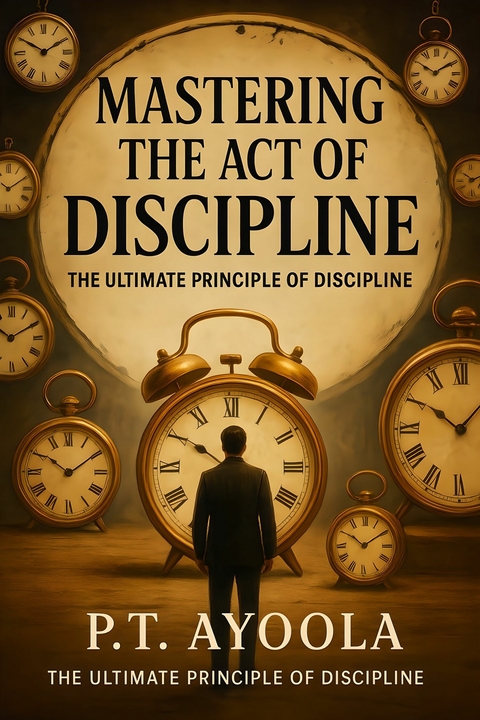
Mastering the Act of Discipline (eBook)
220 Seiten
Publishdrive (Verlag)
978-0-00-110496-9 (ISBN)
Unlock the power of self-mastery and transform your life.
In Mastering the Act of Discipline, you'll discover the unshakable foundation behind every great achievement: discipline. This isn't just another motivational read-it's a practical, no-nonsense guide to rewiring your habits, sharpening your focus, and building the mental toughness required to conquer your goals.
Whether you're striving for personal growth, professional excellence, or spiritual alignment, this book delivers the tools, strategies, and mindset shifts to help you:
- Break free from procrastination and excuses
- Build routines that fuel consistency and momentum
- Cultivate resilience in the face of setbacks
- Stay committed when motivation fades
- Turn discipline into a lifestyle-not a chore
With real-life examples, actionable exercises, and timeless wisdom, Mastering the Act of Discipline is your blueprint for becoming the most focused, driven, and unstoppable version of yourself.
Discipline isn't a punishment-it's your superpower.
Are you ready to master it?
Chapter 1: The Mirror of Truth
Let me tell you something you already know but might not want to hear: no one is coming to save you.
Not your parents, not your spouse, not your boss, not your friends, and certainly not some guru with a seven-step program. The person who will transform your life is staring back at you in the mirror every single morning. And until you accept this fundamental truth, you'll spend your entire life waiting at a bus stop where no bus will ever arrive.
This isn't meant to discourage you. It's meant to liberate you.
Because if no one else can save you, then no one else can stop you either.
The Comfortable Lie We Tell Ourselves
We've become masters at outsourcing responsibility for our lives. We blame our circumstances, our upbringing, our genetics, the economy, our busy schedules, or our lack of resources. We wait for the right moment, the right opportunity, or the right person to come along and make things easier.
These excuses feel good. They feel true. They protect us from the uncomfortable reality that we're exactly where our daily choices have placed us.
Think about the last time you failed to follow through on something important to you. Maybe it was a fitness goal, a business idea, learning a new skill, or simply being more present with your loved ones. What story did you tell yourself about why it didn't work out?
Did you blame your schedule? "I just don't have time."
Did you blame your circumstances? "I can't afford it right now."
Did you blame other people? "Nobody supports me."
Did you blame your nature? "I'm just not that kind of person."
Here's the truth that cuts through all of those stories: you didn't want it badly enough to discipline yourself to get it. And that's okay—you're allowed to have priorities. But you're not allowed to lie to yourself about why you didn't succeed while claiming you wanted it.
The first principle of discipline is radical honesty with yourself. Until you can look in the mirror and say, "I am exactly where my choices have placed me," you cannot move forward. You'll keep spinning your wheels, creating elaborate explanations for why your life isn't what you want it to be, all while the years slip by.
Why External Motivation Always Fails
We live in a culture addicted to external motivation. We consume inspirational quotes, watch motivational videos, attend seminars, hire coaches, and buy books (yes, like this one) hoping to find that magic spark that will finally make us different.
And for a moment, it works. You feel energized. You feel ready. You make big plans and bold declarations. You might even take action for a few days or weeks.
Then it fades.
Why? Because motivation is an emotional state, and emotional states are temporary by nature. They're weather, not climate. They come and go based on circumstances, mood, sleep quality, and a thousand other factors outside your control.
Relying on motivation is like trying to drive across the country but only pressing the gas pedal when you feel like it. You'll get nowhere fast.
The people you admire—the ones who've built successful businesses, transformed their health, mastered difficult skills, or created meaningful relationships—didn't do it through motivation. They did it through discipline. And discipline, unlike motivation, doesn't care how you feel.
Discipline is the decision you make once that eliminates a thousand future decisions. It's the commitment to show up regardless of circumstances, mood, or convenience. It's the recognition that your feelings are not a reliable guide for your actions.
But here's what makes discipline so challenging: it can only come from within. No one can discipline you. They can create external pressure, consequences, or incentives, but the moment that external force is removed, your true patterns reassert themselves.
Think about it. Your parents might have forced you to clean your room as a child, but the moment you moved out, your habits revealed themselves. Your boss might pressure you to meet deadlines, but your work ethic shows up in what you do when no one's watching. A trainer might push you through a workout, but your fitness journey is determined by what you do the other 23 hours of the day.
External motivation is borrowed power. It runs out. Self-discipline is your own power, and it's renewable.
The Prison of Other People's Expectations
Here's a paradox: many of us claim we want to be self-disciplined, but what we actually want is to meet other people's expectations without having to discipline ourselves.
We want the respect that comes with success but not the daily grind it requires. We want the admiration that comes with achievement but not the sacrifice it demands. We want the results but not the process.
So we perform. We create impressive-looking lives on social media. We talk about our goals at parties. We buy gym membership, business books, and productivity apps. We surround ourselves with the aesthetic of discipline without embracing its substance.
This is what I call "expectation discipline"—doing things because you're supposed to, because people are watching, or because you're afraid of judgment. It's not real discipline; it's just performance anxiety.
Real discipline emerges when you stop living for an audience and start living for yourself. It's what you do when no one is watching, when no one will know if you quit, when there's no external reward or punishment on the line.
The mirror of truth reflects this distinction clearly. Are you disciplined because it serves your vision of who you want to become? Or are you just trying to avoid disappointing others while secretly resenting the effort?
One path leads to sustainable transformation. The other leads to burnout and rebellion.
The Moment of Acceptance
There's a specific moment that every person who has ever transformed their life has experienced. It's the moment when the excuses stop working. When the blame falls flat. When the comfortable lies can no longer be believed.
It's the moment you realize: "If this is going to change, I'm the one who has to change it."
This moment can come in many forms. Sometimes it's triggered by a crisis—a health scare, a relationship ending, hitting rock bottom financially, or losing an opportunity you can never get back. Sometimes it comes from simple exhaustion with your own patterns. Sometimes it arrives quietly, a whisper of clarity in an ordinary moment.
However it comes, this moment of acceptance is terrifying and exhilarating in equal measure.
It's terrifying because it strips away all your defenses. You can no longer hide behind circumstances or other people's failures. You can no longer wait for permission or perfect conditions. The responsibility for your life lands squarely on your shoulders, and there's no one else to carry it.
But it's also exhilarating because it means you're finally free. If you're the problem, you're also the solution. If your choices created this life, your choices can create a different one. The same power that led you here can lead you somewhere else.
This is the paradox at the heart of self-discipline: accepting total responsibility feels heavy at first, but it's actually the lightest burden you'll ever carry. Because blame and resentment are far heavier than ownership.
What Actually Happens When You Stop Blaming
When you stop blaming your circumstances, something remarkable happens: you stop feeling like a victim. And when you stop feeling like a victim, you stop thinking like one.
Victims wait for rescue. Owners take action.
Victims ask "Why is this happening to me?" Owners ask "What am I going to do about this?"
Victims need perfect conditions. Owners work with what they have.
Victims resent discipline because it feels imposed. Owners embrace discipline because it's empowering.
Let me share something practical: try this exercise today. Take one area of your life you're unhappy with—your health, your finances, your career, your relationships, whatever. Write down every reason you believe this area isn't where you want it to be.
Now read through your list and cross out anything that places responsibility outside yourself. Remove all the external factors, the bad luck, the other people's failures, the circumstances beyond your control.
What's left?
For most people, not much. And that remaining list is your actual starting point. Those are the things within your control, the places where your discipline can actually make a difference.
This exercise isn't about self-blame or ignoring real obstacles. It's about identifying your sphere of influence. Because you can't discipline your way through things outside your control, but
you can discipline your response to them.
You can't control the economy, but you can control your work ethic and financial habits. You can't control your genetics, but you can control your nutrition and exercise. You can't control other people, but you can control how you show up in relationships. You can't control the past, but you can control what you do today.
The Daily Question
Here's a question that changed my life, and it might change yours: "What would I do today if I actually believed no one was coming to save me?"
Not in a desperate way. Not in a lonely way. But in an empowered...
| Erscheint lt. Verlag | 15.11.2025 |
|---|---|
| Sprache | englisch |
| Themenwelt | Sachbuch/Ratgeber ► Gesundheit / Leben / Psychologie ► Lebenshilfe / Lebensführung |
| ISBN-10 | 0-00-110496-9 / 0001104969 |
| ISBN-13 | 978-0-00-110496-9 / 9780001104969 |
| Informationen gemäß Produktsicherheitsverordnung (GPSR) | |
| Haben Sie eine Frage zum Produkt? |
 EPUB (Adobe DRM)
Größe: 1,8 MB
Kopierschutz: Adobe-DRM
Adobe-DRM ist ein Kopierschutz, der das eBook vor Mißbrauch schützen soll. Dabei wird das eBook bereits beim Download auf Ihre persönliche Adobe-ID autorisiert. Lesen können Sie das eBook dann nur auf den Geräten, welche ebenfalls auf Ihre Adobe-ID registriert sind.
Details zum Adobe-DRM
Dateiformat: EPUB (Electronic Publication)
EPUB ist ein offener Standard für eBooks und eignet sich besonders zur Darstellung von Belletristik und Sachbüchern. Der Fließtext wird dynamisch an die Display- und Schriftgröße angepasst. Auch für mobile Lesegeräte ist EPUB daher gut geeignet.
Systemvoraussetzungen:
PC/Mac: Mit einem PC oder Mac können Sie dieses eBook lesen. Sie benötigen eine
eReader: Dieses eBook kann mit (fast) allen eBook-Readern gelesen werden. Mit dem amazon-Kindle ist es aber nicht kompatibel.
Smartphone/Tablet: Egal ob Apple oder Android, dieses eBook können Sie lesen. Sie benötigen eine
Geräteliste und zusätzliche Hinweise
Buying eBooks from abroad
For tax law reasons we can sell eBooks just within Germany and Switzerland. Regrettably we cannot fulfill eBook-orders from other countries.
aus dem Bereich