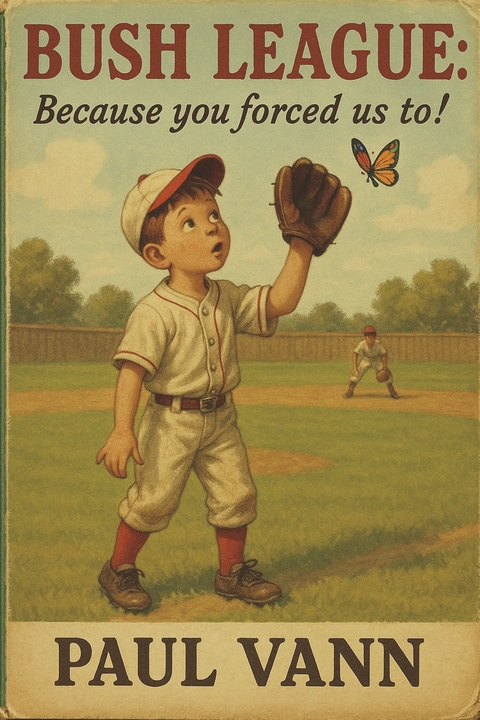
Bush League: Because you forced us to! (eBook)
192 Seiten
Bookbaby (Verlag)
979-8-3178-2429-7 (ISBN)
For over 12 years, Paul Vann survived the chaos of youth baseball, starting with his own kids in tee-ball (a sport best described as herding cats) and eventually owning a travel team. Now that his own players have grown up and moved on, Paul is left with a garage full of gear and an unshakeable passion for the game. He eagerly awaits the day he can coach his grandkids, hopefully with his own kids doing most of the base running. This book is a collection of hilarious stories, life lessons, and practical tips from his time in the dugout, proving that teaching the fundamentals of baseball is just as important as knowing where the nearest ice cream shop is.
Ever wonder what really happens behind the scenes of little league baseball? Buckle up for a hilarious journey through the secret drafts, strategic parent management, and unexpected life lessons that come with coaching youth sports. Mike Callahan is back for his fourth season coaching the Westfield Wildcats, and he's learned that little league baseball is about so much more than teaching kids to swing a bat. It's about surviving the annual player draft, where coaches engage in reconnaissance missions and parents strategically downplay their children's abilities. It's about managing Dave, his statistics-obsessed assistant coach who approaches ten-year-old baseball with the intensity of a playoff series. And most importantly, it's about handling parents who range from blissfully uninvolved to dangerously overinvolved. Through ten interconnected stories, you'll experience the full spectrum of youth baseball coaching. Watch as Mike navigates the politics of draft night, where a "e;do not draft"e; list reads like a diplomatic treaty and every pick requires calculating both player talent and parent headache potential. Discover the psychological warfare of facing teams that shouldn't win but somehow do, and the creative solutions required when league rules meet real-world chaos. From implementing a revolutionary double catcher system to explaining the infield fly rule to parents who think they know better, from surviving the intensity of travel baseball to managing the delicate process of all-star selections, these stories capture both the comedy and the profound moments that make coaching worthwhile. You'll meet unforgettable characters: the parent who brings a radar gun to practice, the kid who chooses teams based on post-game snacks, and the league officials who treat volunteer sports with bureaucratic seriousness. But beneath the humor lies genuine insight into what makes youth sports valuable. These stories explore the balance between competition and fun, the challenge of teaching resilience without crushing spirits, and the unexpected ways that coaching changes not just the kids, but the adults who volunteer their time. Whether you're a coach desperately seeking validation that you're not alone in the chaos, a parent trying to understand the mysterious world of league politics, or simply someone who enjoys sharp observational humor about suburban life, this book offers both laughs and wisdom. You'll recognize the situations, cringe at the familiar parent types, and maybe gain a new appreciation for the volunteers who make youth sports possible. This is little league baseball as you've never seen it: honest, hilarious, and surprisingly heartwarming. Because sometimes the best lessons happen when adults remember that it's supposed to be about the kids having fun, even if we occasionally forget that along the way.
Choose Your Parents Wisely
The draft is complete. The roster is set. Twelve innocent children have been assigned to my care for the next three months of baseball season. But as any veteran little league coach knows, you’re not just getting twelve kids—you’re getting twenty-four parents, assorted grandparents, siblings, and occasionally, the family dog who will somehow end up on the field at the most critical moment of the most important game.
It’s the Sunday evening after the draft, and I’m sitting at my kitchen table reviewing the roster that Commissioner Harkins emailed earlier today. Each name represents not just a player but an entire ecosystem of adult influences that will either make this season run smoothly or turn it into a three-month exercise in conflict management and amateur psychology.
“So, what’s the damage?” my wife, Karen, asks as she places a cup of coffee in front of me. Karen has been through enough baseball seasons to know that this moment—the first review of the complete roster—is a sacred ritual that requires caffeine and silence.
“Mixed bag,” I reply, scrolling through the spreadsheet. “Some familiar names, some new ones. Emma Ramirez—she’s the pitcher I was hoping for. Jackson Miller—his dad owns the sporting goods store. And… oh no.”
“What?” Karen asks, peering over my shoulder.
“Zachary Peterson.”
The name hangs in the air like a warning. Karen’s eyes widen in recognition. “Isn’t he the one whose father—”
“Yep. Filed a formal complaint with the league because his son only played five innings instead of six in the championship game two years ago. Calculated the exact playing time of every child on the team and presented it in a PowerPoint presentation to the board.”
“But you weren’t even coaching that team.”
“Doesn’t matter. Once a Peterson Parent, always a Peterson Parent.”
This is the reality of little league coaching that they don’t mention in the volunteer recruitment pitch. You’re not just teaching kids how to hit a baseball; you’re navigating a complex social hierarchy of adults with varying degrees of investment, emotional stability, and understanding of appropriate sideline behavior.
The first team meeting is scheduled for next Saturday, which gives me exactly five days to prepare mentally for the parent introductions. In professional sports, coaches choose their players. In little league, you choose your players, but the parents come as a non-negotiable package deal. And sometimes, the parents are the ones who determine whether your season is a joyful celebration of youth athletics or a descent into suburban madness.
Dave, my assistant coach, calls me at precisely 9:00 PM, which I know is when his children go to bed and he transitions into full baseball mode.
“Did you see the roster?” he asks without preamble.
“Just looking at it now.”
“We got Peterson.”
“I know.”
“And Williams.”
I scroll down. “Tommy Williams? I don’t think I know the family.”
“Father is a former minor league player. Brings his own radar gun to games. Corrects other kids’ batting stances from the stands.”
I make a note next to Tommy’s name: Father = baseball helicopter. Approach with caution.
“On the plus side,” Dave continues, “we got the Ramirez girl and the Chen twins. Their parents are ideal—they bring good snacks, never complain, and the dad knows how to chalk field lines.”
This is the kind of intelligence that doesn’t appear on any official roster but is crucial information for a little league coach. In my years of coaching, I’ve developed a taxonomy of little league parents that helps me prepare for the season ahead:
- The Invisible Parents: Drop their kids off and disappear until pickup time. Pros: No interference. Cons: Unreachable during emergencies, never volunteer for team duties.
- The Helicopter Parents: Hover constantly, question every decision, offer unsolicited advice. Pros: Always available to help. Cons: Everything else.
- The Former Glory Parents: Reliving their athletic past through their children. Pros: Usually understand the game. Cons: Unrealistic expectations that crush their child’s spirit.
- The Team Parents: Reasonable, supportive, bring good snacks, cheer for all kids. Pros: Everything. Cons: Rare as unicorns.
- The Forced Participation Parents: Their child clearly hates baseball but is forced to play. Pros: The child eventually ages out. Cons: Three months of misery for everyone involved.
Dave and I spend the next hour analyzing each family on our roster, assigning them to categories, and developing strategies for the season ahead. It’s like preparing for a military campaign, except instead of enemy combatants, we’re dealing with adults who might bring an airhorn to a children’s sporting event.
“I’ve prepared a parent handbook,” Dave says, and I can hear him clicking through files on his computer. “It covers everything from practice drop-off procedures to dugout protocols to our strict ‘no coaching from the stands’ policy.”
“Will they read it?”
“Of course not. But when they violate a policy, we can point out that it was clearly stated in the handbook they agreed to.”
Dave’s optimism is both his greatest strength and his most significant delusion. No parent in the history of little league has ever read a handbook, followed a policy, or remembered which day they signed up to bring snacks. But the illusion of structure comforts him, so I let him have it.
“I’ll email it out tomorrow,” he says. “And I’ve reserved the community center meeting room for Saturday. I think it’s important we start with a formal parent meeting before the first practice. Set expectations early.”
I agree, though I know from experience that parent expectations are like weeds—no matter how thoroughly you try to remove them, they always grow back stronger and more resistant to your efforts.
Saturday arrives with the kind of perfect spring weather that makes you believe this season might be different. The sun is shining, birds are chirping, and I’ve had exactly the right amount of coffee to feel optimistic but not jittery. Dave arrives at the community center an hour early to arrange chairs in a semicircle, set up a projector for his PowerPoint presentation, and place a copy of his twelve-page parent handbook on each seat.
“I’ve color-coded them,” he explains as I help him arrange the last few chairs. “Blue for returning families who should know better, green for new families who get a grace period of exactly two games before they should know better.”
“You’ve really thought of everything,” I say, and I mean it. Dave’s organizational skills would impress military generals. If only they translated to actual control over the chaos that is little league baseball.
Families begin arriving at 9:45 for our 10:00 meeting. I stand at the door, greeting each one with a smile that I hope conveys both approachability and authority. It’s a delicate balance—too friendly, and they think they can call you at midnight to discuss their child’s batting order position; too authoritative, and they form a parent rebellion by the third game.
The Ramirez family arrives first—Emma and her parents, both wearing Wildcats t-shirts from last season when Emma played on our farm team. They’re Team Parents, category 4, the kind who bring an extra water bottle for any kid who forgot theirs and never question why their daughter isn’t pitching every inning of every game.
“Coach Mike,” Mr. Ramirez says, shaking my hand. “Emma’s been practicing her changeup all winter.”
“Can’t wait to see it,” I reply, genuinely excited. A reliable pitcher in little league is worth their weight in unbroken batting helmets.
The Chen twins and their parents arrive next, followed by a stream of families I mentally categorize as they enter. Jackson Miller and his sporting-goods-store-owning father (potential sponsor, remember to be extra nice). Olivia Garcia and her mother (single parent, works weekends, grandmother handles most games). Tyler Johnson and both parents (divorced but amicable, alternate games, never cause problems).
And then the Petersons arrive.
Mr. Peterson is wearing a baseball cap with “COACH” embroidered on it, despite not being a coach. He carries a leather portfolio that I suspect contains statistics, diagrams, and possibly a legal brief on why his son should play shortstop. Mrs. Peterson trails behind, already looking exhausted, while Zachary shuffles in with the enthusiasm of a child being led to a dentist appointment.
“Coach Callahan,” Mr. Peterson says, gripping my hand with unnecessary firmness. “I’ve prepared some thoughts on optimal player development strategies for this age group. Perhaps we could schedule a one-on-one meeting to discuss?”
“Great to see you, Mr. Peterson,” I reply, ignoring the question. “Zachary, excited for the season?”
Zachary shrugs noncommittally, which is the most honest response I’ve seen from a child all day.
By 10:05, all families have arrived except for the Williamses. Dave is fidgeting by his PowerPoint, clearly distressed that we might have to start late and disrupt his meticulously planned agenda.
“Should we wait?” he whispers.
“Five more minutes,” I decide. “Then we start.”
At 10:09, the door swings open, and in walks Tommy Williams, a lanky boy with a natural athlete’s grace, followed by a man who can only...
| Erscheint lt. Verlag | 16.11.2025 |
|---|---|
| Sprache | englisch |
| Themenwelt | Sachbuch/Ratgeber ► Sport |
| ISBN-13 | 979-8-3178-2429-7 / 9798317824297 |
| Informationen gemäß Produktsicherheitsverordnung (GPSR) | |
| Haben Sie eine Frage zum Produkt? |
 EPUB (Ohne DRM)
Größe: 1 MB
Digital Rights Management: ohne DRM
Dieses eBook enthält kein DRM oder Kopierschutz. Eine Weitergabe an Dritte ist jedoch rechtlich nicht zulässig, weil Sie beim Kauf nur die Rechte an der persönlichen Nutzung erwerben.
Dateiformat: EPUB (Electronic Publication)
EPUB ist ein offener Standard für eBooks und eignet sich besonders zur Darstellung von Belletristik und Sachbüchern. Der Fließtext wird dynamisch an die Display- und Schriftgröße angepasst. Auch für mobile Lesegeräte ist EPUB daher gut geeignet.
Systemvoraussetzungen:
PC/Mac: Mit einem PC oder Mac können Sie dieses eBook lesen. Sie benötigen dafür die kostenlose Software Adobe Digital Editions.
eReader: Dieses eBook kann mit (fast) allen eBook-Readern gelesen werden. Mit dem amazon-Kindle ist es aber nicht kompatibel.
Smartphone/Tablet: Egal ob Apple oder Android, dieses eBook können Sie lesen. Sie benötigen dafür eine kostenlose App.
Geräteliste und zusätzliche Hinweise
Buying eBooks from abroad
For tax law reasons we can sell eBooks just within Germany and Switzerland. Regrettably we cannot fulfill eBook-orders from other countries.
aus dem Bereich