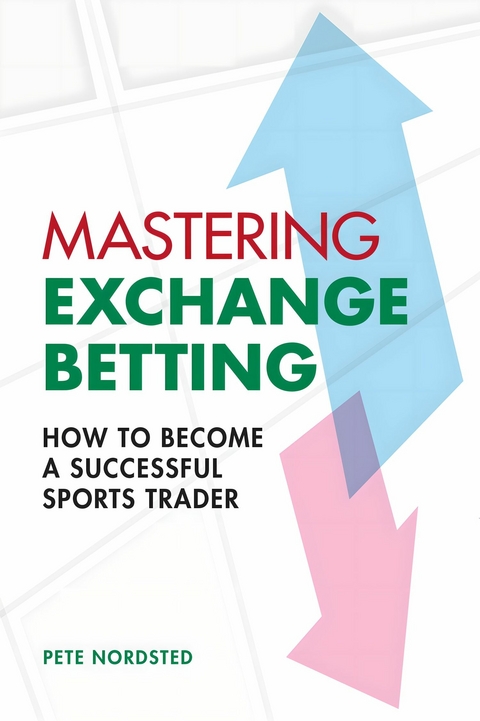
Mastering Exchange Betting (eBook)
208 Seiten
Publishdrive (Verlag)
978-0-85730-611-1 (ISBN)
Mastering Exchange Betting takes you through the strategies and disciplines needed to become a successful sports trader and sets you on the correct path to profitable trading.
There are three things you need to be successful when trading the exchange markets. Firstly, you need to be correctly capitalised. Secondly you need to be following strategies that have a proven edge. Third and probably the most important you need to be in possession of the correct mindset. Although Mastering Exchange Betting cannot help you with the first of these disciplines it can certainly help with the other two.
As well as taking you through some football and tennis strategies, Mastering Exchange Betting gives you eighteen rules that if studied and followed will enable you to become fully prepared to take on and profit from the sporting markets.
To profit regularly from the sporting markets a serious, disciplined approach along with careful planning need to be employed. This is where the eighteen rules contained in this book can help as they cover many of the disciplines associated with the financial markets. Many of these rules are overlooked by the average sports bettor and it can almost be guaranteed that unsuccessful traders have overlooked and broken one of these eighteen rules.
Please note: this is an updated and revised edition of Mastering Betfair: How to Make Serious Money Trading Betting Exchanges, which was originally published in 2009.
Mastering Exchange Betting takes you through the strategies and disciplines needed to become a successful sports trader and sets you on the correct path to profitable trading.There are three things you need to be successful when trading the exchange markets. Firstly, you need to be correctly capitalised. Secondly you need to be following strategies that have a proven edge. Third and probably the most important you need to be in possession of the correct mindset. Although Mastering Exchange Betting cannot help you with the first of these disciplines it can certainly help with the other two.As well as taking you through some football and tennis strategies, Mastering Exchange Betting gives you eighteen rules that if studied and followed will enable you to become fully prepared to take on and profit from the sporting markets.To profit regularly from the sporting markets a serious, disciplined approach along with careful planning need to be employed. This is where the eighteen rules contained in this book can help as they cover many of the disciplines associated with the financial markets. Many of these rules are overlooked by the average sports bettor and it can almost be guaranteed that unsuccessful traders have overlooked and broken one of these eighteen rules.Please note: this is an updated and revised edition of Mastering Betfair: How to Make Serious Money Trading Betting Exchanges, which was originally published in 2009.
1. BETTING BASICS
For those of you who are already reasonably experienced with the exchanges, the following will be common knowledge, and you may wish to skip on to Part Two.
For those reading this book who have little or no experience of betting or bookmakers, in the following few pages I am going to be dealing with some simple betting terminology. I will also explain how the exchanges price their odds and how a traditional bookmaker makes money.
I will also be explaining the commissioning charges and, briefly, the advantages of trading the in-play markets, as well as looking at placing a trade.
A simple trade
When you log on to the exchange sites and start looking at a market, you will be presented with a table highlighting the current available odds. In the example below, we are going to look at a football match between Tottenham and Newcastle (Figure 1.1).
In a football match we are presented with six possible options. We can back or lay the home win, the away win or the draw.
• If you back a team or individual, you are stating that you are expecting that this event will occur.
• If you lay a team or individual, you are saying this event will not occur.
In this case:
• If you were to back Tottenham you are expecting Tottenham to win.
• If you lay Tottenham, you are saying that Newcastle will win the match, or it will end up being a draw.
The best available prices are always displayed in the middle of the table. In the example below, the best odds available for Tottenham to win the match are currently 1.73.
However, there is also money available at odds of 1.72 and 1.71. This money is from the punters who are laying the Tottenham win but do not want to accept the current price of 1.73.
Should someone back Tottenham at 1.73 with £866, the odds at 1.73 would disappear and be replaced by the next price in the queue (i.e. those people who have laid at the odds of 1.72).
Figure 1.1: Odds available Tottenham v Newcastle
On the lay side you will see that £193 is available to lay at 1.74, and the odds of 1.75 and 1.76 come from those who have backed Tottenham hoping to gain a better price than is currently available.
Backing
As you can see from the preceding table, there is £866 available to back Tottenham at the odds of 1.73.
If you were to back at the lower price of 1.72, your bet would automatically get filled at the higher price of 1.73, providing that the total monetary value of your bet is available.
One thing to remember is that the exchanges will always automatically match your bet at the best available odds, whether you are backing or laying.
In this example, if you back Tottenham you are saying I bet £100 that Tottenham will win this match and want to receive 1.73 times my stake.
In this case, should Tottenham win, your return would be £173.
The 1.73 representing 1 + .73, the 1 being your stake of £100 and .73 being the £73 risk that the layer is putting up for you.
Just to clarify, should you want to back and ask for better odds than are currently available your bet will appear on the lay side of the market.
Laying
If you lay Tottenham, you are saying that Tottenham will not win the match. In other words, you are saying the game will result in either:
• a Newcastle win, or a
• draw.
If you were to lay Tottenham for £100 and they did not win, you would win £100.
However, should Tottenham win, then the odds of 1.74 represent your stake: 1 plus your risk of .74, which in this case would be £74.
So, a Tottenham win would represent a loss of £74.
The unexpected happens
On the subject of laying, it is amazing the number of times that value can be found by laying at what would initially seem extremely low odds. It is at this lower end of the market that people really overestimate the chances of an event happening, and it is surprising how often the unexpected happens. Here are a few examples.
• India v England, First test in Hyderabad, January 2024. England 246 and 420 beat India 436 and 202 by 28 runs: Here, in England’s second innings India led by 190 Runs and had England at 163 for 5 and were trading at 1.02 before Ollie Pope scored 196 to set India 231 to win. Again, in India’s second Innings they were 95 for 3 and trading below 1.20 before Tom Hartley finished the home side off, taking seven wickets.
• Manchester United v Coventry, FA Cup Semi Final, April 2024. This is a classic example. Manchester United were 3–0 up after an hour and trading at 1.01. Coventry then went on to make a comeback of historical proportions before losing the tie on penalties. That day hundreds of thousands of pounds were traded and lost at 1.01.
• US Open 2024. Going down the final hole of this event Bryson DeChambeau hit a ragged drive and found sand with his second shot. Meanwhile, up ahead on the green, Rory McIlroy had a short putt for par. Before McIlroy played, DeChambeau was trading at around 20.0. McIlroy, trading between 1.50 and 1.80, missed his short par putt and DeChambeau got down in two from the bunker to seal an unlikely victory.
Low laying opportunities happen all the time in sports such as golf, tennis and one-day cricket. And thanks to the in-play markets, the unexpected often happens; meaning that the odds can move significantly. We will explore some more examples of these in later chapters.
Backing and Laying and asking for a better price
Nowadays the exchanges are looking to seed significantly more markets with their own money. There certainly seems to be less emphasis on a peer-to-peer model.
Peer-to-peer is where you are betting against other people, not the bookmaker. On an exchange, you are placing a bet against another individual bettor. On the exchange you can set your own odds. So, if you don’t like the currently available odds, you can request your own. Your bet will then sit in the market waiting for someone else to match it.
Fifteen years ago, this was not the case as you could put up a price and, providing you were only asking for a few ticks, the probability is you would get your money matched.
Tick Size
On the betting exchanges, tick size refers to the smallest possible movement in the odds.
The odds on the exchanges don’t move in random amounts, they move in set steps called ticks. The size of each tick depends on the current odds. For example:
• Between odds of 2.00 and 3.00, the tick size is 0.02 (odds go from 2.00 to 2.02 to 2.04, etc.).
• Between 3.00 and 4.00, the tick size is 0.05.
In short, tick size is the minimum change in odds allowed on the exchange.
I believe now that, if you are going to get involved in a market, then you should certainly look to take the price that is on offer. However, you only do this if the market is showing good liquidity.
These days, if you ask for a price, the only way you can guarantee that it will be matched is if the price is going against you. For example, if you back at 2.00 and the price goes out to 2.10 then the price has weakened and gone against you.
There have been many occasions in recent years where I have placed money in the market (just above to back or below to lay) and it has not taken. This is mainly in pre-match markets where my money has been sitting there for a length of time before I have taken it out.
If you firmly believe that a price is going to go in your direction, don’t waste time and, as previously stated, if there is good liquidity in the market, then take the current price on offer.
Exchange pricing
All prices quoted on the exchanges are decimal odds. Decimal odds differ from the odds traditionally quoted in the UK in that they include your stake as part of your total return.
If you place a bet of £10 at decimal odds of 4.0 and win, then your total return (including stake) is £40.
In the UK this would traditionally be quoted as 3/1, returning to you winnings of £30 plus your original stake of £10.
Decimal odds are simpler to use than traditional odds and are the most common form of odds quoted in countries outside the UK.
In addition, for the mathematically minded, decimal odds relate more closely to probability. For example, in a tennis match with two equally matched players, the probability of each player winning is 50%. Each player will have traditional odds of 1/1 or decimal odds of 2.0. Hence, the probability of an outcome equals 1 divided by its decimal odds (1/2.0 = 50%).
Decimal odds also offer many more incremental prices – for example, the exchanges offer every price between 1.01 and 2.0, to two decimal places.
Converting decimal odds to traditional odds
Decimal odds minus 1.0 = traditional odds (x to 1).
For example, 4.0 = 3/1, 1.80 = 4/5 (0.8 to 1).
Converting traditional odds to decimal odds, Decimal Odds = (Numerator / Denominator) + 1.
For example, let’s say you have fractional odds of 5/2.
• Divide 5 by 2 = 2.5.
• Add 1 = 3.5.
So, 5/2 in decimal odds = 3.5.
Why add 1?
The ‘+1’ includes your original stake, which decimal odds always do. Fractional odds show only the profit, while decimal odds show total return (profit +...
| Erscheint lt. Verlag | 18.11.2025 |
|---|---|
| Sprache | englisch |
| Themenwelt | Sachbuch/Ratgeber ► Freizeit / Hobby ► Spielen / Raten |
| Sachbuch/Ratgeber ► Sport | |
| Kinder- / Jugendbuch ► Spielen / Lernen ► Abenteuer / Spielgeschichten | |
| Schlagworte | financial strategy theory risk reward • gambling betting trading gambler exchange • games probability statistics odds mathematics math • how to guide top tips expert advice • sports tennis football horseracing leisure hobbies |
| ISBN-10 | 0-85730-611-1 / 0857306111 |
| ISBN-13 | 978-0-85730-611-1 / 9780857306111 |
| Informationen gemäß Produktsicherheitsverordnung (GPSR) | |
| Haben Sie eine Frage zum Produkt? |
 EPUB (Ohne DRM)
Digital Rights Management: ohne DRM
Dieses eBook enthält kein DRM oder Kopierschutz. Eine Weitergabe an Dritte ist jedoch rechtlich nicht zulässig, weil Sie beim Kauf nur die Rechte an der persönlichen Nutzung erwerben.
Dateiformat: EPUB (Electronic Publication)
EPUB ist ein offener Standard für eBooks und eignet sich besonders zur Darstellung von Belletristik und Sachbüchern. Der Fließtext wird dynamisch an die Display- und Schriftgröße angepasst. Auch für mobile Lesegeräte ist EPUB daher gut geeignet.
Systemvoraussetzungen:
PC/Mac: Mit einem PC oder Mac können Sie dieses eBook lesen. Sie benötigen dafür die kostenlose Software Adobe Digital Editions.
eReader: Dieses eBook kann mit (fast) allen eBook-Readern gelesen werden. Mit dem amazon-Kindle ist es aber nicht kompatibel.
Smartphone/Tablet: Egal ob Apple oder Android, dieses eBook können Sie lesen. Sie benötigen dafür eine kostenlose App.
Geräteliste und zusätzliche Hinweise
Buying eBooks from abroad
For tax law reasons we can sell eBooks just within Germany and Switzerland. Regrettably we cannot fulfill eBook-orders from other countries.
aus dem Bereich