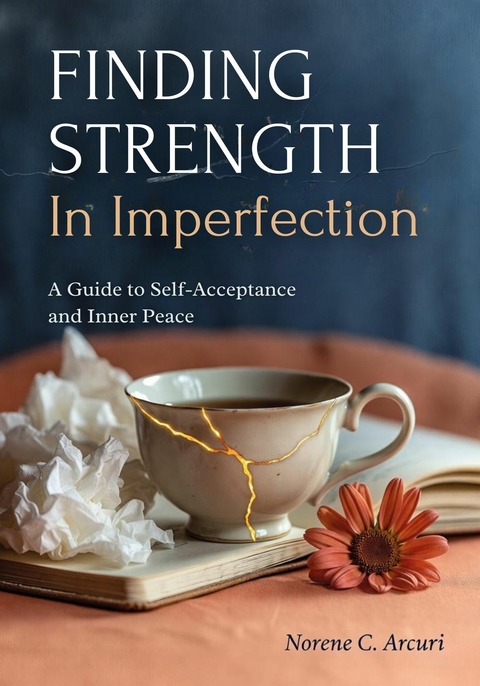
Finding Strength in Imperfection (eBook)
176 Seiten
Seahorse Pub (Verlag)
978-0-00-110200-2 (ISBN)
Do you lie awake at 3 AM, replaying conversations and rewriting emails, convinced that one more revision will finally make you enough? You're not alone-and you're not broken.
Finding Strength in Imperfection is your compassionate guide to breaking free from the exhausting cycle of perfectionism that's stealing your peace, sabotaging your relationships, and leaving you feeling hollow despite your achievements.
Through relatable stories, proven psychological frameworks, and practical exercises designed for real life (not some idealized version of it), this transformative book reveals why perfectionism isn't about excellence-it's about fear. You'll discover how shame fuels your need for flawless performance, why vulnerability is your path to genuine connection, and how self-compassion creates the foundation for authentic growth.
Whether you're the woman who arrives early, stays late, and still feels like an imposter, or you're simply exhausted from performing for everyone else, this book offers a revolutionary truth: your worth isn't conditional on perfect execution. It exists right now, exactly as you are.
Stop chasing an impossible standard. Start embracing wholehearted living. Your journey from exhaustion to inner peace begins here-imperfections and all.
Introduction
The 3 A.M. Reckoning
At 3:17 in the morning, Marina sits at her kitchen table, laptop open, the blue light casting shadows across her face. She's already rewritten the email to her team three times. Each version sounds wrong—too harsh, too soft, too something. Her daughter's science fair project sits half-finished on the counter, a silent accusation. The presentation for tomorrow's client meeting feels incomplete, though she's rehearsed it twice already. Her phone buzzes: a text from a friend she promised to call back two weeks ago.
Marina isn't facing a crisis. She's living her normal life.
She does everything right. She shows up on time, exceeds expectations, volunteers for the extra assignments. Her home looks presentable. Her kids are enrolled in the right activities. Her social media presence suggests a woman who has it together. Yet here she is, again, in the middle of the night, trying to edit her way to enough.
The exhaustion isn't just physical. It's the bone-deep weariness of someone who believes that perfection is just one more revision away. That if she can just get everything exactly right, she'll finally feel the peace she's chasing. That her worth depends on flawless execution of an impossible standard she can't quite name but can't stop pursuing.
This is the perfectionism paradox: the very thing Marina believes will make her worthy is actually hollowing her out from the inside.
If you've picked up this book, chances are you recognize something in Marina's story. Maybe you're reading it at 3 A.M. yourself. Maybe you're exhausted from trying to be enough, do enough, prove enough. Maybe you've achieved everything you thought would make you feel worthy, only to discover that the finish line keeps moving.
You're not alone in this. And more importantly, there's another way forward.
When Striving Becomes Strangling
Let's be clear about something from the start: there's nothing wrong with wanting to do well. Healthy striving—the desire to grow, improve, and challenge ourselves—is part of being human. It's what pushes us to learn new skills, pursue meaningful goals, and become more capable versions of ourselves. Healthy striving asks: "How can I improve?" It's self-focused, internally motivated, and flexible enough to accommodate mistakes as part of learning.
Perfectionism is something else entirely.
Perfectionism asks: "What will people think?" It's other-focused, driven by fear of judgment, and treats mistakes as evidence of fundamental unworthiness. Where healthy striving celebrates progress, perfectionism sees only the gap between current reality and an impossible ideal. Where healthy striving allows for rest and self-compassion, perfectionism demands relentless self-criticism as motivation.
The distinction matters because perfectionism often masquerades as a positive trait. We live in a culture that celebrates "perfectionists" as detail-oriented, high-achieving, and admirably driven. Job interviews reward us for claiming perfectionism as our biggest weakness (really a strength, right?). We're taught that caring deeply about our work means accepting nothing less than flawless execution.
But research tells a different story. Studies have found that perfectionism is increasing among young people, with rates rising significantly over the past three decades. More troubling, perfectionism correlates strongly with depression, anxiety, eating disorders, and even suicidal ideation. It doesn't make us more successful—it makes us more likely to avoid challenges, procrastinate, and burn out.
For women specifically, perfectionism carries an additional burden. We're navigating cultural messages that expect us to be endlessly nurturing yet professionally ambitious, effortlessly beautiful yet not vain about it, perfectly composed yet authentically vulnerable. We're supposed to "have it all" while making it look easy. The bar keeps rising, and we keep exhausting ourselves trying to clear it.
Perfectionism promises that if we can just be flawless enough, we'll finally be safe from criticism, rejection, and shame. But that promise is a lie. Perfectionism doesn't protect us from those painful experiences—it guarantees we'll experience them constantly, because we'll never meet our own impossible standards.
The Shame-Vulnerability Connection
To understand why perfectionism has such a grip on us, we need to talk about shame.
Shame is that intensely painful feeling that we're fundamentally flawed and therefore unworthy of love and belonging. It's not the same as guilt, which says "I did something bad." Shame says "I am bad." Guilt can be useful—it tells us when we've violated our own values and motivates us to make amends. Shame, by contrast, is corrosive. It makes us want to hide, to shrink, to disappear.
Here's what makes shame so powerful: it thrives in secrecy. The things we're most ashamed of—our perceived inadequacies, our failures, our fears—are the things we work hardest to hide from others. We believe that if people really knew us, they'd reject us. So we present carefully curated versions of ourselves, showing only what we think will be acceptable.
This is where perfectionism comes in. Perfectionism functions as armor against shame. If we can just be perfect enough, we reason, we won't give people anything to criticize. We'll be safe from judgment. We'll finally be worthy of love and belonging.
But here's the cruel paradox: perfectionism actually increases our shame. Because perfectionism sets impossible standards, we inevitably fall short. And each time we fall short, shame whispers that we're not enough. So we double down on perfectionism, trying harder to be flawless, which sets us up for more failure, which triggers more shame. It's an exhausting cycle.
The way out of this cycle isn't through more perfection—it's through vulnerability.
Vulnerability is the courage to show up and be seen when we can't control the outcome. It's admitting we don't have all the answers. It's asking for help. It's letting people see our imperfections and trusting that we're still worthy of love and connection. Vulnerability feels dangerous because it exposes us to potential judgment and rejection. But it's also the only path to genuine connection, creativity, and wholehearted living.
Closely related to vulnerability is authenticity—the practice of letting go of who we think we should be and embracing who we actually are. Authenticity means cultivating the courage to be imperfect, to set boundaries, and to allow ourselves to be vulnerable. It means exercising compassion toward ourselves when we struggle, and staying true to our values even when it's uncomfortable.
These concepts—shame, vulnerability, and authenticity—form the foundation of understanding perfectionism and finding our way beyond it. Throughout this book, we'll explore how they show up in our lives and how we can work with them to move toward wholehearted living.
Where Do You Stand? A Perfectionism Self-Assessment
Before we go further, take a moment to reflect on your own relationship with perfectionism. There are no right or wrong answers here—just honest observations. For each statement, notice how often it feels true for you: rarely, sometimes, often, or almost always.
- I have trouble enjoying accomplishments because I immediately focus on what could have been better.
- I believe that if I don't do something perfectly, it's not worth doing at all.
- I regularly sacrifice sleep, rest, or personal time to meet my own standards for tasks.
- I have difficulty delegating because I worry others won't do things correctly.
- I frequently compare myself to others and feel inadequate.
- I'm extremely sensitive to criticism, even when it's constructive.
- I procrastinate on important projects because I'm afraid I won't do them well enough.
- I feel like I'm constantly performing, even with close friends or family.
- I believe that my worth depends on my productivity and achievements.
- I struggle to show vulnerability or admit when I need help.
If you answered "often" or "almost always" to several of these questions, perfectionism likely plays a significant role in your life. But remember: recognizing these patterns isn't about judging yourself. It's about starting to see clearly what's been driving you, so you can make conscious choices about where you want to go from here.
How to Use This Book
Think of this book as a documentary you're watching about your own life—except you're not just an observer. You're also the director, with the power to reshape the story as it unfolds.
Each chapter explores a different aspect of moving from perfectionism toward wholehearted living. You'll find personal stories from women who've walked this path (details changed to protect privacy), frameworks for understanding what's happening beneath the surface, and practical exercises to help you apply these insights to your own life.
The practices in each chapter are designed in three levels: five-minute, fifteen-minute, and thirty-minute options. Start wherever feels manageable. Some days you'll have more time and energy; other days you won't. There's no perfect way to use this book—only the way that works for your actual life, not some idealized version of it.
You might read straight through, or you might skip to the chapters that resonate most urgently. You might work through the exercises systematically, or you might return to them as issues arise. Some concepts will land immediately; others might take months to fully understand. All of this is normal.
What matters most...
| Erscheint lt. Verlag | 13.11.2025 |
|---|---|
| Sprache | englisch |
| Themenwelt | Sachbuch/Ratgeber ► Gesundheit / Leben / Psychologie ► Lebenshilfe / Lebensführung |
| ISBN-10 | 0-00-110200-1 / 0001102001 |
| ISBN-13 | 978-0-00-110200-2 / 9780001102002 |
| Informationen gemäß Produktsicherheitsverordnung (GPSR) | |
| Haben Sie eine Frage zum Produkt? |
 EPUB (Adobe DRM)
Größe: 1,7 MB
Kopierschutz: Adobe-DRM
Adobe-DRM ist ein Kopierschutz, der das eBook vor Mißbrauch schützen soll. Dabei wird das eBook bereits beim Download auf Ihre persönliche Adobe-ID autorisiert. Lesen können Sie das eBook dann nur auf den Geräten, welche ebenfalls auf Ihre Adobe-ID registriert sind.
Details zum Adobe-DRM
Dateiformat: EPUB (Electronic Publication)
EPUB ist ein offener Standard für eBooks und eignet sich besonders zur Darstellung von Belletristik und Sachbüchern. Der Fließtext wird dynamisch an die Display- und Schriftgröße angepasst. Auch für mobile Lesegeräte ist EPUB daher gut geeignet.
Systemvoraussetzungen:
PC/Mac: Mit einem PC oder Mac können Sie dieses eBook lesen. Sie benötigen eine
eReader: Dieses eBook kann mit (fast) allen eBook-Readern gelesen werden. Mit dem amazon-Kindle ist es aber nicht kompatibel.
Smartphone/Tablet: Egal ob Apple oder Android, dieses eBook können Sie lesen. Sie benötigen eine
Geräteliste und zusätzliche Hinweise
Buying eBooks from abroad
For tax law reasons we can sell eBooks just within Germany and Switzerland. Regrettably we cannot fulfill eBook-orders from other countries.
aus dem Bereich