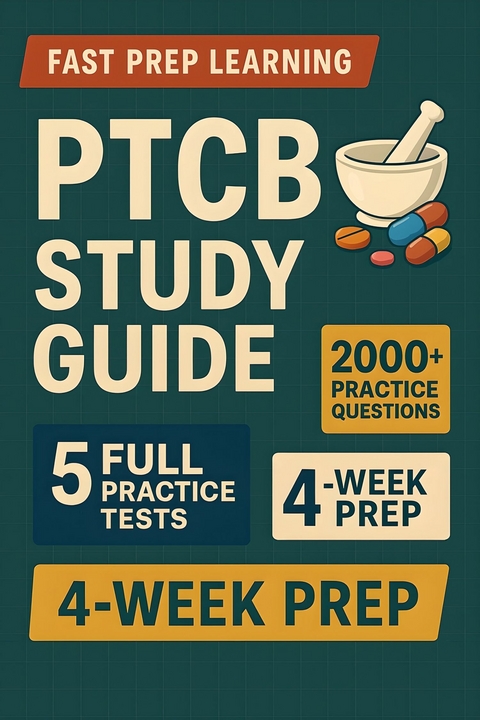
PTCB Study Guide (eBook)
221 Seiten
Publishdrive (Verlag)
978-0-00-110011-4 (ISBN)
What if I told you that preparing for the PTCB exam with confidence-without stress, without confusion, and without feeling overwhelmed-can become your reality?
If you're worried about passing on the first attempt or you feel unsure about pharmacy math, drug names, or federal laws, then following a certification-aligned study plan can be your answer.
It's so effective because every chapter is built using real PTCB testing patterns, clear explanations, and skill-based practice that helps you understand exactly what the exam expects.
All sections follow the latest PTCB blueprint, making this guide ideal for new students, pharmacy workers, or anyone returning to study after a long break. So whether you're starting in the pharmacy field or aiming for a promotable credential, this guide supports every learning level.
You don't need prior pharmacy experience to benefit-but it becomes even more powerful if certification is your next step. So you get one study guide... that works for first-time test takers, retakers, and busy adults who want a simple and reliable path to passing.
Inside this book you'll find simplified explanations, pharmacy examples, and exam-focused strategies designed to help you learn quickly and retain the information that matters most.
You don't need long study hours. Even if you only have 30 minutes a day, this system helps you build confidence step by step.
This works best if you want a cost-effective prep solution without needing expensive courses or complicated textbooks.
Whether you struggle with calculations, federal law, controlled substances, medication safety, or order processing, every chapter is built to make pharmacy concepts simple and clear.
Here is just a fraction of what you'll discover inside this book:
• A complete 4-week study plan with straightforward daily tasks
• Full coverage of all PTCB domains: Medications, Federal Law, Patient Safety, and Order Processing
• Medication classifications explained with simple memory tricks
• Step-by-step pharmacy math, including conversions, dosages, and dilutions
• Federal law essentials broken down into easy-to-remember rules
• Safety procedures, error prevention, and pharmacy communication basics
• 90+ exam-style practice questions with detailed explanations
• Short, focused lessons ideal for busy students
• No outdated information-everything aligned with modern PTCB expectations
• Quick-reference charts, checklists, and terminology summaries included
Chapter 1: Role of the Pharmacy Technician
Overview
Pharmacy technicians play an essential role in modern healthcare, serving as the backbone of daily pharmacy operations. Whether in community, hospital, specialty, or long-term care settings, technicians support safe and efficient medication use by performing tasks that allow pharmacists to focus on clinical decision-making. Their responsibilities span data entry, medication preparation, inventory management, customer communication, insurance processing, and workflow coordination. Because pharmacy environments are fast-paced and highly regulated, technicians must demonstrate strong attention to detail, accuracy, and professionalism. This chapter establishes a foundational understanding of the technician’s role, scope of practice, and daily responsibilities across different practice settings. It also outlines collaborative expectations between pharmacists and technicians and emphasizes patient-centered conduct, confidentiality, and communication skills essential for safe medication dispensing. Mastering these fundamentals provides the groundwork for every topic that follows—pharmacy law, medication safety, pharmacology, and calculations—and is the first step toward becoming a competent, confident, and exam-ready pharmacy technician.
Learning Objectives
- Identify core responsibilities of pharmacy technicians across major settings
- Distinguish technician duties from pharmacist-only tasks
- Understand the full prescription workflow from intake to dispensing
- Apply professional communication standards when interacting with patients and providers
- Demonstrate awareness of legal and safety expectations in daily operations
Core Concepts
1. Technician Responsibilities
Technicians support the safe and accurate delivery of medications. Their responsibilities vary based on workplace, certification, and state regulations but generally fall into several categories.
1.1. Medication Preparation
In community pharmacies, this includes:
- counting and pouring medications
- labeling prescription vials
- selecting correct medication and strength
- packaging and organizing prescriptions for pickup
In hospitals or compounding settings, this expands to:
- reconstituting oral suspensions
- preparing IV bags under pharmacist supervision
- mixing topical formulations
- assisting with sterile and non-sterile compounding steps
Technicians must always follow USP standards and site-specific policies to ensure consistency and safety.
1.2. Prescription Processing
Technicians often manage the first stages of prescription intake:
- accepting written, electronic, or faxed prescriptions
- verifying insurance information
- collecting patient demographics
- performing accurate data entry
- interpreting SIG (directions for use)
- calculating day supply
- checking for missing or invalid information
Pharmacists always verify final accuracy, but technicians build the foundation of a correct prescription.
1.3. Inventory & Supply Chain Duties
Common duties include:
- ordering medications
- checking deliveries
- updating inventory counts
- rotating stock
- identifying soon-to-expire medications
- managing recalls
- storing refrigerated items correctly
Hospital technicians may also deliver medications to patient care units via carts, automation, or pneumatic tubes.
1.4. Patient Interaction
Technicians frequently interact with patients by:
- answering non-clinical questions
- confirming personal information
- assisting with OTC selections
- managing drop-off and pickup windows
- providing status updates on prescriptions
Technicians must maintain professionalism, confidentiality, and patience—especially during busy hours.
1.5. Insurance & Billing Support
A major part of community pharmacy work:
- processing insurance claims
- resolving rejections
- communicating with insurance companies
- applying DAW (dispense as written) codes
- understanding copays, deductibles, and formulary tiers
Insurance proficiency helps reduce wait times and improves patient satisfaction.
1.6. Workflow Coordination
Technicians ensure an organized workflow by:
- triaging incoming prescriptions
- assigning tasks based on urgency
- preparing batches for pharmacist verification
- managing queues in dispensing software
- keeping work areas clean and stocked
Clear communication with pharmacists and fellow technicians keeps operations safe and efficient.
2. Scope of Practice
Technicians must understand which duties belong to them and which must remain strictly pharmacist-only.
2.1. Technician-Allowed Duties
Depending on state rules:
- data entry
- counting/measuring medications
- compounding under supervision
- insurance processing
- inventory management
- resolving administrative issues
- preparing prescriptions for verification
These tasks involve accuracy and organization but no independent clinical judgment.
2.2. Pharmacist-Only Duties
Technicians must never:
- provide clinical counseling
- answer drug-information questions requiring judgment
- clarify prescribing errors with providers
- interpret clinical laboratory values
- approve therapeutic substitutions
- perform final verification
- authorize refills beyond standing protocols
- independently compound high-risk sterile preparations
The dividing line is simple:
Technicians support the medication-use process; pharmacists ensure clinical safety.
2.3. Examples of Scope Boundaries
Allowed: Explaining how to use a pill organizer.
Not allowed: Explaining side effects of lisinopril.
Allowed: Asking a patient for updated insurance.
Not allowed: Advising on medication alternatives.
Allowed: Preparing an IV bag per instructions.
Not allowed: Reviewing compatibility or stability.
Understanding these limits is essential for patient safety and exam success.
3. Workflow Basics
The prescription workflow has predictable stages that technicians must master to work efficiently and safely.
3.1. Step 1: Prescription Intake
A prescription may arrive:
- electronically (most common)
- via fax
- written by hand
- through the provider’s office directly
- via hospital orders
Technician duties at this stage include verifying:
- patient identity
- prescriber information
- medication, strength, quantity
- SIG
- refills
- date of issue
- legal requirements
3.2. Step 2: Data Entry
Accurate input is essential. Technicians enter:
- patient demographics
- allergies
- insurance profile
- medication details
- DAW codes
- clinical notes (as allowed)
Errors here can propagate throughout the system, so precision matters.
3.3. Step 3: Filling
Includes:
- selecting correct product
- scanning NDC to verify the match
- counting/measuring
- printing and affixing labels
- assembling all parts of the prescription
Hospital filling often requires:
- mixing IV solutions
- preparing unit-dose packaging
- reconciling automated dispensing cabinets (ADCs)
3.4. Step 4: Pharmacist Verification
The pharmacist checks ALL elements:
- prescription accuracy
- NDC match
- labeling
- interactions
- allergies
- dosage appropriateness
- legal requirements
No medication may be dispensed without pharmacist approval.
3.5. Step 5: Patient Pickup or Delivery
Technicians:
- verify identity
- collect signatures
- answer administrative questions
- manage returns-to-stock
- prepare counseling flags for pharmacist
Correct documentation protects the pharmacy legally and clinically.
4. Communication & Professional Conduct
Technicians are often the patient’s first point of contact.
4.1. Professional Communication
Key traits include:
- calm tone
- clear explanations
- active listening
- respectful language
- cultural sensitivity
- discretion with patient details
4.2. Handling Difficult Situations
Situations may include:
- insurance rejections
- medication shortages
- long wait times
- confused or frustrated patients
Technicians should:
- acknowledge concerns
- provide factual updates
- avoid making clinical promises
- involve the pharmacist when needed
4.3. Confidentiality & HIPAA
Technicians must protect:
- patient names
- medical histories
- medication lists
- insurance information
- private...
| Erscheint lt. Verlag | 5.11.2025 |
|---|---|
| Sprache | englisch |
| Themenwelt | Sachbuch/Ratgeber ► Beruf / Finanzen / Recht / Wirtschaft ► Bewerbung / Karriere |
| ISBN-10 | 0-00-110011-4 / 0001100114 |
| ISBN-13 | 978-0-00-110011-4 / 9780001100114 |
| Informationen gemäß Produktsicherheitsverordnung (GPSR) | |
| Haben Sie eine Frage zum Produkt? |
 EPUB (Adobe DRM)
Größe: 1,1 MB
Kopierschutz: Adobe-DRM
Adobe-DRM ist ein Kopierschutz, der das eBook vor Mißbrauch schützen soll. Dabei wird das eBook bereits beim Download auf Ihre persönliche Adobe-ID autorisiert. Lesen können Sie das eBook dann nur auf den Geräten, welche ebenfalls auf Ihre Adobe-ID registriert sind.
Details zum Adobe-DRM
Dateiformat: EPUB (Electronic Publication)
EPUB ist ein offener Standard für eBooks und eignet sich besonders zur Darstellung von Belletristik und Sachbüchern. Der Fließtext wird dynamisch an die Display- und Schriftgröße angepasst. Auch für mobile Lesegeräte ist EPUB daher gut geeignet.
Systemvoraussetzungen:
PC/Mac: Mit einem PC oder Mac können Sie dieses eBook lesen. Sie benötigen eine
eReader: Dieses eBook kann mit (fast) allen eBook-Readern gelesen werden. Mit dem amazon-Kindle ist es aber nicht kompatibel.
Smartphone/Tablet: Egal ob Apple oder Android, dieses eBook können Sie lesen. Sie benötigen eine
Geräteliste und zusätzliche Hinweise
Buying eBooks from abroad
For tax law reasons we can sell eBooks just within Germany and Switzerland. Regrettably we cannot fulfill eBook-orders from other countries.
aus dem Bereich