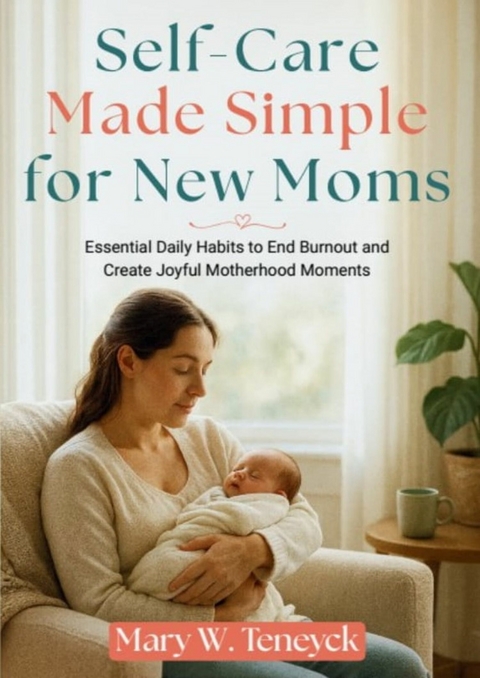
Self-Care Made Simple for New Moms (eBook)
238 Seiten
Seahorse Pub (Verlag)
978-0-00-109978-4 (ISBN)
In the raw, unfiltered trenches of new motherhood-where sleep is a myth, hormones rage, and self-doubt whispers loudest- Teneyck's groundbreaking guide, 'Self-Care Made Simple for New Moms', emerges as your lifeline. Teneyck shatters the myth of effortless 'maternal instinct' and delivers real, evidence-based tools to reclaim your sanity, body, and identity.
Forget the Instagram-perfect facade; this isn't another feel-good fluff piece. It's a no-nonsense roadmap for the 85% of new moms battling overwhelm, identity loss, and burnout, backed by cutting-edge research from evidence based journals . From decoding your 'maternal brain revolution'-those neurological shifts making you hyper-vigilant yet foggy-to dismantling toxic self-care myths that label rest as selfish, you'll learn practical, bite-sized strategies tailored to your chaotic reality.
Discover your 'Self-Care Emergency Kit' for instant overwhelm relief: 30-second breathing hacks, nervous system resets, and crisis protocols that work even with a crying baby in arms. Build sustainable systems across physical recovery, emotional regulation, relationship navigation, and time mastery. Plus, inclusive adaptations for single moms, working parents, or those facing financial stress-no one-size-fits-all here.
But this book goes deeper: It's your blueprint for long-term thriving, from identity reconstruction to community leadership, ensuring you emerge stronger, more resilient, and joyfully connected. If you're exhausted but fiercely loving, this is your permission slip to prioritize you-because a well mother raises a well family. Join thousands transforming postpartum chaos into empowered grace. Your thriving future starts now.
Introduction
Understanding the Reality of Maternal Wellness
Recent research reveals that up to 85% of new mothers experience some form of emotional adjustment challenges during their first year postpartum, yet many suffer in silence, believing their struggles indicate personal failure rather than normal adaptation to one of life's most significant transitions. A comprehensive study published in the Journal of Maternal-Fetal & Neonatal Medicine (2023) found that 73% of mothers reported feeling overwhelmed by the demands of new motherhood, while 68% experienced identity confusion during the first six months postpartum. These statistics aren't shared to alarm you, but to validate what you may be experiencing and to emphasize that you're part of a vast community of mothers navigating similar challenges.
The transition to motherhood involves simultaneous biological, psychological, and social changes that would be overwhelming in any context. Your body is recovering from pregnancy and childbirth while adapting to hormonal fluctuations that can affect mood, energy, and cognitive function. Sleep disruption, which can persist for months or even years, impacts every aspect of your physical and mental well-being. Meanwhile, you're learning to care for a completely dependent human being whose needs are unpredictable and often unclear, especially in the early weeks when crying can feel like an unsolvable puzzle.
What many mothers don't anticipate is the profound identity shift that accompanies new motherhood. The person you were before your baby arrived doesn't simply expand to include motherhood – there's often a period of confusion, grief, and reorganization as you integrate this new role with your existing sense of self. Research from the International Journal of Women's Health (2022) indicates that 78% of first-time mothers report feeling like they've lost aspects of their pre-baby identity, leading to what researchers term "maternal identity confusion." This isn't pathological – it's a normal part of human development that occurs during major life transitions.
Cultural myths about motherhood compound these natural challenges. Despite overwhelming evidence to the contrary, our society perpetuates the belief that maternal instincts are automatic and universal, leaving many mothers feeling defective when they don't immediately know how to soothe their crying baby or when they don't feel an instant bond. The reality is that maternal skills are learned through practice, observation, and sometimes trial and error. Even mothers who feel confident in other areas of their lives may feel completely unprepared for the practical and emotional demands of caring for a newborn.
Relationship changes add another layer of complexity to the postpartum period. Your partnership, if you have one, must adapt to include a third person whose needs often take precedence over adult relationship maintenance. Friendships may shift as your availability and priorities change. Extended family relationships can become strained by differing opinions about childcare practices or by the pressure to fulfill traditional gender roles. Social isolation is common, particularly for mothers who are breastfeeding, recovering from difficult births, or managing babies with challenging temperaments.
The physical reality of postpartum recovery extends far beyond the commonly discussed six-week clearance. Your body has undergone tremendous changes, and returning to pre-pregnancy physical capacity can take months or even years. Energy depletion from night wakings, physical demands of infant care, and the mental load of constant vigilance creates a perfect storm for burnout. A longitudinal study published in Maternal and Child Health Journal (2023) found that maternal energy levels don't typically stabilize until 12-18 months postpartum, yet most support systems and resources focus only on the first few weeks after birth.
Dismantling Harmful Self-Care Myths
The greatest barrier to maternal wellness isn't lack of information – it's the collection of myths and misconceptions that prevent mothers from prioritizing their own well-being. These beliefs are so deeply embedded in our cultural narrative about motherhood that many mothers don't even recognize them as myths rather than facts.
The most pervasive myth is that self-care is selfish, particularly for mothers. This belief suggests that prioritizing your own needs somehow diminishes your love for or commitment to your child. The truth is exactly the opposite. The airplane oxygen mask metaphor isn't just a cliché – it's a fundamental principle of sustainable caregiving. When you're physically exhausted, emotionally depleted, and mentally overwhelmed, your capacity to provide the kind of care you want to give your family is significantly diminished. Research consistently demonstrates that mothers who engage in regular self-care practices report higher levels of patience, emotional availability, and satisfaction with their parenting.
Another destructive myth is that good mothers don't need help. This belief isolates mothers from the support systems that are essential for both maternal and child well-being. Anthropological research shows us that throughout human history, children have been raised in community settings with multiple caregivers sharing responsibilities. The expectation that one person can meet all of a child's needs while maintaining their own well-being is both historically unprecedented and psychologically unrealistic. Seeking support – whether from family, friends, professionals, or community resources – demonstrates wisdom and planning, not inadequacy.
Many mothers avoid self-care because they believe it requires significant time and financial resources they don't have. This misconception prevents them from recognizing the numerous micro-moments throughout their day that could be redirected toward wellness activities. Self-care can happen in thirty-second breathing exercises while your baby sleeps, in choosing nutritious snacks that support your energy levels, or in setting boundaries around phone calls and social media consumption. The most effective self-care practices are often those that integrate seamlessly into your existing routine rather than requiring additional time slots in an already packed schedule.
The commercialization of self-care has created another harmful myth – that self-care equals indulgence. Images of spa days, expensive yoga classes, and elaborate beauty routines dominate social media representations of self-care, creating the impression that wellness is a luxury rather than a necessity. True self-care encompasses basic needs like adequate nutrition, movement that feels good in your body, emotional regulation skills, and social connection. While spa treatments can certainly be part of a wellness plan, they're not the foundation of sustainable self-care.
Perhaps the most damaging myth is that needing self-care indicates failure as a mother. This belief prevents mothers from recognizing early warning signs of burnout and seeking help before reaching crisis points. Proactive self-care – maintaining wellness practices before you're desperate – is far more effective than reactive self-care that attempts to recover from severe depletion. Mothers who prioritize consistent, small-scale wellness practices report better outcomes than those who wait until they're overwhelmed to seek support.
The Science behind Sustainable Maternal Wellness
The strategies presented in this book are grounded in peer-reviewed research spanning multiple disciplines, including psychology, neuroscience, attachment theory, and public health. This scientific foundation ensures that the recommendations you'll find here have been tested and validated through rigorous research processes, not just personal anecdotes or cultural traditions.
Attachment theory, originally developed by John Bowlby and Mary Ainsworth, provides crucial insights into the relationship between maternal well-being and child development. Recent neuroimaging studies published in Developmental Psychology (2024) demonstrate that mothers who engage in regular stress-reduction practices show increased activity in brain regions associated with emotional regulation and empathy. This research suggests that maternal self-care doesn't just benefit mothers – it directly impacts their capacity to provide the kind of responsive, attuned caregiving that supports secure attachment formation.
The field of interpersonal neurobiology, advanced by researchers like Daniel Siegel, reveals how chronic stress and sleep deprivation affect brain function in ways that make effective parenting more challenging. Studies using functional magnetic resonance imaging (fMRI) show that sleep-deprived mothers have decreased activity in the prefrontal cortex, the brain region responsible for executive functioning, emotional regulation, and decision-making. However, the same research demonstrates that targeted interventions – including mindfulness practices, social support, and structured self-care – can help restore optimal brain function even in the context of ongoing sleep disruption.
Trauma-informed care principles, developed through decades of research on how adverse experiences affect mental health, provide essential frameworks for understanding postpartum adjustment. Birth trauma, previous losses, family-of-origin issues, and current stressors can all impact a mother's ability to adapt to new motherhood. The approach used in this book recognizes that healing happens in the context of safety, choice, and empowerment – principles that guide every recommendation and strategy presented.
Cultural competency research emphasizes the importance of adapting wellness strategies to align...
| Erscheint lt. Verlag | 9.11.2025 |
|---|---|
| Sprache | englisch |
| Themenwelt | Sachbuch/Ratgeber ► Gesundheit / Leben / Psychologie |
| ISBN-10 | 0-00-109978-7 / 0001099787 |
| ISBN-13 | 978-0-00-109978-4 / 9780001099784 |
| Informationen gemäß Produktsicherheitsverordnung (GPSR) | |
| Haben Sie eine Frage zum Produkt? |
 EPUB (Adobe DRM)
Größe: 1,0 MB
Kopierschutz: Adobe-DRM
Adobe-DRM ist ein Kopierschutz, der das eBook vor Mißbrauch schützen soll. Dabei wird das eBook bereits beim Download auf Ihre persönliche Adobe-ID autorisiert. Lesen können Sie das eBook dann nur auf den Geräten, welche ebenfalls auf Ihre Adobe-ID registriert sind.
Details zum Adobe-DRM
Dateiformat: EPUB (Electronic Publication)
EPUB ist ein offener Standard für eBooks und eignet sich besonders zur Darstellung von Belletristik und Sachbüchern. Der Fließtext wird dynamisch an die Display- und Schriftgröße angepasst. Auch für mobile Lesegeräte ist EPUB daher gut geeignet.
Systemvoraussetzungen:
PC/Mac: Mit einem PC oder Mac können Sie dieses eBook lesen. Sie benötigen eine
eReader: Dieses eBook kann mit (fast) allen eBook-Readern gelesen werden. Mit dem amazon-Kindle ist es aber nicht kompatibel.
Smartphone/Tablet: Egal ob Apple oder Android, dieses eBook können Sie lesen. Sie benötigen eine
Geräteliste und zusätzliche Hinweise
Buying eBooks from abroad
For tax law reasons we can sell eBooks just within Germany and Switzerland. Regrettably we cannot fulfill eBook-orders from other countries.
aus dem Bereich